
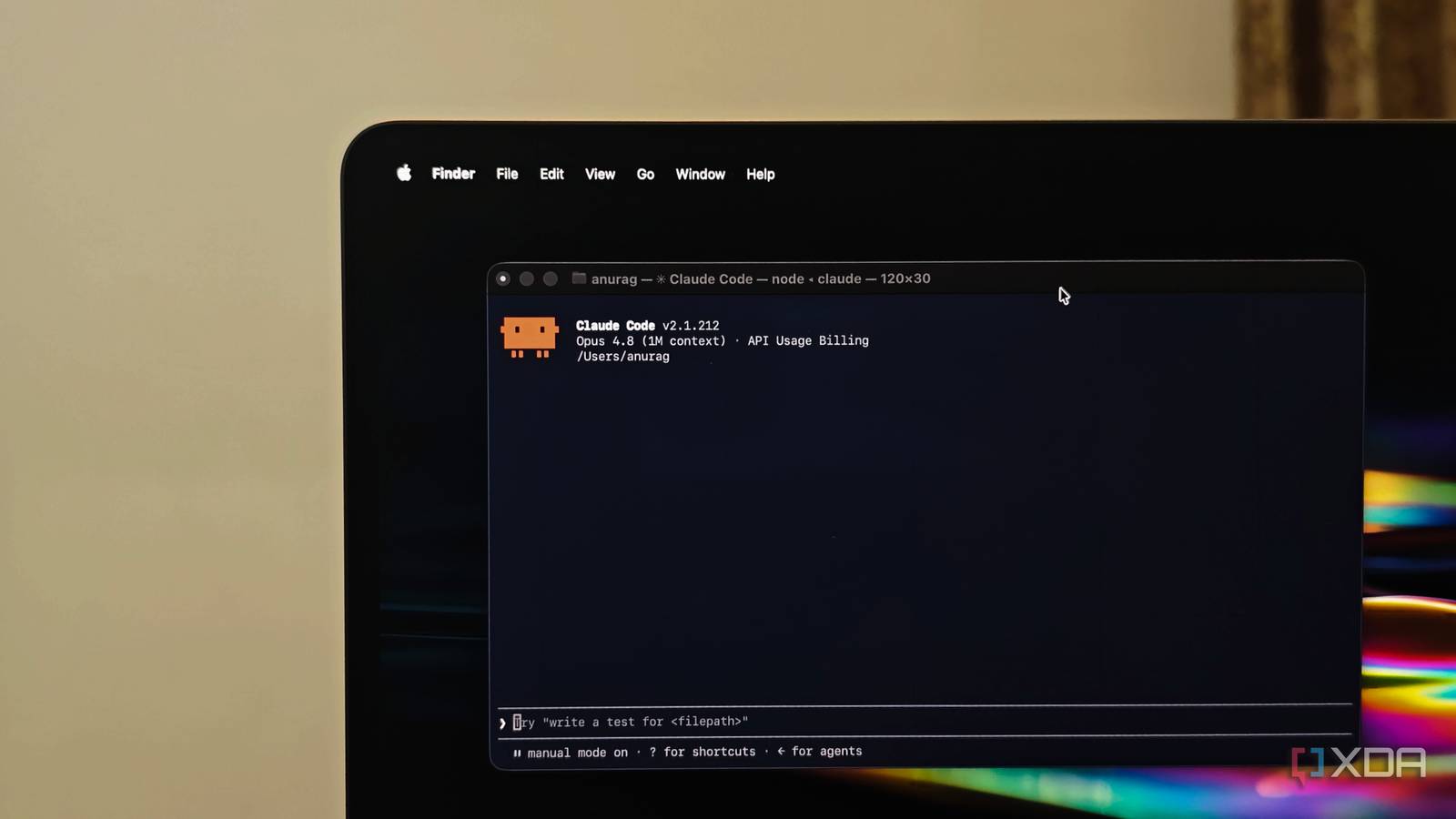
Published Jul 27, 2026, 5:00 PM EDT Anurag is an experienced journalist and author who’s been covering tech for the past 5 years, with a focus on Windows, Android, and Apple. He’s written for sites like Android Police, Neowin, Dexerto, and MakeTechEasier. Anurag’s always pumped about tech and loves getting his hands on the latest gadgets. When he's not procrastinating, you’ll probably find him catching the newest movies in theaters or scrolling through Twitter from his bed. Competition is more important than ever because if companies like Anthropic get free rein, they won’t hesitate to exploit consumers. We are already seeing that with Claude, whose subscription is almost useless if you are on the $20 plan. Claude applies both five-hour session limits and weekly caps, and longer conversations and extended thinking consume your allowance even faster. Forget using subagents regularly, because they will burn through the limit in no time. I gave Claude its sweet time and paid for the subscription for more than six months because there simply wasn’t a better option. Despite all its problems, Claude remained the best model for the kind of technical work I was doing. But now that OpenAI has released its new GPT 5.6 Sol model, I have finally canceled my Claude subscription, and I don’t regret it one bit. The $20 plan stopped being enough You can't use it to build anything I didn’t have a problem with Claude’s usage limits when I was only using the chat feature. I could ask it advanced questions and make it think for a long time. That was never a problem, and the usage limits were also fine. The problem started showing up when I began using Claude Code. The usage limit is shared between the chat app and Claude Code, which means that if you use Claude Code enough, you run out of usage on both. And unlike a typical software tool, Claude’s limits also aren’t based on a fixed number of messages. Every request consumes a different amount depending on the model, the length of the conversation, and how much context Claude needs to process. This means you never know how long your allowance will last. A session involving a large codebase can drain it remarkably quickly, and allowing Claude Code to explore the project on its own makes the problem worse. I’ve almost never started and completed a project in a single Claude Code session because I nearly always run out of usage and have to wait for the limit to reset. Instead of waiting, I usually end up moving the project to either Codex or Antigravity. The weekly cap makes this even more restrictive because conserving the five-hour allowance still doesn’t guarantee that Claude will remain available for the rest of the week. Anthropic lets you purchase additional usage after exhausting the included allowance, but that makes the subscription difficult to justify. If I have to pay separately to continue working, what exactly is the monthly fee covering? The next individual plan costs $100 per month, which is five times the price of the Pro. That is a massive jump just to use Claude without constantly looking at a usage meter, especially when competing tools are offering capable models with far more manageable limits under their regular subscriptions. Claude’s mistakes became expensive You don't have room for retries I don’t want to pretend that Claude Code suddenly became unreliable because that wasn’t my experience. It remained capable, and I continued using it because it was still one of the best coding agents available. However, it also made the same mistakes that most coding agents make. It would sometimes ignore an instruction, change something I hadn’t asked it to touch, or repeat an approach that had already failed. These mistakes were usually fixable, but fixing them required more prompts. If Claude made an unnecessary change, I had to ask it to reverse the change and then explain the original task again. If it repeated the same mistake, I had to interrupt it, point out what had gone wrong, and get it to try another approach. All of this consumed the same usage allowance that was already difficult to manage on the $20 plan. This became particularly frustrating when Claude spent a large part of the session heading in the wrong direction. Even if it eventually fixed the problem, I had already paid for its failed attempts through the usage it consumed. The longer the conversation became, the more context Claude had to process with every new prompt, which meant the corrections could consume even more of the allowance. None of this would have bothered me as much if the subscription provided enough usage to finish the project. Coding agents are going to make mistakes, and I never expected Claude Code to get everything right on the first attempt. The problem was that Anthropic gave me very little room for those mistakes. A couple of wrong decisions from Claude could shorten an already limited session and leave me waiting for the reset. Sol 5.6 finally gave me a reason to leave It's good enough to ditch Claude The reason I finally canceled Claude wasn’t that Claude Code had become unusable. OpenAI simply released a model that came close enough while giving me considerably more room to work. Sol 5.6 is now available through Codex with the $20 ChatGPT Plus subscription, which puts it directly against Claude Code with Opus 4.8. Sol 5.6 is OpenAI’s flagship model for complex coding and agentic work. Inside Codex, it can inspect a repository, make changes, and verify whether everything works. You can also change its reasoning effort depending on the task, while the new Ultra mode available to Plus subscribers can divide larger jobs among subagents. The benchmark results don’t show a clear winner, but they establish that Sol belongs in the same category as Opus 4.8. In OpenAI’s published results, Sol scores higher on the Artificial Analysis Coding Agent Index and Terminal-Bench 2.1, while Opus 4.8 remains ahead on SWE-Bench Pro. These are OpenAI-published comparisons, so I wouldn’t treat them as the final word. My own experience matters more here, and Sol has been almost as capable as Opus 4.8 for the projects I’ve given it. The larger usage window is what makes the switch worthwhile. Codex still has weekly limits, and complex tasks consume the allowance faster, so this isn’t unlimited usage. However, I’ve been able to work for much longer before hitting the limit, which has given me a better chance of finishing a project without moving it to another coding agent. The value difference became even harder to ignore after Anthropic moved Fable 5 outside the included allowance for Pro subscribers. Since July 19, using Fable 5 on the $20 Claude plan requires pay-as-you-go usage credits. That effectively leaves Opus 4.8 as the relevant included alternative for my work, and Sol 5.6 is now close enough that I no longer need to maintain a separate Claude subscription. Fable 5 is still something I’d pay for While I’m quite happy with GPT-5.6 Sol, I still miss Fable 5. I used it extensively when Anthropic included it in the $20 plan, and that model really impressed me. It one-shotted things I could never get Opus 4.8 to do. I will admit, though, that the model is too expensive for simply tinkering around. If you need to get some serious work done, it’s definitely worth paying for.
I cancelled Claude after 6 months of daily use — here's what went wrong
Full Article
Original Source
Read the full article at Xda-developers →KhanList aggregates and links to publicly available news content. We do not host full articles from third-party sources. Always verify important information with original sources.