
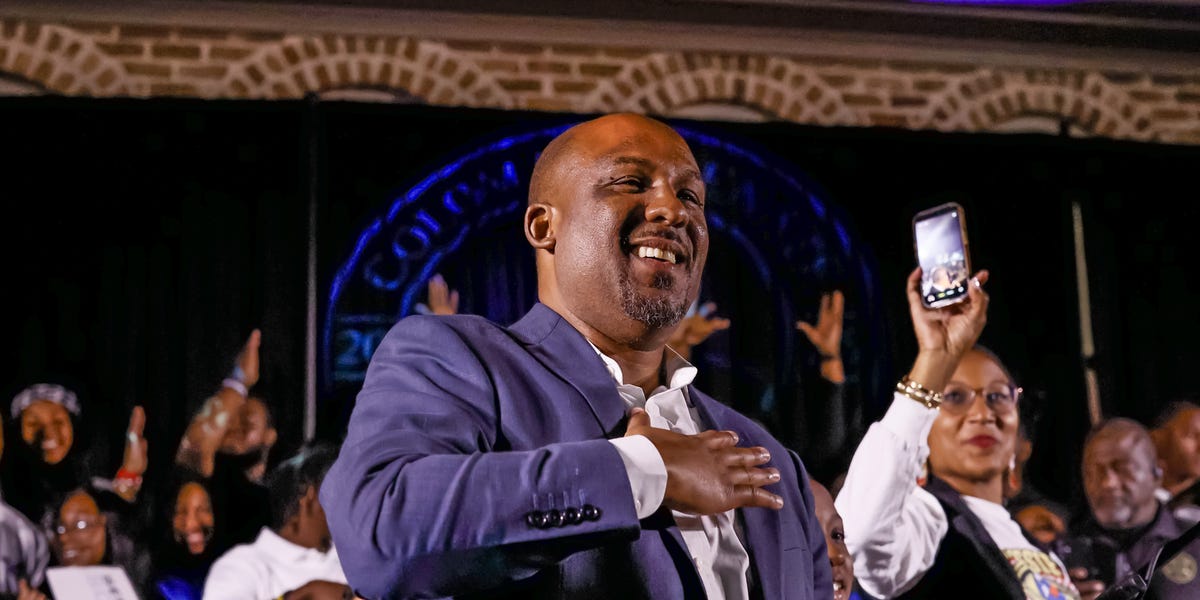
4 min read(Optional Musical Accompaniment to This Post)Okay! Now, we can celebrate. From the Mississippi Free Press:Scott Colom, a Democrat, will be Mississippi’s next U.S. senator and the first Black senator to represent the state in the U.S. Capitol since 1881. His historic feat comes just six years after Mississippi retired its old Confederate-themed state flag. The 43-year-old district attorney defeated incumbent Sen. Cindy Hyde-Smith, the Republican junior senator, and upended years of conventional wisdom about Mississippi’s status as a “solid red state.” The Associated Press called the race on Wednesday evening....For over a week, the velocity of Colom’s march to victory was slow as the vote total trickled in while local election officials cured and counted affidavit and absentee ballots. From the moment Hyde-Smith’s lead evaporated in the late hours of election night to the AP’s call today, the lead grew for Colom, with Democratic gains across every county in the state.Oh, to hell with the numbers. Let's just celebrate a win by a guy cool enough to receive the good news of his election while wearing a Richard Pryor hoodie. From his victory speech:In Mississippi, our prayers have often changed history. For people who don’t know, the first African American to be a United States Senator was from the great state of Mississippi. His name was Hiram Revels. And the way he got to be a United States senator, was he was a minister in Natchez, Mississippi. He was elected to be in the state house. And when they were trying to figure out who was going to do the opening prayer, someone suggested Hiram Revels. He gave a prayer that was so powerful that people at that convention decided that he had a voice to be a United States senator....I can’t help but think about Medgar Evers on Veterans Day, a moment like this where he served his country and came home to Mississippi, and he could not vote. But he had faith that Mississippi could make progress. He had faith that one day, everybody would have the right to vote. He had faith that a day like this was possible. When you talk about faith, you can’t forget about Fannie Lou Hamer, who had faith that her being sick and tired could move a nation to understand that places like Mississippi have to matter. Who had faith that, even after she became a national celebrity—and she could have gone anywhere in the world—she came right back to Mississippi. She had faith, y’all. And right now, we have veterans of the civil rights movement who are a part of our tradition of faith. Let's please give them a round of applause, y'all.One day in 1994, in the employ of another magazine, I went down to Jackson on assignment for a story about the death penalty that ultimately never ran. It was the day after the Republicans, led by Rep. Newt Gingrich, won control of the entire Congress for the first time since 1952 and control of the House of Representatives for the first time since 1954. It can be argued, and I have, that these results scared the courage out of the Democratic Party as thoroughly as George McGovern's landslide loss to Richard Nixon in 1972 did. And when the modern Democratic Party gets scared, it inevitably runs away from its most sacred commitments and the proudest moments in its history. This result caused Democratic president Bill Clinton to sign grotesque legislation like the Defense of Marriage Act and a crime bill that, relevant to my mission to Mississippi, added 28 new death-penalty crimes to the federal code. The bar in the Walthall Hotel, where I was staying, was filled every night by gloating Republicans, which drove me to room service for the balance of my stay.On my last day in Jackson, I took a drive across town to what was then called 2332 Guynes Street in the Elraine subdivision, which had been developed in the 1950s by men named Winston Thompson and Leroy Burnett in order to service the rising black middle class of the city. One of the houses in the development was purchased by Medgar and Myrlie Evers. On the night of June 12, 1963, Myrlie and their children were watching the speech in which President John F. Kennedy finally got off the dime on civil rights when they heard Medgar's car coming up the driveway. The kids ran out to greet him. From behind a bush across the street, a back-shooting coward named Byron De La Beckwith sighted down his .30–06 Enfield and murdered Medgar Evers in front of his family.I parked my car and walked slowly from De La Beckwith's sniper's nest to the driveway at 2332 Guynes Street, tracing the route of the bullet that killed Medgar Evers on that night in 1963. I was strangely aware of every step I took. I was deeply aware of the rise and fall of my feet, one after another. It was as though there was a tiny tremor of history beneath me the closer I came to the spot under the carport where he fell, bleeding, before his family. It felt very much like a pilgrimage to some ancient shrine. There were sad and solemn bells tolling in my mind.Listening to Scott Colom accept his victory on Wednesday night, as he name-checked Medgar Evers, along with Fannie Lou Hamer and Hiram Revels, I heard those bells again in my mind. Loud and raucous this time, they drowned out the crack of the whip and the crack of a .30–06 Enfield rifle fired with murderous intent. This time, they rang with joy, and the tremors of history I felt beneath my feet that day in 1994 felt like an earthquake.
I Can Feel the Tremors of History Rumbling Beneath Scott Colom’s Victory
Full Article
Original Source
Read the full article at Esquire →KhanList aggregates and links to publicly available news content. We do not host full articles from third-party sources. Always verify important information with original sources.