
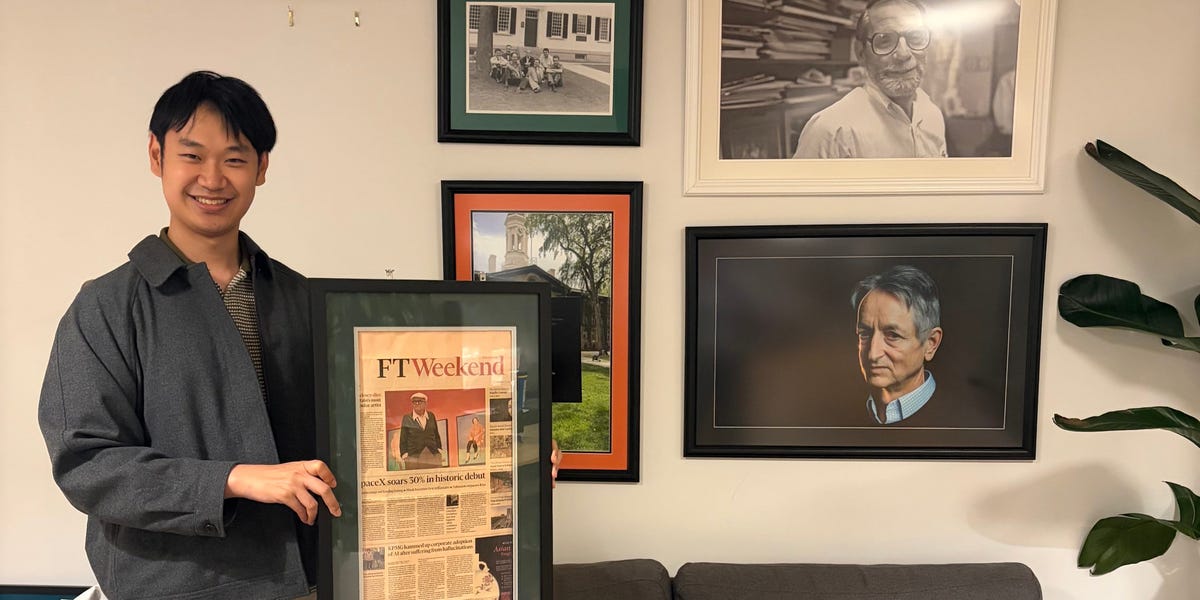
I built GPTZero in college, and it became a hit. We sold it to an AI company —Now I worry AI is ruining writing. GPTZero cofounder Edward Tian's last day at the GPTZero office before the team moved to the Superhuman offices. Courtesy of Edward Tian This as-told-to essay is based on a conversation with Edward Tian, the 26-year-old cofounder of GPTZero, who's based in New York. His words have been edited for length and clarity.I was never planning to go down the founder path straight out of college. I had a visual investigations fellowship lined up for after graduation and was ready to start a journalism career.My cofounder Alex and I went to high school together. When ChatGPT came out, he was pursuing his Ph.D. in computer science at the University of Toronto, and I was in my senior year at Princeton. Over winter break, we built an AI detection tool and put it online. The success was almost overnight.Three years later, we sold our company, GPTZero, to Superhuman, and have stayed on board to work with the team. Superhuman is a very pro-AI company, and I think it was an unexpected move for us as an AI detection company to join them.We didn't build GPTZero to say there should be no AI on the internet. I think that's the biggest misunderstanding about why we started our company, but my feelings on AI have changed. I had a different job lined up for after graduationI studied computer science at Princeton and worked with a professor at the Princeton Natural Language Processing Lab on AI research. I also worked on a few other startup projects in school, but I was always hoping to work in journalism.While in college, I became very involved in the open-source investigation community. I ended up working on open-source investigative projects with the BBC and Bellingcat, and had a visual investigations fellowship at The New York Times lined up after graduation, which I was excited about but ultimately didn't take.After ChatGPT came out, I was inspired to investigate where and when AI was being used online. It took about a week over winter break to build the first version of our AI detection tool, and it was released in January 2023.We created artificial scarcity to help grow the businessMy cofounder Alex and I posted on social media to market the tool so people could try it, but we didn't view it as a business right away. However, it blew up online pretty quickly. After seeing the success, we wanted to double down on the opportunity and turn it into a legitimate site. One piece of advice I have for founders is that using a waitlist is really helpful for generating hype and excitement. We put the first version of GPTZero on a waitlist because it had reached capacity. So I think that artificial scarcity was also very helpful in the success.We had a lucky combination of very talented engineers and some traction and buzz, so we started reaching out to VCs. Many of our early VC partners went to my alma mater, and kind of all knew each other. Jack Altman is also an investor, and I remember we had a call where I was in my dorm room, and he was like, "Oh, I recognize that dorm room too."For founders raising funding for the first time, my advice is not to optimize for the flashiest name or the biggest brand because you think it will attract future talent. Go for where there's familiarity and trust; trust is the most important thing when working with an investor.We raised around $3.5 million in our first funding round. I stayed at Princeton to finish my senior year and graduate, and we kept growing the business. My cofounder Alex left his Ph.D. program to focus on the business.It was bittersweet to sell the companyWhen Shishir, the new CEO of Superhuman, joined in 2025, we spoke with him about his broader platform vision for a suite of products. He thought we could be part of the authenticity suite he wanted to create.It was bittersweet to think about giving up something that we started from scratch and put so much energy and care into. At the same time, it was a lot easier because the team stayed on. I'm now a director of product at Superhuman.For company acquisitions, a lot of folks think the three most important things for a great fit are product match, people fit, and economic sense. We had similar people philosophies, and the deal made sense financially. Then, product-wise, we realized we're definitely not against AI use anywhere in education. We just want to make sure there's some authenticity and truth with that usage.Over the next few years, we're going to take our shot at building a startup within a larger company. I've seen a lot of startup founders go to larger companies and start their moonshots from within.The bigger mission we have is to take steps to ensure people are being respectful of the person who's on the receiving end of AI generations and productivity now. We want it to be that we're reaping the benefits of AI without making other people deal with more work. Read more of our Tiny Teams series I wouldn't major in computer science anymoreWhen we first started GPTZero, I think I was actually more pro-AI than I am now. I believe people should know when something is AI-generated, but I wasn't saying not to outsource anything at all.In the past year, though, I've started to see an over-reliance on AI among people who finished university after ChatGPT was launched, especially with writing. If I went back to college right now, I wouldn't major in computer science. I'd probably major in journalism and get a minor in computer science. I'd get a humanities degree because those are the important skills now.I've started to see a friction point at work when people can't write or edit, and everything they send reads like AI. Part of what I'm doing now at Superhuman is working on responsible AI usage policies and guidance.People are allowed to use these tools however they see fit. At the same time, I feel a profound sadness for the internet at large. It's important to make sure we still have human-written content online.Do you have a story to share about working on a tiny team? If so, please reach out to the reporter at aapplegate@businessinsider.com. Read next Business Insider tells the innovative stories you want to know Business Insider tells the innovative stories you want to know Business Insider tells the innovative stories you want to know Business Insider tells the innovative stories you want to know Agnes Applegate is a senior associate editor at Business Insider on the Business Contributors and Freelance team. She writes and edits as-told-to articles and works with freelancers and contributors on personal essays covering a variety of topics, including AI-powered startups, AI careers, major career pivots, viral career moments, and job market strategies. She previously was a fellow on the Business Contributors and Freelance team and worked as a breaking news runner at The New York Post. as told to AI Tiny Teams More Entrepreneurship Startups College
I built GPTZero in college, and it became a hit. We sold it to an AI company —Now I worry AI is ruining writing.
Full Article
Original Source
Read the full article at Businessinsider →KhanList aggregates and links to publicly available news content. We do not host full articles from third-party sources. Always verify important information with original sources.