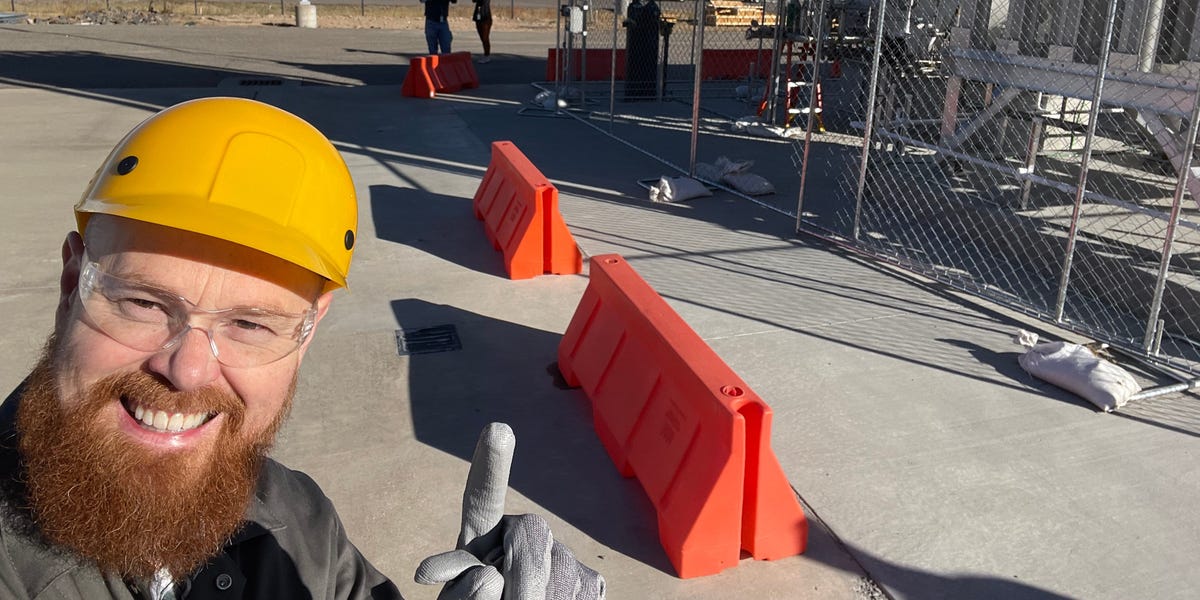
Sean James works at Nvidia as a distinguished engineer. Sean James This first-person essay was written by Sean James, a distinguished engineer in energy systems at Nvidia, where he works on the power and energy infrastructure needed to support AI data centers. He previously spent more than two decades at Microsoft designing and building data centers.Chances are you passed an electrical substation today that delivers power to thousands of homes at hundreds of thousands of volts. It was so unremarkable that you didn't even notice. Sometime in the past, these marvels of engineering simply vanished into the background.For most of my career, when asked, I told people I built data centers. And only in the last five years did people know what one even was. I still don't think my mom knows what I do. Contrast that with today and how often I get calls and see texts asking this and that about data centers. Mostly, it's questions about water usage and energy demand. Data centers went from large concrete buildings assumed to be just another warehouse to headline news. And I want them to disappear again.I recently left Microsoft where I spent 25 years operating, designing, building, and toward the end, innovation. Innovation was all about making data centers less resource intensive, faster to build, and modular so they would come together like Lego bricks. Last month, while cleaning out my home office, I came across a page of notes from 2015. Scrawled across the top: Top 3 Career Goals. One of them read: disappear the data center. This remains the goal."The most profound technologies are those that disappear." - Mark, Weiser, Scientific American, September 1991. Disappearing tech can still be seen; I am not talking about hiding it. Technology matures until it blends into daily life and stops asking for attention. It becomes unremarkable. Like water mains and substations, infrastructure graduates when it stops being news, stops demanding attention from us. Two decades ago, our focus was to keep data centers invisible by making sure they were always online and powered up and never the source of an outage. Sean James previously spent 25 years designing and building data centers for Microsoft. Sean James Now think of a data center like a factory. An industrial engineer's job is to identify and kill all non-value-added parts. A slug of steel goes in one end, and a wheel comes out the other end, and the mission is to make everything in the middle as elegant, fast, and efficient as possible. The AI factory works the same way, turning electricity into tokens.Unfortunately, data centers are not disappearing today. I would not want to live next to one. Loud, dust, traffic, water, interactions with the grid. The North American Electric Reliability Corporation (NERC) issued a rare Level 3 alert in May, its highest tier. The trigger: events where more than 1,000 megawatts of data center load dropped off the grid in seconds. Voltage dips are common on the grid, and we don't even notice them in our homes. But data centers are designed to protect their servers. When they sense a dip, they let go of the grid and jump to onsite batteries. The computers ride through without a blink. The grid takes the hit. This type of disappearing makes our grid unstable. Believe me or don't, but I have watched the data center diminish over the decades. Energy needed to cool servers dropped when evaporative cooling replaced chillers. Server companies keep relaxing temperature requirements to make servers easier to cool. PUE, the measure of how energy efficient a data center is, has gone from 3 to 5 in the 90s to 1.2 to 1.5 today. Waste, too. I remember mountains of foam from server packaging. Now racks arrive fully assembled in reusable wooden boxes. Safety at data center projects has become the highest priority. Workers go home whole and projects are uneventful. And those of us who design them are still not satisfied. Chasing the next breakthrough is what gets us out of bed in the morning.Today, the data center is starting to vanish one piece at a time. Nvidia, where I work now, went public this summer with a design that runs coolant at up to 113 degrees, hotter than a hot tub. At that temperature, heat exchangers and outside air can carry the heat away in most climates. No cooling towers. Cooling water use at the site drops to zero. Data centers are also learning to be grid assets instead of liabilities. Grid stabilizers. Flexing to hand capacity back when the grid is stressed. Riding through voltage dips instead of letting go. Even the diesel generators are starting to disappear from the design, replaced by fault-tolerant networks, batteries, and fuel cells.The criticism of data centers is important feedback. A lot of it is accurate. Some of it is not. The encouraging part for me is to see the open dialog. Data center designers can't improve in a vacuum. And the local jurisdictions that set the rules for construction need to modernize them, so that development of any kind meets the needs of the communities that host it.Substations and water towers are critical to modern life. They surround us, quietly hidden in plain sight. Data centers need to fade into the background too, and that is the goal of every data center designer. We will continue to make them efficient, sustainable, and eventually unremarkable. Read next Natalie is a senior reporter on Business Insider's Business News team.She was previously on BI's Legal Affairs team where she covered major cases out of state and federal court, as well as bankruptcy. Her coverage often focused on stories at the intersection of law, business, politics and technology. Natalie has covered Donald Trump’s criminal and civil cases, the wave of lawsuits against the second Trump administration, the indictment and criminal trial of Sean “Diddy” Combs, the shooting death of UnitedHealthcare CEO Brian Thompson, and the legal battles facing Elon Musk and his companies. Natalie came to Business Insider in June 2021 as a breaking news reporter, focusing on the most interesting angles around the trending news of the day. Natalie largely drove BI’s coverage around the fatal “Rust” shooting involving Alec Baldwin and the disappearance and murder of Gabby Petito.Prior to joining BI, Natalie worked for the New York Post, the New York Daily News, and The Brooklyn Paper. She has an extensive background covering crime and courts. During her more than 12-year journalism career, she did a stint covering the police beat out of the headquarters for the New York Police Department. Natalie, a Brooklyn native, graduated from Brooklyn College in 2012 with a journalism degree. Popular articlesWalmart and Amazon face legal trouble for using a points system to track and fire employees over absences: lawyersCelebrities who partied with Diddy may want to contact their lawyersAn unchecked AI could usher in a new dark ageAt Diddy's A-list 'white parties,' naked women were a staple — but that didn't seem to raise eyebrows at the timeThe illegal maneuvers the rich use to get richerOwner of ship that crashed into Baltimore bridge will likely try to invoke 1851 law used to cap damages after Titanic disaster AI Data Centers Technology More
I build AI data centers. I want them to disappear from view.
Full Article
Original Source
Read the full article at Businessinsider →KhanList aggregates and links to publicly available news content. We do not host full articles from third-party sources. Always verify important information with original sources.