
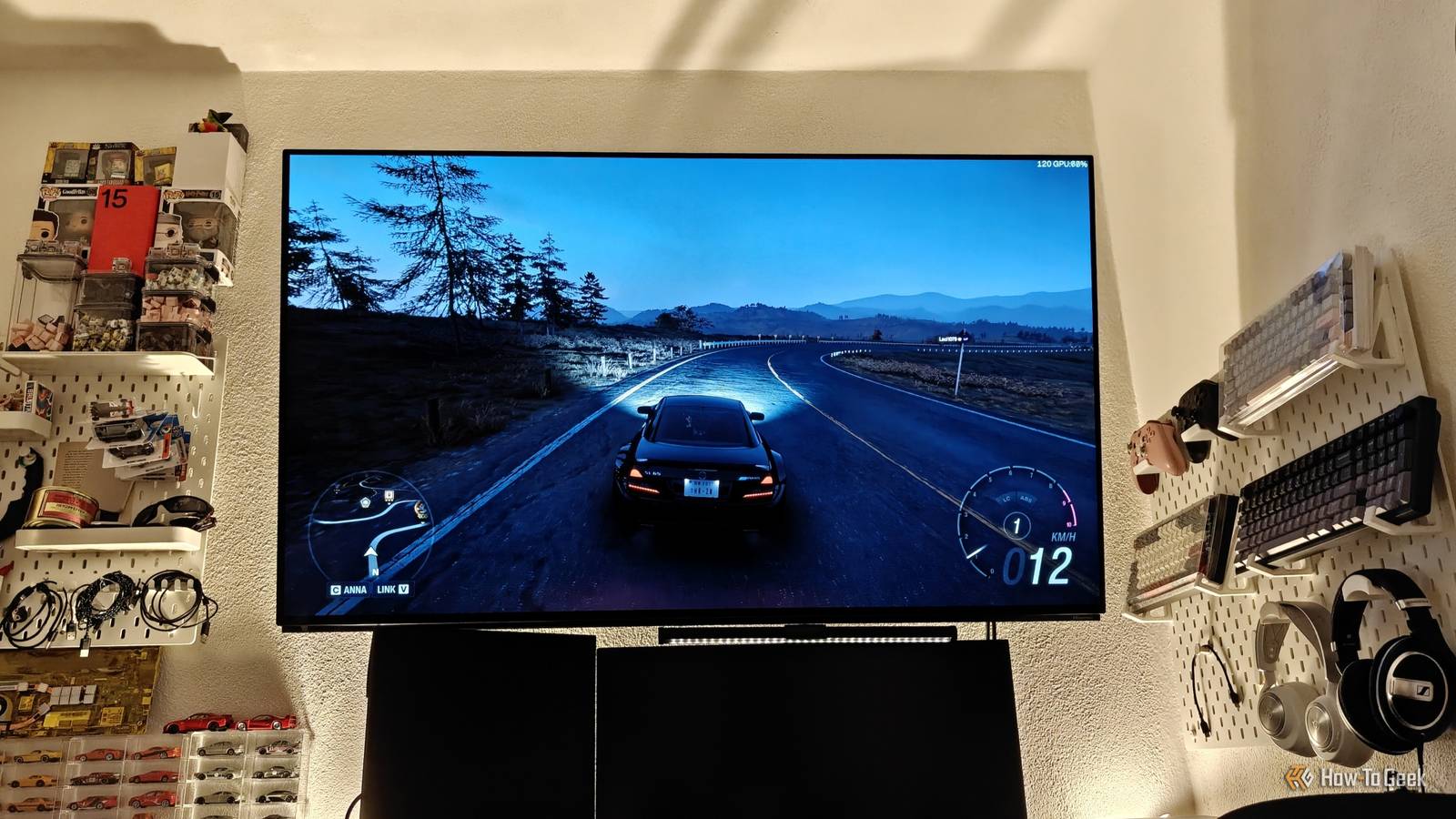
Published Nov 5, 2026, 2:00 PM EST Ismar is a Senior Author at How-To Geek. He previously worked as a writer, editor, and general manager at a content agency before joining the team in 2023. He began his writing career in 2021 after completing a BA in English Language and Literature. Beyond How-To Geek, Ismar has contributed to Red Stag Fulfillment and Authority Hacker. He has also worked on various SEO projects to help clients improve their search visibility. Ismar has been around Windows PCs since the age of three, so friends and family naturally chose him as the resident tech support. His projects often involve tinkering, such as disassembling mechanical keyboards and gaming mice to mod his beloved gear. He also enjoys pushing hardware to the max through overclocking while staying on a reasonable budget. An avid gamer, Ismar has logged thousands of hours across various genres, including first-person shooters, RPGs, racing games, and roguelites. When he is not at his desk, he is probably exploring other people’s phones to discover their quirks and features or experimenting with the latest AI tools. In his free time, Ismar enjoys spending time with his wife, working out at the gym, playing guitar and bass, cooking gourmet meals, and traveling. Above all else, he’s a proud cat owner. As far as TV panel technology is concerned, OLED is the endgame. Or so we've been told. While OLED has some legitimate benefits, such as pitch-black scenes and the supposedly "infinite" contrast ratio, I have some regrets about buying an expensive OLED TV last year that I don't think get enough attention — and they've got nothing to do with burn-in. All the reasons I bought an OLED TV in the first place It's the kind of upgrade you notice immediately When I first mounted my 55-inch 4K Hisense 55A85K (a budget-friendly, Europe-only model) on the wall and turned it on, I was blown away by its incredible contrast ratio. In dark scenes featuring bright objects, the image quality is unmatched. This is because, on OLED panels, each pixel emits its own light independently. This allows each pixel to gradually reduce its brightness in a darker scene or turn off completely to achieve what's often referred to as true black. LED-backlit LCD displays (including Mini-LED TVs) can never achieve this level of contrast, no matter how hard they try, because some amount of backlighting can always bleed through, making scenes look washed out. IPS panels suffer the most from this, but even VA panels with Mini-LED backlighting can't achieve the same levels of contrast as OLED. Even on the best Mini-LED TVs, there's often a distracting halo effect around bright objects in dark scenes, as the backlighting has to illuminate a group of pixels rather than each pixel individually, as OLED does. Give an OLED TV a dark HDR scene in a video game or gritty cinematic movie, and it'll look drastically more impressive than any other technology (well, except ultra-expensive MicroLED TVs). Bright highlights that happen in dark scenes, such as explosions and fires, look fantastic on my humble OLED TV. Viewing angles are incredible, too, which is very important in my specific setup because the TV sits rather high relative to my couch. I've noticed a bit of a green tint shift because it's a WOLED panel, but it's not a deal-breaker. Another benefit of OLED is its instant response time, which means the pixels can change color almost instantly. Combined with the high refresh rate of 120Hz (which is surprisingly common in OLED TVs), motion in games looks buttery-smooth, without the smearing and ghosting I sometimes notice on my 240Hz IPS monitor. My OLED TV's brightness has been its biggest disappointment HDR content gets hit the hardest When people think about the drawbacks of OLED, burn-in is often the first thing they bring up. It's one of the biggest concerns for people buying an OLED TV, but it's actually been a complete non-issue for me. OLED burn-in affects people who watch the same TV channels for prolonged periods, as static logos can cause uneven wear on the pixels in that area, but I only turn the TV on for a few hours every week to play games and stream shows. My biggest gripe with this OLED TV is its brightness. Despite coming out in 2023, this Hisense model doesn't feature brightness-boosting technology such as MLA (Micro Lens Array). Hisense lists its peak brightness at 900 nits and its typical brightness at just 135 nits. For comparison, a high-end OLED TV like the LG OLED evo G6 measured 432 nits of full-screen brightness and over 3,000 nits of peak brightness. The difference is huge, which helps explain why my TV looks so dim even in a dimly lit room. I have to turn all the lights off to get a reasonable level of brightness. And while HDR can look good in particularly dark scenes, things fall apart when a bright scene contains highlights that should be considerably brighter than the rest of the image, such as direct sunlight on a sunny day. In those situations, the TV's ABL (Auto Brightness Limiter) automatically dims the overall image when too much of the screen is bright. This helps limit power consumption and heat. My other gripe has to do with color saturation. Although the colors on this TV appear to be well-calibrated, its WOLED panel struggles to maintain high color saturation at high brightness levels compared to QD-OLED. I could have bought a much bigger Mini-LED TV for less money I paid a premium for OLED but had to settle for a smaller screen I bought this OLED TV because it was one of the cheapest OLED TVs on the market at the time. I paid around $1,000 for it, which I consider a fair bit of money for a commodity like this. I thought of it as an investment, as I planned to keep the TV for a long time. My logic behind the purchase was that even a budget OLED would blow a Mini-LED TV out of the water. I also thought that the panel's relatively low brightness wouldn't be as big of an issue as it turned out to be, considering that the room it's in is naturally rather dark. I spent months convincing myself that this TV was the right call, but it all fell apart the moment I saw a massive 75-inch Hisense Mini-LED TV in a mall for the same $1,000 I paid for my OLED. It's hard to overstate just how big the difference between 55 and 75 diagonal inches is until you see the two sizes side by side in person. Luckily for me, that TV was displayed next to a 55-inch model, giving me a point of reference for how much bigger it was than my OLED at home. I'm not sure which exact model it was, but I remember that HDR content looked much more impressive on that TV in the brightly lit showroom than it does on my OLED, even in a dark room. The parts of the image that were supposed to be bright were actually blindingly bright. As the cherry on top, it even had a slightly higher refresh rate of 144Hz, making it perfectly adequate for gaming. While there was some of that halo glow around objects against pitch-black backgrounds that my OLED doesn't suffer from, the trade-off would have been worth it. The Mini-LED TV was drastically bigger, which is one of the most important aspects of a TV, and its much higher brightness would make games and most TV shows come alive. I rarely regret the things I buy, which makes this mistake hurt that much more in retrospect. Hisense 75-inch E7 Cinema Series Hi-QLED Mini-LED 4K Dimensions 75" Display Technology OLED The Hisense 75E7SF is a 75-inch 4K QLED Mini-LED TV with full-array local dimming, designed to deliver better contrast, brighter HDR highlights, and more vibrant colors than conventional LED TVs. It also features a native 144Hz refresh rate, Dolby Vision IQ, HDR10+ Adaptive, and Amazon Fire TV, making it a compelling option for all types of content. OLED TVs can be great, but they're hard to recommend on a budget Look, I'm not saying that you shouldn't go out and buy an OLED TV. If you've got the money, it can absolutely be worth it, but you need to know what you're getting for your money. All OLED TVs share the advantage of incredible contrast, but that doesn't mean much if the TV can't reach high enough brightness levels. If I could turn back time, I would've spent my money on a preferably higher-end Mini-LED TV, as I'd generally get more benefits than sacrifices for the money. Next time, I'll only buy an OLED TV if I can afford a model with high enough average and peak brightness to really make HDR content shine.
I bought an OLED TV last year, and I regret it
Full Article
Original Source
Read the full article at Howtogeek →KhanList aggregates and links to publicly available news content. We do not host full articles from third-party sources. Always verify important information with original sources.