
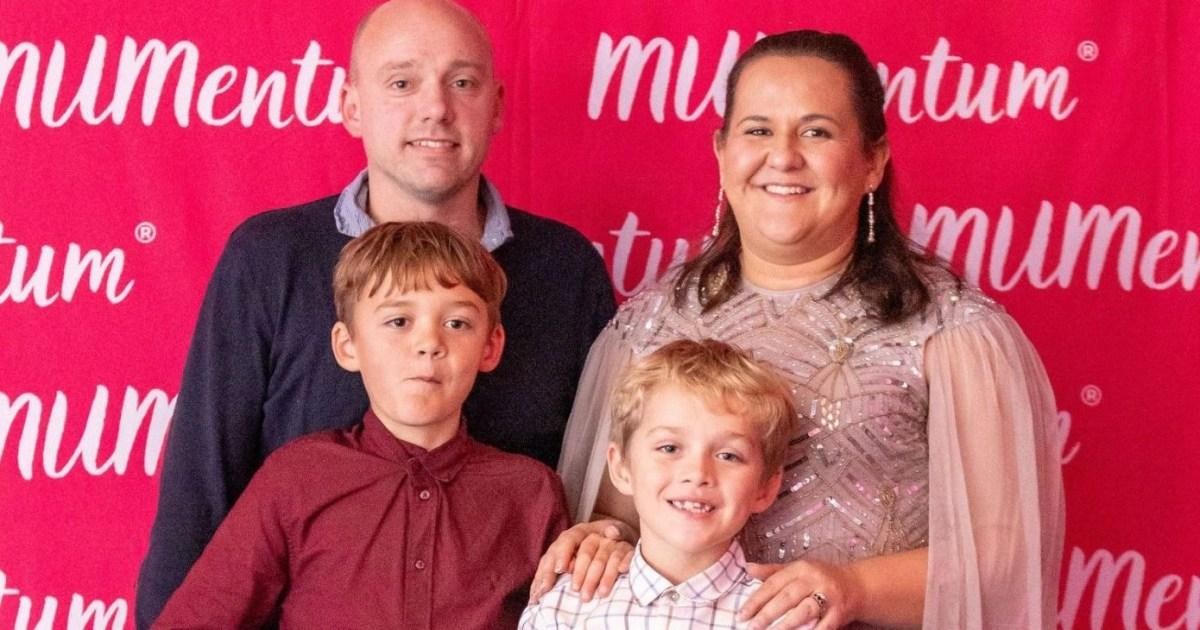
Sophie spent years living without any self-worth or self-confidence (Picture: Imogen Moon Lunar Photography) One day in 2021, Sophie Harris got up and walked out of her house. She didn’t have her phone, her keys, or her purse. She just left. She’d been homeschooling, due to Covid. Her children had been crying. Her husband, Dan, was working from home, and she had to keep everyone quiet – including the dogs. And it reached a point where it all got too much. ‘It wasn’t that I didn’t love the kids, or that I didn’t love Dan,’ she says. ‘I just couldn’t carry on – I didn’t know who I was.’ Sophie had lost herself when she first became a mother; she’d spent years living without any self-worth or self-confidence, and without knowing who she was outside of caring for her children. Her postnatal depression had never really, truly lifted. And she couldn’t do it any more. Sophie went and sat on a bench in a nature reserve, where she was visibly upset. A woman walked past, and asked: ‘Are you OK?’. ‘Not really,’ Sophie admitted. Look beyond the headlines Get a curated list of the most important stories of the weekend every Sunday from our weekend editor Jess Austin. Look beyond the headlines with exclusive articles, emotive interviews and must-read explainers from our expert team of reporters across news, lifestyle and entertainment. Sign up here. This woman then asked Sophie what mattered most to her, in that moment; and Sophie realised it was her children and her husband. ‘I’d give my life for my family,’ she tells Metro. So she went home – but she knew something needed to change. Sophie grew up believing in fairytales. ‘I always wanted three children; always wanted to get married,’ says the 38-year-old. ‘I was of an era of Disney films – I really wanted a family. Like my own little Cinderella story.’ But when Sophie did become a mum at age 27, the reality was very different. Sophie started to suffer from severe postnatal depression (Picture: Sophie Harris) Ask Metro Use AI to go deeper into the stories you care about – powered by Metro and trusted publications. ‘When George was born, it was the best feeling ever – because he was ours,’ says Sophie. But before long, Sophie started to suffer from severe postnatal depression: ‘I couldn’t go out. I didn’t do things normal mums would do.’ She’d lost a lot of blood during labour, which slowed down her milk supply, so she couldn’t breastfeed. ‘I think that was the start of not feeling good enough; of not knowing I could be a good mum,’ says Sophie. ‘Dan would tell me I was doing great but I just couldn’t hear it.’ Things got worse when Dan went back to work after two weeks of paternity leave. ‘I was trying really hard – probably over trying – and I should have just said to myself, “Sophie, you’re doing a really great job.” Sophie wasn’t able to focus on herself at all (Picture: Imogen Moon Lunar Photography) ‘They say, “Nap when your baby naps”; but you can’t, because you’re trying to do the jobs that you can’t do with a baby in your arms. So it was just a constant cycle.’ When George was eight weeks old, he had suspected meningitis. As part of the diagnosis, doctors had to put a needle into George’s spine to drain the fluid for analysis. Sophie recalls the pain of hearing her baby’s piercing screams. After that, Sophie started to experience postnatal OCD on top of depression. ‘I felt like everything had to be clean; if it wasn’t clean, someone would take George away from me,’ she explains. ‘You know it’s irrational, but you can’t stop the thoughts. ‘In the night, if George hadn’t woken up for his bottle, I wouldn’t think, “He hasn’t woken up yet”. I’d think, “Something bad has happened; he’s not breathing”.’ Over and over again, Sophie would think: ‘Who am I?’ (Picture: Imogen Moon Lunar Photography) The combination of postnatal depression and OCD meant that Sophie became consumed by looking after George – and she wasn’t able to focus on herself at all. ‘I just had to do what I could for George, all the time,’ she says. ‘I never did anything for myself. I couldn’t even brush my teeth sometimes.’ There’s a saying known as ‘getting your pink back’, used to describe new mums who are starting to feel more like themselves in the throes of early parenthood. It’s inspired by flamingos: When flamingos have chicks – flaminglets – they initially lose their bright pink colour, but gradually, the pink grows back. But Sophie wasn’t getting her pink back. In fact, she didn’t for years. Sophie had always known she wanted to help other women (Picture: Sophie Harris) In 2016, when George was one, Sophie went to counselling and was told she should spend time doing something for herself every day. The very thought of this made Sophie feel guilty; but eventually, with Dan’s help, she started crafting: vinyl designs for glasses, sewing things like aprons. Slowly but surely, Sophie felt her self-worth and confidence start to come back. At the end of 2016, Dan and Sophie decided to have another child, William; and in 2018, just before William was born, Sophie started a craft business. It was just for fun, but it helped to broaden Sophie’s identity outside being a mum to two young children. Sophie decided to write a book about how to find yourself again as a new mum (Picture: Sophie Harris) But when Covid hit, the craft business was no longer viable. Dan, meanwhile, had started his own business up, so Sophie helped him run that. ‘But it wasn’t my dream; it was his – and I really didn’t know what to do,’ she says. It was during this time that Sophie walked out of the house. Sophie’s family knew she’d disappeared. Dan had even taken the kids to the park to see if they could find her. When she was nowhere to be seen, he didn’t want to worry them; so they went home and waited. When Sophie walked in, he held her, said sorry for not seeing just what Sophie was going through, and agreed to get her more help: More intensive counselling, making sure Sophie had time to exercise and breathe at least once a day without worrying about anyone else. But the years went on, and Sophie still didn’t know who she was. ‘It reached a point where the kids didn’t need me any more. They didn’t want to call me Mummy: “You’re Mum”, they said.’ Sophie now has a purpose and identity outside of caring for her children (Picture: Sophie Harris) But ‘Mummy’ was all Sophie knew how to be. Over and over again, Sophie would think: ‘Who am I?’. By September 2024, Dan and Sophie were arguing all the time. They weren’t happy. In fact: ‘we were on the verge of divorce,’ says Sophie. One night, Dan asked Sophie to go into the garden and look at the stars with him. He reminded her about the North Star – how it’s constant, and will always guide you home. ‘Maybe you need to find that home within yourself,’ he suggested. ‘Maybe that’s what you’re missing.’ It was exactly what Sophie needed to hear. In that moment, something clicked. ‘I always thought home was everywhere else, and not me,’ she explains. ‘I thought it was a comfy sofa, and everything nicely decorated. But actually, I realised, that night with Dan, that home is what I make it. Home is within you. It’s not material things; it’s who you are.’ Slowly but surely, Sophie’s getting her pink back (Picture: Imogen Moon Lunar Photography) Sophie decided to make a change. She started taking time to listen more to herself and her needs: her self-care, like having a soak in the bath without interruptions, taking time to watch a TV programme, even reading a chapter of a book. When she turned 37, in 2025, she spent her first birthday without her husband and children, at a sound bath. Most of all, she’d always known she wanted to help other women. So she decided to write a book about how to find yourself again as a new mum. From September 2024 to July 2025, she’d write and research every day, for hours. Sophie still struggles with her self-worth. Her youngest, William, is struggling with meltdowns, and she’ll often think, ‘Am I not being a good enough mum? Am I not there enough for you?’. But now, everything Sophie does – especially with regard to her book – is premised on the fact that, if you’re a mother, you are more than ‘just a mum’; and she now has a purpose and identity outside of caring for her children. Slowly but surely, Sophie’s getting her pink back. And she wants the same for every other mother who’s forgotten who they are. Do you have a story you’d like to share? Get in touch by emailing jess.austin@metro.co.uk. Share your views in the comments below. Arrow MORE: As a girl I ate cereal off the spoon my mum cooked her heroin on Arrow MORE: My therapist set me up on a blind date with another patient Arrow MORE: I’ve started telling him every time I masturbate — it’s changed our sex life The Sunday Edit Look beyond the headlines with exclusive articles, emotive interviews and must-read explainers from our expert team of reporters across news, lifestyle and entertainment.
‘I became a mum and forgot who I was’
Full Article
Original Source
Read the full article at Metro →KhanList aggregates and links to publicly available news content. We do not host full articles from third-party sources. Always verify important information with original sources.