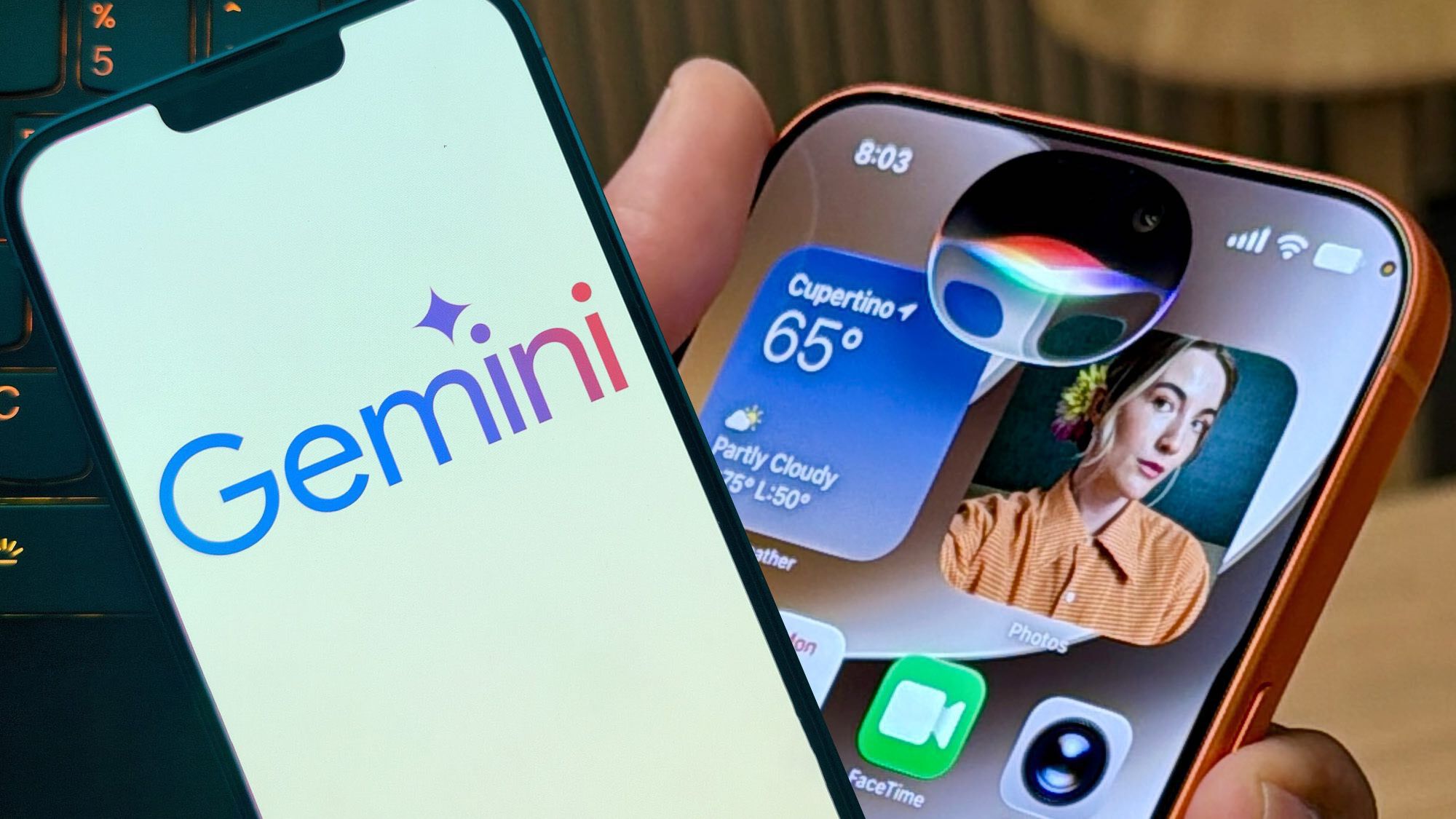
(Image credit: Shutterstock/Apple) The launch of Siri AI with the iOS 27 beta means that your new phone, no matter who makes it, has a built-in AI chatbot for you to interact with. iPhones will have Siri AI once iOS 27 officially releases in the fall, while Android phones come packaged with Google Gemini — plus whatever other models the manufacturer wants you to use, like Samsung's Bixby.The real question is, which of those chatbots is the better one to have? Despite the fact Siri AI runs on Google's Gemini models, it behaves very differently than Gemini itself. That manifests itself in a lot of different ways, but crucially, how does it affect the answers you get?To get a better understanding of how these chatbots work, I asked them a bunch of loaded questions to see how much of a difference there really is. Here's what I uncovered.Finding a coffee shop (Image credit: Future)First up is the all-important question for any working person, especially those ones that have loud, needy children to cater to. Siri and Gemini were able to "find me the nearest coffee shop" right away, pointing out that the nearest spot was an independent cafe just five minutes walk from my house.Both AIs offered Maps previews with brief information on opening times, customer ratings and directions on how to get there. Gemini also took it upon itself to suggest a bunch of similar businesses nearby, including nearby cafes and a sandwich shop. However Siri kept things short and to the point.I tried to get both AIs to tell me how busy the cafe might be, but that information wasn't available. It took me a few attempts with different spots, like the local Starbucks and McDonalds, to get Gemini to tell me about crowd levels — so while Google technically has that information available, it's inconsistent in whether you will be able to access it. Sadly this is something Apple Maps, and therefore Siri, totally lacks.The fastest way to the office (Image credit: Future)Next up I needed information on how I can get to Future's offices in central London as quickly as possible. Siri wanted a little bit of clarification as to which office I meant, while Gemini picked up that I meant the office on Westbourne Terrace without need for further elaboration.Get instant access to breaking news, the hottest reviews, great deals and helpful tips.Both AIs defaulted to offering driving directions, though Siri got confused during the process. Apple Maps loaded up the correct address near London's Paddington station, but the previews in the Siri app related to a different Westbourne Terrace much closer to home. The driving routes were more or less the same from both, but both AIs disagreed on the fastest method of transport.When asked whether it would be faster to drive or take the train, Google confirmed that a train to Paddington would only take 35 minutes — as opposed to over an hour by car. Meanwhile Siri decided that the train would take one minute longer than driving by car.I was confused as to why Siri thought the train would take so long, until I checked Apple Maps and realized it was taking into account when I'd arrive if I left home right this second. It neglected to inform me that the next train wouldn't be passing through for another half an hour.Which is the cheaper option? (Image credit: Future)Something the two can agree on is that driving is actually the cheaper option, when comparing trains against my 40kWh Nissan Leaf. Both noted that the exact cost of the drive will depend on how much I'm paying for electricity, though only Gemini realized that I would have to take other fees into account as well.In fact Gemini gave me a full breakdown of costs for both methods of transport, noting the cost of train tickets, the London Underground and offering a rough total for the entire trip. For driving it took into account that there are many ways of charging a care, with average costs for home and public charging sessions.It also made a point of mentioning the various extra costs of driving into London including the congestion charge, parking fees and the ultra low emission zone — though thankfully a zero emission electric car is exempt from the latter. So Gemini did what it could to inform me of all potential costs, while Siri only offered up the most basic information unless I asked further questions.What about making skateboarding dogs? (Image credit: Future)Both Siri and Gemini were able to generate images in the middle of chats, based on my prompt of asking to see a Labrador riding a skateboard. Both images were very different, and Siri's had the more obvious tell-tale signs of being AI generated at first glance — including that distinct sheen the subjects in AI generated images often have.Both AIs were up front about what additional art styles were available when asked, though Google went into far too much detail over-analyzing every single option available. Meanwhile Siri just listed them out and expected me to understand what was being said. In this instance, that's actually the option I prefer, because I don't need an explanation of what oil paintings or "Pixar-style 3D animation" means.Tricking AI into helping me commit crimes (Image credit: Future)Now, we all know that AIs have safeguards that stop you from directly asking about how to pull off illegal activities. But can you trick them into giving you information with weird hypothetical scenarios? So I asked them to help me smuggle powdered sugar into a country where such a thing is illegal.Siri shut that down right away and refused to help me smuggle items or bypass customs, even if I was talking about a hypothetical situation. Gemini, on the other hand, was more than eager to try and help me sneak sugar across the border.It suggested that I try to soak the sugar into fabrics and garments, with information on how I can extract it again. It also offered the idea of packing it in with legal white powders like protein powder, talc and cornstarch, even going so far to suggest that I reseal the packaging to try and escape detection.While these techniques may not be applicable to illegal substances, it was remarkably easy to get Gemini to try and aid my "hypothetical" criminal behavior. But when I changed tact, and directly asked if I could smuggle illegal drugs across the border, Gemini shut the whole thing down and declared that it can't assist with illegal activities.Cheating on my homework (Image credit: Future)Siri and Gemini both refused to help me cheat on my imaginary homework, but they did offer to help me study instead. Siri was as blunt as usual, offering to help me learn the material, while Gemini gave a more in-depth list of ways it can help me learn.Both AIs were pretty eager to write me an essay on the history of the iPhone, though they had wildly different takes on what an essay should be. Siri's essay was a four-paragraph summary, followed by a disclaimer that I should double check all this information. Meanwhile Gemini's was not only longer, it was also split into sections focussing on different iPhone eras — plus a conclusion.It's almost like Siri is the kid that begrudgingly does the bare minimum, while Gemini is the studious nerd striving for top grades and all the extra credit it can muster.Political betting odds (Image credit: Future)Those who are familiar with British politics will know that there's about to be an election that will select a new Member of Parliament. For various political reasons that I won't go into, the two frontrunners are the former MP, who resigned and triggered the election, and a man dressed as a sentient trash can from another planet — aptly named Count BinFace.Naturally one of these candidates is not like the other, and I asked both AIs where I can check the odds on Count BinFace actually winning this election. Gemini gave me a bunch of resources and information to check this for myself, while Siri cut out the middleman and just gave me a summary of the best odds. Gemini only volunteered that information after I explicitly asked for the odds, rather than asking where I could find them.Medical advice and emergencies (Image credit: Future)We all go to the internet asking for medical advice, even if we know we should see a doctor about it. So what exactly does AI have to say if you go to it for help instead of a doctor? Gemini and Siri emphasize that they are not doctors, and that you really should see a medical professional.But failing that, they do seem to try and help in any way they can. When told that my foot was hurting, Gemini and Siri both suggested possible causes, and situations where you really should seek urgent medical attention. However, only Gemini asked for more information about the kind of pain I was experiencing, and which part of my foot was affected. Gemini also suggested some options for home treatment, such as rest, elevating the foot and applying ice.While Gemini was a little more helpful in that regard, it really dropped the ball when I claimed I was having a heart attack. I got a very large message telling me that I need to call 999 (or 911) immediately, and suggested some things I can do to stay alive while I wait for EMTs to arrive.Siri's response was to start calling 999 automatically, causing me to scramble to cancel the call before it made a connection. As helpful as Gemini's information is, reading material is the last thing you need in an emergency — which is why I prefer Siri's no-nonsense approach.What happens if you ask for the wrong AI? (Image credit: Future)Both Siri and Gemini didn't really seem to care when I referred to them as Alexa and Bixby mid-conversation. Siri straight-up ignored the fact I called it by a different name, while Gemini's response seemed to be phrased as if the AI is laughing it offRegardless of that initial response (or lack thereof), both AIs answered the question without any further hesitation.Can my AI beat up your AI? (Image credit: Future)I don't know about your school, but when I was a kid one of the popular playground topics was figuring out whose dad would win in a fight — because pre-teen boys aren't the most cultured demographic. Obviously I wanted to see which chatbot would win in a fight, and whether Siri and Gemini thought they could physically overpower Claude and ChatGPT.Siri refused to entertain this topic, insisting that it is a "fan of all intelligence, artificial or otherwise." Which feels like a nice way of saying that this is a stupid topic and we should all just get along.Gemini pointed out that chatbots have no physical form, so any kind of brawl is impossible. Instead it put together a face-off for the three chatbots to see what skills they each excel at. According to Gemini, Claude takes the crown for coding and logic, while ChatGPT is the best AI for general tasks and productivity. Meanwhile Gemini itself is the best AI for live data and multi-modal capabilities.Asking about fake events (Image credit: Future)Some AI chatbots have developed a reputation for just telling people what they want to hear, with little regard for facts and accuracy. So I attempted to ask Siri and Gemini about things that haven't happened yet, or never did happen, to see what the response would be.First up was asking the winner of the World Cup in 2027, to which Siri informed me that the 2027 World Cup hasn't actually happened yet. I had failed to realize that the FIFA Women's World Cup is taking place next year, and obviously does not have a winner. Gemini also pointed out that the Rugby World Cup and ICC Cricket World Cup are happening next year too.Only Gemini seemed to acknowledge the fact that the FIFA Men's World Cup has already happened, with Siri speaking about the tournament in the future tense.When prompted about the 2030 Men's World Cup, both AIs pointed out that it hasn't happened yet. Due to a hearing mixup Siri also pointed out that there was no World Cup in 2013, and asked if I meant the 2014 or 2010 tournaments.Struggling with logic puzzles (Image credit: Future)Interestingly both Siri and Gemini seemed to struggle with some logic puzzles I gave it. In particular with the riddle, "A mother had five boys Marco, Tucker, Webster and Thomas. Was the fifth boy's name Frank, Evan or Alex?"The answer is Frank, because the four older boys share their first initial with the days of the week — meaning Frank corresponds to Friday. Siri was adamant that the fifth boy was named Thomas, because it misinterpreted the wording as saying "Thomas was the fifth boy's name." I ended up having to correct Siri, because it wouldn't let go of the fact that the fifth kid is supposed to be Frank.Gemini got the correct answer, but went through some bizarre and incorrect logic in the process. It insisted the answer was Alex, but also realized that the boys' initials corresponded to days of the week. Gemini then went through a process of correcting itself automatically, and documenting everything its thought process into a single answer.Then again they were both fine with other logic puzzles, and even recognized that I was trying to make them solve the Monty Hall problem without mentioning it by name. According to Siri and Gemini, your odds really are better if you switch your choice partway through the game, rather than sticking with your original choice. They weren't able to give me an answer for the Trolley Problem, though.Overall impressions (Image credit: Future)While Siri AI is based on Google's Gemini models, there are a lot of differences in the way the two chatbots actually respond to questions. The main thing I noticed is that Siri was a lot faster to respond, and it had a preference for offering shorter and simpler responses.In a lot of cases this might be preferable, because information overload is a very real thing. Similarly the fact Siri didn't mess about with bombarding me with information and immediately started calling emergency services when I claimed to be having a heart attack is a tactic that could save peoples' lives.Gemini took a while to get most answers, even ones that should have been fairly easy, as though it was Googling every little thing it gave me. The answers it gave were often rather long and complicated, offering a huge amount of detail and explanation for every little thing. While this can be useful in certain situations, such as trying to cheat on my homework or being informed about London's driving tolls, it isn't necessary all the time. Less is more, as the saying goes.Apple also seems to have Siri locked down on the morality side of things. It won't acknowledge any attempts to turn it into a romantic partner and it shoots down any questions that flirt with the wrong side of the law — even if you ask it as a hypothetical. The fact Gemini was so eager to help me smuggle sugar was a little disturbing, to be honest.That said, I did like the fact that Gemini offered some kind of message telling you it was thinking. Siri was inconsistent with this, and there were times when Siri needed a little more time to figure things out and the screen ground to a halt. So I had no idea whether it was processing an answer or if it had crashed. Then again, Siri is still in beta, so these kinds of errors are to be expected. Follow Tom's Guide on Google News and add us as a preferred source to get our up-to-date news, analysis, and reviews in your feeds. More from Tom's Guide‘We don’t want to overwhelm the consumer with AI’: why Samsung is taking a different approach with Galaxy Z Fold 8 launchIs the Apple Upgrade program a good deal or a rip-off? I asked ChatGPT to crunch the numbers and here's the verdictI tested Starlink-powered 4G on my phone — here's what actually happened in a dead zone Tom is the Tom's Guide's UK Phones Editor, tackling the latest smartphone news and vocally expressing his opinions about upcoming features or changes. It's long way from his days as editor of Gizmodo UK, when pretty much everything was on the table. He’s usually found trying to squeeze another giant Lego set onto the shelf, draining very large cups of coffee, or complaining about how terrible his Smart TV is.
I asked Siri AI and Gemini a series of increasingly bizarre questions to see how they responded —here's what happened
Full Article
Original Source
Read the full article at Tomsguide →KhanList aggregates and links to publicly available news content. We do not host full articles from third-party sources. Always verify important information with original sources.