
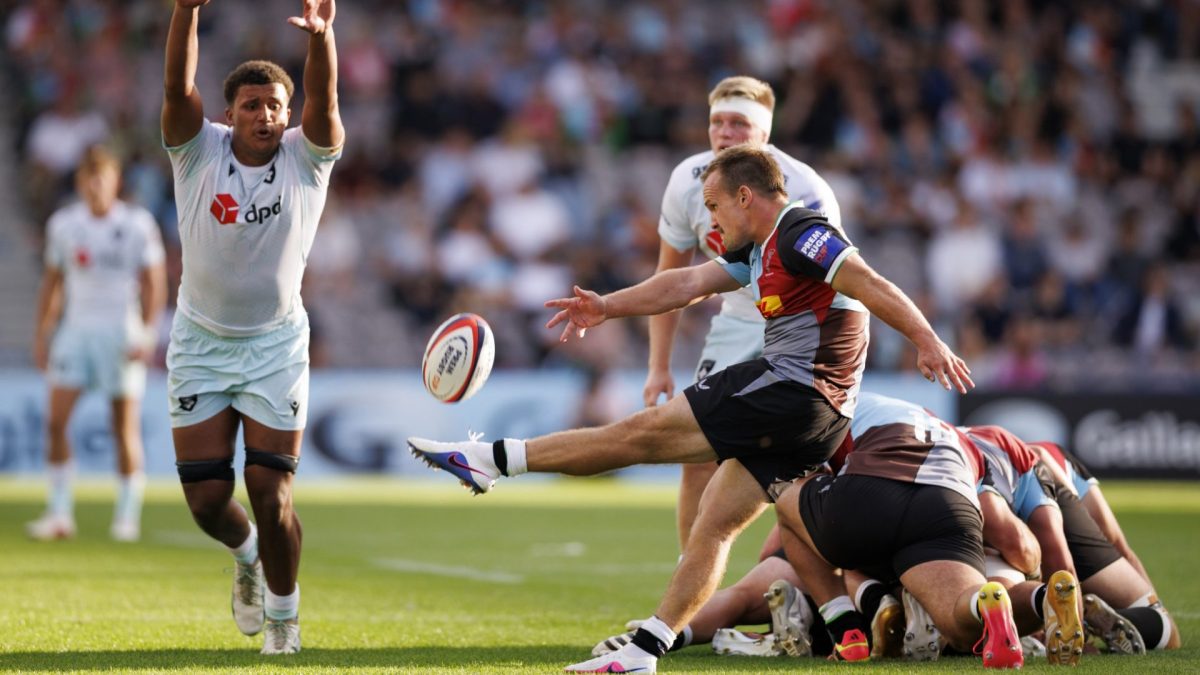
The laws of rugby union are a constant topic of debate among players and coaches, fans and pundits – before, during and after matches. In one way, this is the simplest of sports: just move the ball up the field and score some points. In other ways, there is a complex tangle of what’s legal and what is not, at scrums and line-outs, mauls, rucks, tackles, restarts and the rest. There are also grey areas that can never be clarified in black and white, and are left to the referee to decide , and in these can lie both the beauty of the spectacle and the inevitably differing views. We asked the 10 men in charge of coaching the clubs in England’s Prem clubs which laws they would like to see changed or introduced or just got rid of, to improve the game… Rob Baxter (Exeter Chiefs director of rugby) “I’d change the law on the ‘held up over the tryline’, leading to a drop-out. And I’m saying this as someone having won a semi-final on it last year. I just don’t think that’s the way an attack should end, and the defending team getting that much of a pressure release. “People say you hand the ball back to the attacking team with the kick [drop-out], but defences are organised enough now that the way of building a defence out onto your 22 is a massive pressure outlet for a team that has potentially worked the length of the pitch. It doesn’t feel like a productive, positive law change that was introduced, and I don’t think it’s created what the game ever wanted to create.” “People talked about it creating these big, dead periods in games, whereas I don’t think it ever did. “It’s a build and build of attack, it gets the crowd going as well, and if a team hold out from that repeat five-metre scrum pressure, that’s a key moment. “You also need to look beyond just Premiership rugby. I watch a lot of university games and our local club games, when the officials don’t have TV and they’re unsighted, they pretty much have to give ‘held up’. It’s frustrating for the players. So there’s more to it than just relying on TV. The game’s bigger than that. It’s about creating positivity right through the whole game.” Alex Sanderson (Sale Sharks director of rugby) “I really don’t know what the goalline drop-out has given us. Maybe it speeds the game up a little bit. But I would revert to giving something to reward the attacking team. Maybe a five-metre tap. At the moment, you are just putting another kick in there, aren’t you? And not really a transitional kick – you end up just shaping moves around the point of contact. It has not changed the game as they thought it would. Ball-in-play time is no greater, so it’s just a law amendment that hasn’t had an effect.” Sanderson would also act to preserve the complexity of the scrum. “That is a great thing, so I would like a scrum referee looking at it from a box or from the sideline; someone who specialises in that area. If 30 to 40 per cent of penalties come by way of the scrum, that’s an influential part of the game, so let’s get that nailed and make it a proper pushing contest. “You see the acumen that someone like [ex England prop and now TV analyst] Dave Flatman has on the touchline – far greater than the ARs [assistant referee], who aren’t full-time, and probably better than most referees, because of his experience of it. A scrum ref would make it a fairer contest, and less cheating because it’s poacher turned gamekeeper, so to speak. “When I coached the scrum, and I wasn’t a front-rower, I had to learn it technically, and be watching 200, 300 scrums a week, for the pattern recognition. Referees can’t do that, because they’ve got to look at full games and talk about all the decisions.” Coaches want to see scrummaging protected as a skill (Photo: Getty) Jason Gilmore (Harlequins head coach) “The slap-down [of the ball by a defending player]. I think it’s too inconsistent. Some guys will get yellow-carded, others will be a penalty, others will be a knock-on for a scrum. If you look at the rule, it’s to change the reaction of a defender. But because everything happens so quick, it hasn’t changed the reaction of the defenders in 20 years. “To me, it’s actually poor attack, because you’ve dug too deep into the line. If they’d passed two steps earlier, they’d still get the line break. So potentially, if you don’t make it as harsh against the defence, will it change the execution of the attack to be a little bit better, and then you get better flow through the game? “Maybe you just make it a half-arm tap and let’s play. Let’s get on with it, rather than we go up to the TMO, we watch five replays and we end up with a yellow card. “We’ve got far too many yellow cards as it is. Rarely do you see a game where it’ll be now where it’s 15 on 15 for 80 minutes. That takes away from the spectacle. We need ways that you still get an advantage from it, the game still moves on, and we still have 15 on 15 on the field.” George Skivington (Gloucester head coach) “I’m still not convinced on the aerial contest, the way we’ve got it at the moment. It’s messy, because it is just a contest of two people jumping in the air, and while you can argue there’s a skill there, I’m not convinced it’s produced better flowing rugby, in return for taking away an element of protection on something that, if you did it correctly, was pretty safe. I’m not convinced taking away an opportunity to let your guy catch it and get into an attack has pushed the game on.” Would you reintroduce the ability to shepherd the receiver? “I would. It was brought in to bring more attack, but actually, a lot of the best attack at that time was coming from counter-attack and transition. So the ball was getting kicked from catching the ball – and we [Gloucester] were one of the best at transition, at the time, which is probably why I’m saying it – but now it becomes a scrap with people just kamikaze-ing into each other and balls bouncing.” A ball ‘held up over the line’ now results in a defensive drop-out, not an attacking scrum (Photo: Getty) Dan McFarland (Newcastle Red Bulls head coach) “There are so many tweaks every year, I’d like to leave it the same for a while, please, so we can all settle down and understand what we’re trying to do. “But I think the maul one [where players are prevented from ‘swimming’ round the side in defence] is interesting, because it’s definitely going to make it easier to referee, which I think is the goal. You’re always a little bit nervous when suggestions come out of South Africa, and why they’ve been suggested – because it suits their strengths, normally, sugar-coated with ‘this is good for the game’. “We’ll see. If it leads to way more maul tries, I’d say it’s probably not right, because we’ll just end up with lots of kicking to the corner, and we won’t get the innovation that comes out of tap penalties or scrum plays close to the line or quick taps.” Johann van Graan (Bath head of rugby) “Let’s make sure that the scrum and the maul keep their place in the game, and whichever way we decide to referee it, keep that consistent across the next number of years – that we don’t have change every few months. “There’s the bit about the brake foot coming back in now [the hookers must keep a foot on the ground throughout the engagement of the scrum]. Sometimes I feel we’re creating a problem where there wasn’t a problem. I thought the scrums in the Prem last year were very good by the 10 teams.” The referee made a point of enforcing the brake foot in the second Test between South Africa and New Zealand? “That’s an example where two fantastic teams are playing and, in my view, let’s not make a thing out of a brake foot before the ball is even into play. Let’s look after the set-piece, because rugby is a game for all shapes and sizes.” No coach wants to game to slow down, that is a common theme (Photo: Getty) Pat Lam (Bristol Bears director of rugby) “I would like the clock to be stopped for every reset scrum in the last 10 minutes of games. Sometimes the referees do stop the clock, but I think it should be mandatory in that last 10 minutes. So from the 70th minute to the 80th minute, if a scrum collapses, the clock stops. I believe you’ll find fewer resets. “At the moment, you can see it being used tactically by the team that’s ahead to run the clock down – you can pretty much guess that the scrum’s going to go down or go up, and the clock keeps going. Everyone wants to keep the scrum. But if the game’s close with 10 minutes to go, you want to use all the time possible of ball in play.” Geoff Parling (Leicester Tigers head coach) “I generally think the game’s in a good space. We just need consistency. Let’s ref the offside line, a lot. Keep the space. But apart from that, I think we’re in a pretty good area.” Read more Big read: Inside the Saracens revolution: ‘We want to f**king dominate’ Comment: I subscribed to every rugby TV channel and it cost me £1068 – it’s a big problem Phil Dowson (Northampton Saints director of rugby) “You don’t need to change the rules, just understand that because there’s so many laws in the game anyway, let’s simplify it and decide which rules you’re going after: the ones that create the best spectacle, create the best game. “One thing I’ve had consistent conversations with Paul Hull [the RFU’s head of professional game match officials] around is to really go hard after the back foot [keeping defending players onside]. Keep the space in the game, so that it’s all clear and obvious. Assistant referees have got a role in that, for sure. It just needs to be consistent, in the Top 14, in international rugby and in our game in the Prem. It’s something that can be pushed really hard.” Joe Shaw (Saracens head coach) “I don’t really get annoyed by much. The quicker the game can be, I do like that – playing the game at tempo, all the time for everybody. The fact that you can’t go at the base of a scrum any more, that’s really helped – having nines that have got to stand back, so you can get the flow and, unless the scrum is going to a scrum penalty, you can get the ball out and you’ve got exciting backs across the league now. That’s a rule I’ve enjoyed. “I’ve always thought that referees have got a tough job, and sometimes people get something wrong, but most of the time, are they trying their hardest? Yes. Is it a tough job out there? Yes.”
I asked every Prem coach for one rugby law they would get rid of
Full Article
Original Source
Read the full article at Inews →KhanList aggregates and links to publicly available news content. We do not host full articles from third-party sources. Always verify important information with original sources.