
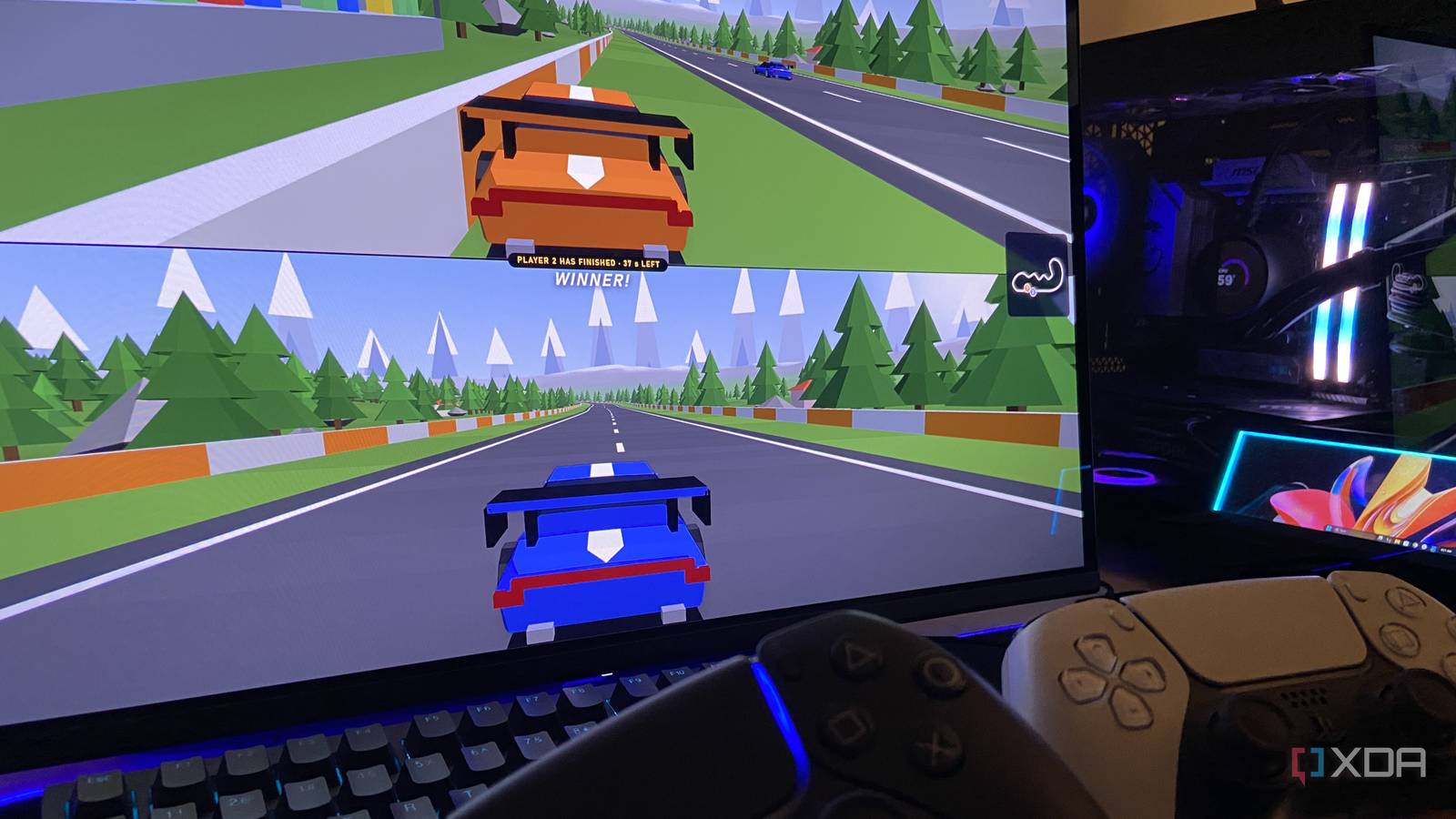
Published Nov 27, 2026, 10:30 AM EST Abhinav pivoted from a career in banking to pursue his first love in writing. Even while working full-time, he continued contributing as an editor-at-large, a role he has held for more than 7 years. A lifelong tech enthusiast who has built three gaming and productivity powerhouse PCs since 2018, his passion for technology keeps him closely following the semiconductor industry, from NVIDIA and AMD to ARM. His MSc dissertation explored how artificial intelligence will reshape the future of work, reflecting his curiosity about the wider social impact of emerging technologies. Last week, I put three coding agents against each other with the same prompt to build a game, and Claude Code, running Sonnet 5.5, ended up surprising me with a breathtaking 3D racer with DualSense support that beat nearly every single game that I've seen it code. I was quick to share the game with a few of my colleagues, who, like myself, believed that a game this well-built was sitting on a gold mine of potential. One idea kept coming back to me all this while. Split-screen used to be a staple of racing games back in the day, and now, I rarely see it in new releases. So I went back to the same project and asked Claude Code to take its own codebase a little further. One prompt and about 14 minutes later, it delivered the game that I'd asked for in a single HTML file, and it had made decisions that I never even thought to ask for. Claude Code's racer had everything, except a second player Racing your own ghost only goes so far Ghostline, as Claude itself named it, is a 3D time-trial racer that runs straight from a folder on my PC. While writing the prompt to create it, I was going for the simplicity that was characteristic of a .io game that you could just jump into with nothing to install, no need to commit, and pure arcade racing from the second you launch. The game's three tracks take you from a sunset coastline to an alpine climb and a neon city at night. It's almost fascinating how feature-packed the game is, considering that it is fewer than 3,200 lines of code. It works with a DualSense controller right out of the box, lowers its own render resolution if the frame rate dips, and gives the curbs and grass their own grip levels, so cutting corners costs you time. For all of that, though, it was still just a little project that you'd open every once in a while to appreciate how far AI-assisted coding had come. For it to be a game that I could enjoy with my friends, it needed to have something that my five-year-old self would have expected from any racing game, and that was a split-screen mode. Claude Code added split-screen without breaking single-player It was easier than waiting for a DLC With my prompt, I deliberately kept things simple and didn't specify the technical aspects of how a split-screen mode should work in execution. I simply asked for a two-player mode that left the existing game's time trial mode, best laps, and ghosts as they were. Each player could join with their own DualSense controller, the screen would split top and bottom with its HUD for each half, and the race would run three laps with the ghost switched off. I also asked for cars to be able to bump into each other, for vibration to reach only the right controller, and for a results screen at the end of the race with an option to rematch. Sonnet 5.5 wrapped the entire thing in about 14 minutes, which was less than half the time it took it to build the original from scratch. It put the whole mode in a single new file and gave the existing ones small hooks that leave single-player as it was. Since it had built its own renderer the first time around, teaching it to draw onto half the screen only took a handful of lines: region(x, y, w, h) { this.aspect = w / h; this.gl.viewport(x, y, w, h); } At this point, it seemed like a simple and straightforward job, at least that's what I thought. However, it then did something that grabbed my interest. Sonnet 5.5 took the call to run the old and the new code side by side on identical inputs, and noted that the physics matched exactly over 153,234 steps. Only then did it proceed to test the two simulated DualSense controllers through joining, pausing, full races, and even accounting for controller disconnects. The two-player mode is full of improvisations I never asked for If you win the race, you can't get in the way anymore The game itself is a dream from a user experience point of view, and that was something that I noticed from the very first launch. Each player gets to join the race by pressing X on their DualSense, which plays a chime to confirm, and the race starts from a side-by-side grid with the screen split top and bottom. Cars bump and release yellow sparks when they touch, and Claude Code treats each one as a capsule the length of the car. Upon inspecting the code itself, I noticed that every knock could scrub off between 2% to 8% of your speed depending on how hard you hit. That was a level of meticulousness that I genuinely did not anticipate going in. if (closing 0) return null; const keep = 1 - U.clamp(0.02 + 0.003 * closing, 0.02, 0.08); a.vx *= keep; a.vz *= keep; b.vx *= keep; b.vz *= keep; state.cool = BUMP.cooldown; My favorite touch, by far, however, is what happens after you cross the finish line, and that's something that I discovered by accident, owing to the fact that my partner was an entire lap behind me during our race. Once a car crosses the finish line, it stops being solid, so a player that's still racing drives straight through the winner instead of crashing into a parked car: // A car that has taken the flag is out of the way: no contact with it. if (a.started && !a.finished && !b.finished) { As for the rest of the mode, it feels just as considered. The results screen ignores input for nearly a second so nobody can skip it by mashing buttons on the controller, and fascinatingly enough, every rematch swaps grid sides. Customization is also possible by changing the car's colors, which helps to not get confused in the middle of the race as both cars are based on the same model. To be fair though, that was something that the original had as well. All it took was a prompt, and a second controller Perhaps the true magic of the game is just the amalgamation of how all of these invisible little fine touches make for an enjoyable experience. The game itself transported me back to the days of when I used to play split-screen racers in the PS2 era, and that is not a feeling that I expected that a prompt would be able to bring back.
I asked Claude Code to build a racer with splitscreen and DualSense support, and it delivered a Steam-ready game
Full Article
Original Source
Read the full article at Xda-developers →KhanList aggregates and links to publicly available news content. We do not host full articles from third-party sources. Always verify important information with original sources.