
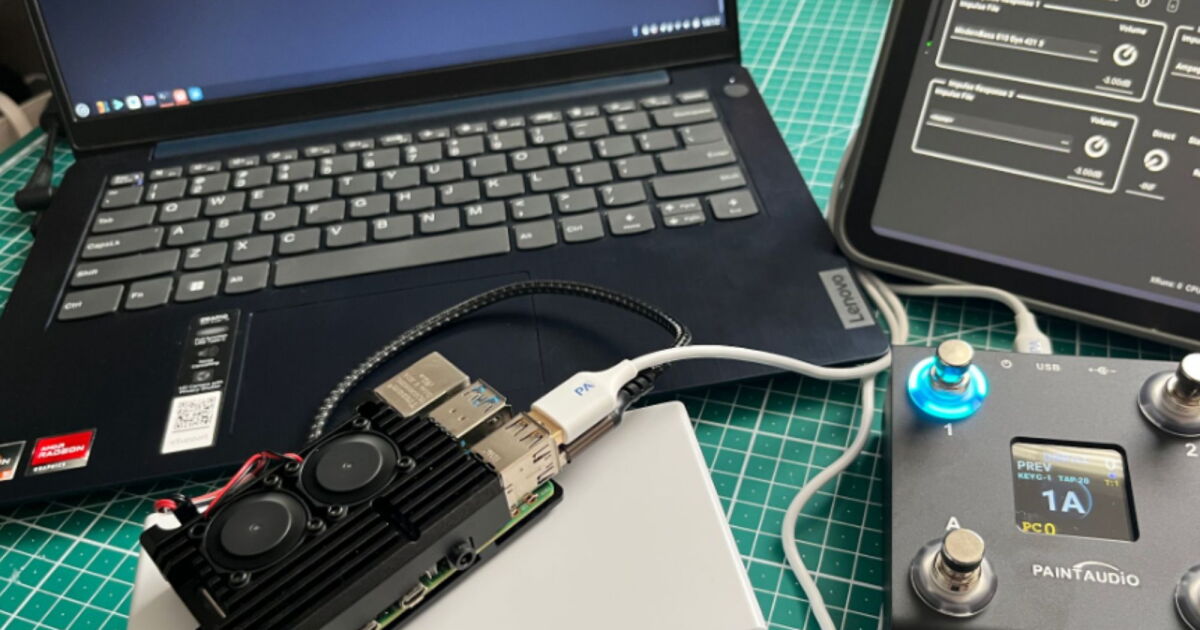
stompbox (noun) A little box of knobs, switches, and dark magic that musicians stomp on to summon everything from angelic shimmer to utter filth. If you ever plug in an instrument or use a microphone (or would like to), this might just be of interest to you. I’m in the process of buying a new bass, which inevitably led to the dangerous business of looking at things to plug it into.I've played with all the toys, so I know I want a decent multi-effects pedal. A box that gives me whatever sound I need without carpeting the floor in lots of little stompboxes. Of course, the one I really wanted was going to cost more than would pass the wife test. After the recent V2 update, I'd stumbled across TONE3000. TONE3000 is an enormous online library of Neural Amp Modeller captures – digital models of real amplifiers, cabinets, pedals, and even complete signal chains. Think Fender, Trace Elliot, Marshall, Boss...I wasn't in the market for effects then, so I thought, yeah, modelling, very cool, and moved on. So great timing, thanks Alex from the Bitflip podcast for enthusing about this and putting me onto PiPedal. That was the magic gadget that put TONE3000 squarely back in my sights. New Atlas looked at the same technology in Blackstar’s Beam Mini, pulling thousands of captured amp and pedal tones into a commercial product.Enter PiPedal. A free, open-source effects platform turning a Raspberry Pi 4 or 5 into a multi-effects unit. PiPedal 2.0 now talks directly to TONE3000, allowing users to browse and download Neural Amp Modeler (NAM) captures of real amplifiers, preamps, and pedals without leaving the software. Alongside these are conventional effects plugins covering reverb, delay, chorus, compression, EQ, distortion/saturation, and pitch shifting. Howard Armitage/New Atlas This was beginning to look very, very interesting.I just happened to have an old Raspberry Pi 4. And as luck would have it, a spare USB audio interface. How fortuitous. What I didn't have was much idea how to turn those things into the sophisticated effects rig I could now see was possible.All I said was: Howard Armitage/New Atlas And this is where the story stops being about a Raspberry Pi.I didn't spend the next couple of days reading Linux audio documentation, GitHub discussions, and MIDI manuals, like in the good old days. I just described what I wanted. ChatGPT downloaded, installed, and configured the software, diagnosed what didn't work, tweaked settings, and gradually turned a pile of spare hardware into an effects processor.Make it boot straight into the pedal setup. Done.Give me a bass sound for Sledgehammer. Done.I could say “here's my 40-track playlist, make me a preset for each one.”And it did.In just a few minutes.Astonishing!Within a couple of hours, I had a multi-effects pedal, individual song presets, amp and cabinet combinations, effects chains, and a touch-friendly interface on my iPad. Add a six-button MIDI foot controller and, from the player's point of view, it starts behaving like a conventional stompbox.Sorrow, stomp. New York Minute, stomp. Earth Song, stomp.The sounds are really very good. New Atlas pegged neural-network amp modelling back in 2020, and now it's so good that Alex and Stephen on Bitflip are discussing why, in blind comparisons, it can be extremely difficult to tell it from the genuine article.In broad terms, I’d accidentally built an open-source cousin of something like Neural DSP’s Quad Cortex – just that mine was spread across a Pi, interface, tablet, and controller instead of wrapped in one gorgeous, expensive appliance.Modelling isn't new. Yamaha was doing it in 1993 with the VL1, mathematically recreating the airflow, reeds, and resonances of saxophones and other acoustic instruments, while Line 6, among others, later applied the same broad idea to guitar amps. What’s changed is the sophistication of the models and, crucially, how cheaply we can now run them. Howard Armitage/New Atlas NAM works by training a neural network on recordings of real audio equipment, learning how that equipment responds to an input signal rather than simply approximating its sound with conventional effects. Its new Architecture 2 can substantially reduce the processing power required, around 30–40% less CPU than its predecessors.A little Pi can now run technology that not very long ago belonged firmly in the expensive category.But let's not get carried away. I haven't built an HX Stomp for twenty bucks.A commercial multi-effects pedal is a beautifully integrated appliance. It comes in a rugged metal box, with proper footswitches, instrument-grade connectors, and a manufacturer responsible for making the whole lot play nicely. My version consists of a Raspberry Pi and a handful of spare bits.I also discovered that the choice of audio interface matters. One perfectly tiny interface from a renowned guitar manufacturer proved so troublesome that I abandoned it in favour of a larger Arturia unit that felt much more like something that would survive being thrown in a gig bag.And much as I strive to find criticism (undo would be nice), it's all there, it all makes sense, and it does what it says on the tin.So would I swap this collection of boxes for a commercial pedal if I were walking onto a stage in front of 20,000 people?That should be two questions.Does it sound like a business? Yes. Yes, it does.Would I trust it with my reputation in a live situation? Not yet, and only because I haven’t put it through anything like that yet.But would I take it to the studio? You bet I would. Would the techs want to know what the hell it was, and would I play it cool while showing off my self-made custom gadget that made me sound like Pino Palladino or Guy Pratt in a blink? Yes, humbly, I believe so.Would I turn up with a second PiPedal ready to go, just in case? That would indeed be pertinent.As impressed with my creation as I was, the truly extraordinary part was that I could build it at all, that I didn't have to acquire all the expertise beforehand.Building this is VERY achievable. This is one of those projects that’s now almost too easy not to try. These were the steps involved:Install Pi OS. Boot Pi. (Important: enable SSH).Tell ChatGPT “Please use Desktop Commander and turn the RasPi on my network into a PiPedal.”Sit back. Put feet up. Instruct the audience to prepare for your re-enactment of that scene from Back to the Future.Occasionally it might ask for a little help, but nothing you can't handle (like, press ENTER). When it's finished, give it your playlist and say, "Make me a patch for each track."And it will. Howard Armitage/New Atlas Some it will nail. Some will be a good starting point, and some you'll just wonder why. But you don't even have to make the changes yourself."Put some more chorus on that, add some mid and swap out that Boss CS-3 for a Cali76."And it is done.Projects like this used to have an invisible entry price - knowledge. The hardware might cost only a couple of hundred dollars, but you also needed Linux, audio, and networking knowledge, and the patience to glue everything together. For many, that knowledge toll was higher than the cost of buying the finished product. And fair enough.AI changes that equation.I supplied the ambition and the judgment. I knew what I wanted the finished thing to do, and I knew whether the bass coming out of the speakers sounded right. The machine supplied expertise as I needed it.That feels considerably more revolutionary to me than just another clever Raspberry Pi project.It is, however, very obviously free and open-source software.It doesn't look like it was assembled by Pininfarina. PiPedal's web interface has a faint whiff of Geocities about it, and nobody is pretending this is what you hand a pro and say, "It'll be cool, go with it."But then again, what do you want? It's free and open source.More importantly, it has the parameters, routing, models, and flexibility where it matters. It may not look like a thousand-dollar pedal, but in terms of what it can actually do, it gets so close I personally think it makes the thousand-dollar alternative start to look a little silly.I went looking for an expensive commercial effects pedal. Instead, I spent roughly $100 on a footswitch to complete a rig around hardware I already owned, ended up with more sounds than I'm ever likely to use, and discovered that changing it now requires little more than barking at my AI.The most interesting component in my new stompbox isn’t the Raspberry Pi. It’s the sentence I use to tell it what to become next.I wonder if Chat can operate Audioprism…
I asked ChatGPT to build me a $1,000 effects pedal. Here's what it did
Full Article
Original Source
Read the full article at Newatlas →KhanList aggregates and links to publicly available news content. We do not host full articles from third-party sources. Always verify important information with original sources.