
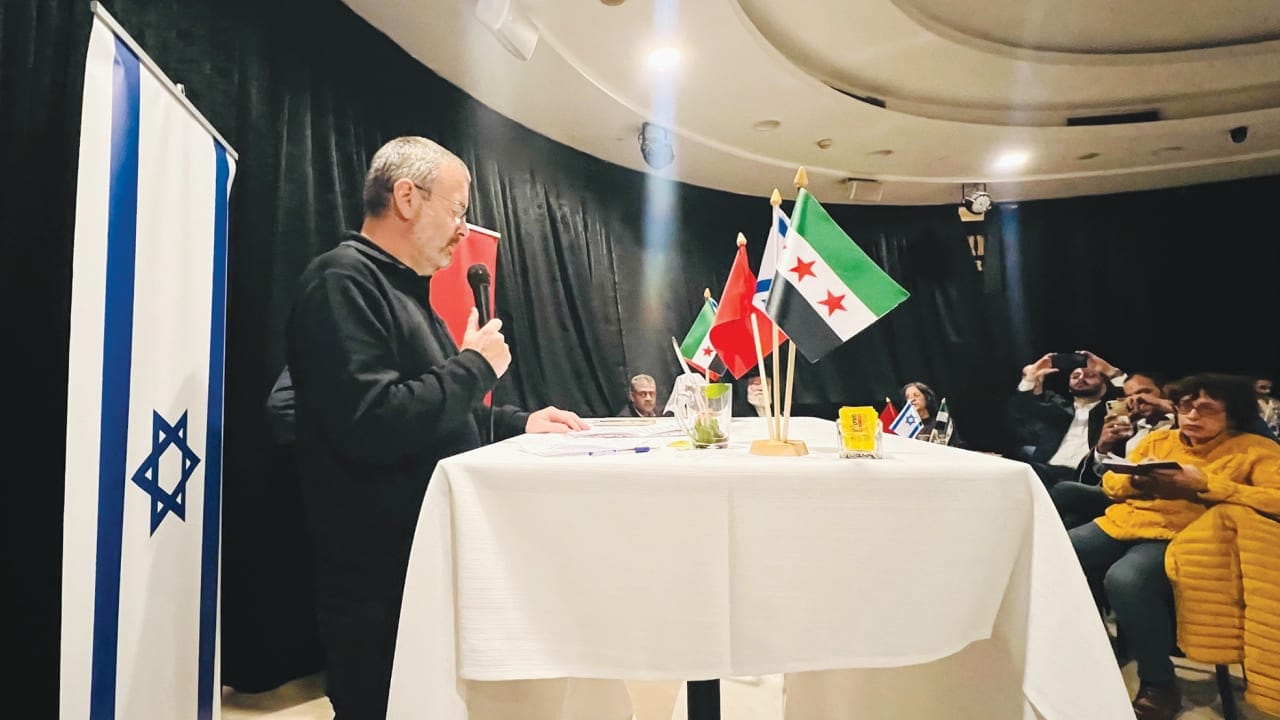
SEPTEMBER 19, 2026 16:00In much of the West, asking someone about the weather is about as inconsequential as small talk gets. In parts of the Middle East, however, even a conversation about the weather with someone across the border can cross a legal line. In countries where contact with Israelis is criminalized or restricted, a seemingly harmless exchange can carry the risk of imprisonment or execution.The Abrahamic Movement was founded on the idea that these communication barriers can be challenged. Bringing together Israelis and people from across the Muslim world, the movement seeks to build relationships across religious and national divides, drawing on their shared Abrahamic heritage.With artificial intelligence and international travel more accessible than ever, forms of diplomacy once largely reserved for governments and the wealthy are increasingly within reach of ordinary people, which is perhaps why the movement has grown so rapidly in recent years.The Jerusalem Post spoke with Tom Wegner, CEO of the Abrahamic Movement initiative and author of The Abrahamic Revolution, as well as several members of the group, some of whom risked their freedom and potentially their lives by speaking with an Israeli journalist about their desire for peace.Wegner originally started the group in 2019, though it did not gain momentum until after October 7, 2023, when 1,200 people were killed by Islamists.FOUNDER OF the Abrahamic Movement Tom Wegner. His book ‘The Abrahamic Revolution’ sets out his vision for a shared Abrahamic identity capable of bridging the religious and national divisions that have long shaped the Middle East. (credit: Courtesy Tom Wegner)Wegner realized that something had to change and reached out to the diverse contacts he had built over years of working in the IDF’s District Coordination and Liaison unit in Jericho, where he facilitated coordination between Israel and the Palestinian Authority’s police; as a spokesperson for former prime minister Ehud Barak; and as a spokesperson for the Peres Center for Peace.Telling them that “the regional configuration is not working for us,” Wegner explained that the region’s destabilization had been apparent long before Hamas’s invasion. The massacre of the Yazidis, the civil wars in Yemen and Iraq, and the conflicts that followed were all evidence that something was not working compared to the seemingly functional Western world.Shared Abrahamic identityThough Europe seems peaceful compared with the often volatile Middle East, Wegner highlighted that the West has not always enjoyed such stability. Before the formation of the European Union, Europe experienced civil uprisings, invasions, and two world wars, resulting in hundreds of millions of deaths.Wegner attributed much of that shift toward peaceful coexistence to the development of a European collective identity. That identity “wasn’t coerced on the people. It is not about oppressing someone to fit your narrative, but of creating an umbrella identity, which means that the French can continue to eat frogs and the Greeks can continue to break plates. The Protestants can remain Protestants, and the Catholics can remain Catholic, but everyone is part of a bigger story,” he explained.The Abrahamic Movement seeks to create that same sense of collective identity in the Middle East, based on a shared Abrahamic heritage.“The world has missed, to some extent, that 100% of the people involved in this conflict – whether a secular Jew, an Orthodox Jew, a very religious Muslim, a liberal Muslim, an ex-Muslim, a Christian Arab, a Druze, or an Alawite – agree on the Abrahamic narrative. Meaning, we all agree that we came from Abraham,” he said.This shared heritage, he added, means it is important to view the conflicts as fighting among cousins and families rather than through the Western-centric lens of occupiers and colonists.The idea that conflicts can be solved simply by drawing lines on maps, Wegner said, is too Western, too managerial, and too simplistic to address conflicts rooted in identity. Rather, he argued, the solution lies in creating a broader “in-group,” limiting the conflict that can arise from in-group and out-group social dynamics.The Muslim Brotherhood’s oppositionWhether it is soccer hooligans in the UK, gangs in the United States, or ethnic groups in the Middle East, the same in-group versus out-group dynamic can contribute to conflict, with people defining themselves in opposition to those they see as belonging to another group, Wegner argued.The concept is well established in social psychology, with research showing that in-group identification can contribute to out-group prejudice, stereotyping, and discrimination, creating conditions that can deepen hostility between groups.Beyond creating a shared in-group identity, it is also imperative to create an identity that is oppositional to the Muslim Brotherhood and its Shia alternatives, like Hezbollah, Wegner insisted.The Islamist identities are currently all-consuming, he said. The Muslim Brotherhood and Shia groups such as Hezbollah have no mainstream counter-ideology for the average individual living in a Muslim country and are therefore more effective in their recruitment.The all-encompassing Islamist movements and their various branches provide thought leaders, media, education, healthcare, employment opportunities, social circles, community, and everything an individual could ever need. Wegner explained that all these factors can draw people toward an extreme ideology when no opposing ideology balances it out.The idea of “Abrahamic Islam,” true to the Quran in its acknowledgment that the Children of Israel will return to the promised land (Surah Al-Isra, 17:104), “enables Muslims to remain loyal to their original religion,” he said, adding that this new ideological approach could be the driving force in finally ending Israel’s wars against extremist groups.“Losing your honor in this part of the world is worse than losing your life. When it comes to Arab and Muslim society, you’re better off losing your life than losing your honor,” he said, highlighting that Hezbollah, Hamas, the Islamic Revolutionary Guard Corps, and every other enemy of Israel face the choice to die in battle as a martyr or sacrifice their honor by surrendering to Israel.“If we understand that killing all the radicals is not a very good or solid plan, then we should ask ourselves what the way out is. And over here, the Abrahamic Movement represents a way out for many reasons.... It implies that this is common ground, and when you come to common ground, that’s not surrendering,” he said. “That’s an identity that both of us can live with, without losing our honor.”‘The Quran: A Zionist document’Wegner believes that Jews “missed the Quran,” overlooking the wisdom it could offer and its potential to help Zionists communicate with people in the region in terms they can understand and accept.Familiarity with the Islamic holy text, he said, has allowed him to win heated debates with Islamist scholars and bring large numbers of people closer to accepting the humanity of Zionists and their place in the region.“The Quran is a Zionist document,” he claimed, recounting how heated debates often cool when he can cite Quranic verses in support of his position.Though many seek to counter Islamists by relying on passages they believe undermine Islamic teachings, including frequently citing the Prophet Muhammad’s marriage to Aisha bint Abi Bakr, such arguments will never be fruitful and are no way to conduct diplomacy, he argued.Instead, he pointed to the Quran’s numerous references to the Children of Israel, or the Jewish people, as a basis for engaging with Muslims on terms rooted in a text they recognize as authoritative.In Surah Al-Ma’idah (5:21), Moses tells the Children of Israel to enter the holy land that God prescribed for them. In Surah Al-Isra (17:104), the Quran instructs the Children of Israel to live in the land until the end of days, while Surah Yunus (10:93) states that God settled the Children of Israel in a blessed place and provided them with good provisions.“If we really want to speak with the Muslim world and create some sort of dialogue, the whole approach of saying ‘Muhammad was a pedophile,’ or all that jazz that basically tries to contradict Islam at face value, is not relevant. It’s not helping anyone,” he insisted. “It’s only creating more animosity and tension.“We can probably get better results if we speak to our cousins the way cousins speak to each other, focusing on our shared heritage and the things that are common to us.”Peace in the Middle East is often painted as a pipe dream, and many might call Wegner idealistic for his ambitions. But the Abrahamic Movement has gained tens of thousands of supporters and now has more than 20 branches across the Muslim world – including in countries that criminalize communication with Israelis – thanks solely to the efforts of volunteers and without funding.Several members readily volunteered to speak with the Post about why they were so invested in peace despite the potential cost. One Pakistani member, in particular, insisted he did not want to speak anonymously, despite concerns about potential risks to his safety.‘I am not pro-Israel; I am pro-Abraham’Khurram Ali Raza, chairman of the movement’s Pakistan branch, insisted that the Post use his name despite repeated warnings that doing so could put him in danger.While Pakistan does not have a specific law criminalizing contact with Israeli citizens, Islamabad does not recognize Israel, and Pakistani passports explicitly state that they are valid for travel everywhere except the Jewish state.In a country where people are still lynched for accusations of blasphemy, Raza remained confident about his safety, despite acknowledging that his advocacy for normalization with Israel had already cost him a great deal.Sharing several articles he had written for his website, Faith and Freedom News, about his desire for peace, Raza said he had already been investigated by Pakistani authorities, who initially appeared to suspect that he was working for Israel. He said the unfounded suspicions led to his imprisonment for four months in a jail where he said the conditions were “hell.”“Somehow, I made them understand that I am doing this for peace, harmony and tolerance among these three religions, not for intelligence agencies or anything else,” he said. “I am not pro-Israel; I am pro-Abraham, and if you are pro-Abraham, the first religion is Judaism.... We are like brothers. We are from one family and one home.”The conditions of Raza’s four-month detention, spent in a cramped room without a fan or light, have continued to affect him, but they have not deterred him from carrying out his work with the movement as openly as he can.Despite being free, Raza said, it is impossible to access his website in Pakistan without a VPN, suggesting an unofficial block on his publications to prevent the masses from accessing them.In his personal life, close relatives have also urged him to keep his distance, fearing that his work could have consequences for the wider family.The lack of education in Pakistan, Raza argued, has led to many accepting without critical thought what they have been told about Jews and acting with hostility to those seen as part of an out-group.According to Pakistan’s Education Ministry, the country’s current literacy rate stands at only 62.3%, meaning an estimated 60 million people remain illiterate.Asked why, given all that he has suffered, he would continue to speak out in favor of a country he has never visited, Raza said that one day he will stand before God and answer for everything he has done in his life, and that he would be proud to answer for his efforts to promote peace and tolerance.‘Iraq can benefit from establishing peace relations’In May 2022, the Iraqi parliament passed the “Criminalizing Normalization and Establishment of Relations with the Zionist Entity” law, with 275 of 329 lawmakers voting in favor. The law imposes severe penalties, including life imprisonment or the death penalty, for a range of activities involving normalization or relations with Israel or Israelis.Under Article 7, promoting Zionist or Masonic ideas, whether through public speeches, conferences, publications, or social media posts, is punishable by death or life imprisonment.In July 2025, the Karkh Criminal Court in Baghdad sentenced a man to life imprisonment for promoting the “Zionist entity” on social media. According to Iraq’s Supreme Judicial Council, he had posted photos and videos supporting normalization with Israel, while Hebrew-language books and newspapers were seized from his home.Despite the apparent risks of holding such views, speaking with the Post, and participating in the Abrahamic Movement, the Sunni scholar Abu Musa Al-Iraqi said he believes it is in Iraq’s interest to normalize ties with Israel.“Iraq can benefit from establishing peace relations to prevent extremism and ideological and cultural terrorism from taking root among religious extremists, as well as to end this unjustified conflict,” Al-Iraqi, who used his alias, told the Post. “We can send messages of peace to future generations of Jews and Muslims. We do not want to pass this hostility on to them, but, rather, establish social and economic relations and communication to develop the land and reject the divisions created by extremists for narrow personal interests.”Working closely with Iraq’s Sunni and Sufi communities, Al-Iraqi has had opportunities to study Islamic and Abrahamic texts. Through this research, he said, he came to understand that the conflict between Jews and Muslims “is not a genuine one.”“Islam respects Judaism, but some Quranic texts and their meanings have been distorted and interpreted outside the context in which they were formulated, and misrepresented by those who are ideologically corrupted and do not want there to be a relationship or communication between Judaism and Islam, for purely political purposes,” he explained, adding that he understands Islam to be an extension of Judaism.Though his research may have provided a clearer understanding of Islam, it was not well received in Iraq. Many newspaper articles Al-Iraqi sent to the Post showed individuals affiliated with the Popular Mobilization Forces, Hizb ut-Tahrir, and other Islamist groups complaining about an “Israeli influence network within Iraqi territory.”Hizb ut-Tahrir even published a statement in June complaining of the “increasingly active” Abrahamic Movement’s presence in Iraq, saying it is largely viewed “as an extension of normalization with Israel.”Except for Wegner himself, none of the Abrahamic Movement’s members or leaders interviewed by the Post have had the opportunity to visit Israel. The movement faces no shortage of obstacles, from laws restricting contact with Israelis to Islamist groups that have openly opposed its activities.There is no guarantee that personal relationships will translate into political change, or that large numbers of people will embrace the concept of Abrahamic Islam.Still, movement members continue to risk their freedom, safety, and livelihoods in the hope of ending a conflict that predates the establishment of the Jewish state and, for many, living memory.Follow us on Google
'I am pro-Abraham': Meet the unlikely allies risking everything for peace with Israel
Full Article
Original Source
Read the full article at Jpost →KhanList aggregates and links to publicly available news content. We do not host full articles from third-party sources. Always verify important information with original sources.