
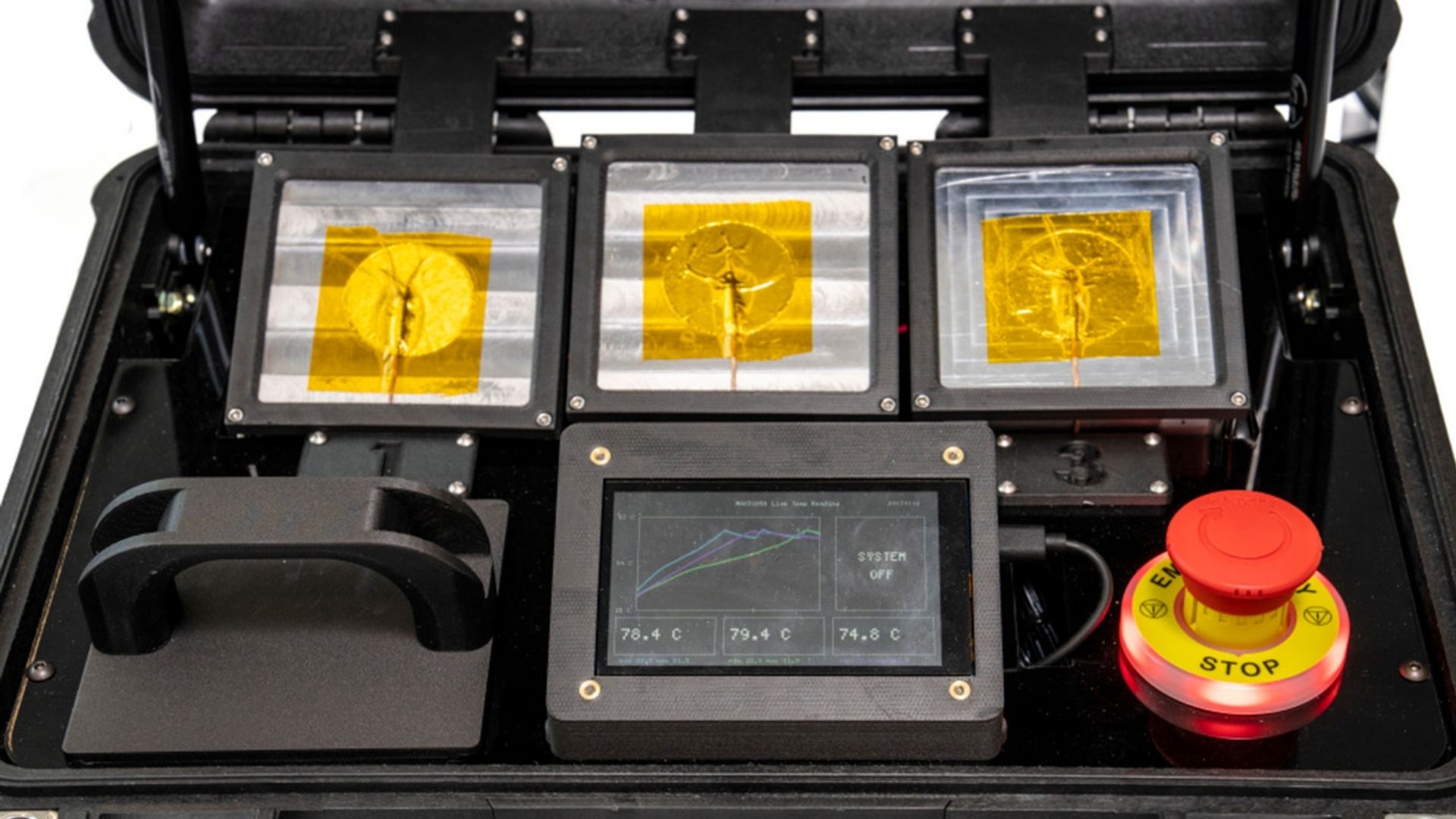
Engineers at the Johns Hopkins Applied Physics Laboratory (APL) are developing a new type of heatsink that could help electronics manage short bursts of intense heat while taking up significantly less space and weight. Called SPEAR, the system combines phase-change materials (PCMs) with additive manufacturing to create compact thermal-management systems for applications where size, weight, and available cooling options are tightly constrained. A heatsink that melts to absorb heat Traditional metallic heatsinks absorb heat and transfer it away from an electronic component. SPEAR takes a different approach by using a phase-change material that absorbs and stores heat as it transitions from a solid to a liquid. The principle is similar to ice melting in a drink. The ice absorbs heat as it changes state, helping limit how quickly the surrounding temperature rises. According to APL, this approach can provide substantially greater thermal storage capacity within the same volume. The researchers say a phase-change heatsink can reduce size and weight by more than 50 percent while maintaining the thermal capacity of a conventional design. That could be particularly useful for systems that generate large amounts of heat for relatively short periods but do not have continuous access to cooling. Potential applications include hypersonic vehicles, spacecraft, radio-frequency electronics, transmitters, and interceptors, according to APL mechanical engineer Yoni Ferneau. These systems can face a difficult thermal-management problem. They may need to handle intense heat during a brief operating period while having limited space for conventional cooling hardware. 3D printing makes the heatsink in one piece Phase-change heatsinks are traditionally assembled from multiple machined components, but APL researchers realized that additive manufacturing could allow the structure to be produced as a single piece. The SPEAR team designed and 3D-printed its own heatsinks before filling and sealing them with the phase-change material. For testing, the researchers created two SPEAR heatsinks and compared them with a baseline aluminum heatsink. One SPEAR design occupied the same volume as the aluminum version, allowing the team to compare how much additional thermal storage could fit into the same space. The second was designed to provide the same thermal capacity as the aluminum heatsink, allowing the researchers to measure the potential reduction in size and weight. The prototypes were successfully filled, sealed, and tested without leaks. APL then built an integrated test unit that applies heat to multiple heatsinks simultaneously while monitoring their temperatures in real time. The team’s ability to design, manufacture, package, and test the components in-house also allows it to rapidly modify the designs and evaluate their performance. Compact cooling for demanding systems SPEAR is still a development effort rather than a commercially deployed cooling technology, but its design highlights how additive manufacturing can enable thermal-management approaches that would be difficult to produce using conventional manufacturing. For systems where every gram and cubic centimeter matters, storing heat rather than immediately removing it can provide another way to manage short-duration thermal loads. APL says the technology could ultimately be adapted to different mission requirements, potentially giving engineers a compact alternative for managing heat in systems ranging from spacecraft to high-performance defense electronics. Get the latest in engineering, tech, space & science - delivered daily to your inbox.Kaif Shaikh is a journalist and writer passionate about turning complex information into clear, impactful stories. His writing covers technology, sustainability, geopolitics, and occasionally fiction. A graduate in Journalism and Mass Communication, his work has appeared in the Times of India and beyond. After a near-fatal experience, Kaif began seeing both stories and silences differently. Outside work, he juggles far too many projects and passions, but always makes time to read, reflect, and hold onto the thread of wonder.
Hypersonics: 3D-printed heatsink to cut cooling size and weight by over 50%
Full Article
Original Source
Read the full article at Interestingengineering →KhanList aggregates and links to publicly available news content. We do not host full articles from third-party sources. Always verify important information with original sources.