
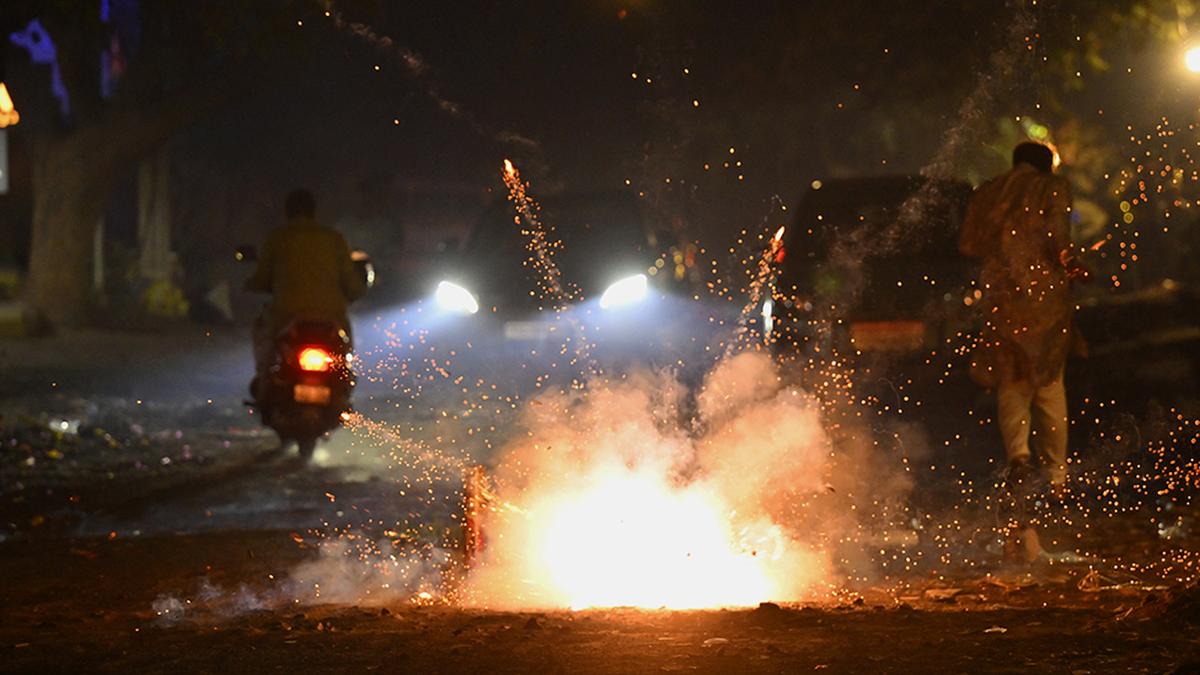
Motorists make their way through a road during Deepavali by lighting fire crackers in Hyderabad. | Photo Credit: NAGARA GOPAL With Hyderabad recording an Air Quality Index (AQI) of over 300 on Deepavali and many other days recording poor air quality earlier this year, doctors and public health experts have called for a coordinated effort by hospitals to track the health effects of pollution and build a city-level database that can help shape public policy.The issue came into focus during a panel discussion on ‘Impact of Mobility on Air Quality and Public Health’ at Cyberabad Moves, where doctors said that the effects of polluted air went beyond respiratory illnesses and were also linked to cardiovascular problems and strokes. They stressed that the health consequences of daily exposure to pollution, particularly during commutes, needed to be documented through local medical data.Pawan Mukulutla of WRI India, who moderated the discussion, pointed out that congestion was only the most visible consequence of the way people travelled. The less visible costs included exposure to polluted air, unsafe roads and the lack of pedestrian infrastructure. He cited Hyderabad’s AQI crossing 300 on Deepavali and said particulate matter levels, including PM2.5 and PM10, had been several times above prescribed thresholds.Pool health dataDr. Sudheer Vinnamala, Regional Medical Director of KIMS, said hospitals could work together to create a Hyderabad-level health database by sharing anonymised information on respiratory illnesses, strokes and cardiovascular conditions with public health authorities.“What you can’t measure, you can’t manage,” he said, arguing that such a database could help identify vulnerable groups and establish a clearer picture of the relationship between air quality and health outcomes.He said doctors could also use daily AQI information to alert patients with asthma and other respiratory conditions when pollution levels deteriorated, allowing them to take precautions and avoid unnecessary exposure. Hospitals could play a role in reducing pollution and traffic by encouraging carpooling, staggering appointments and arranging last-mile transport links from Metro stations.Dr Vishwanath Gella, a pulmonologist at AIG Hospitals, said pollution affected people with and without pre-existing health conditions. He said doctors were seeing patients with asthma, respiratory infections and other lung-related complaints, with an increase in cases during periods of poor air quality, particularly around Deepavali and in winter.Children face daily exposureDr Shailaja Tetali of the Public Health Foundation of India said research into school travel patterns showed that around 80 per cent of children lived within two to three kilometres of their schools. A majority travelled by public transport, walked or cycled.While walking and cycling offered physical activity, children using these modes were also exposed to roadside pollution and faced road safety risks. She said improving infrastructure around schools could address several of these concerns, as interventions within a three-kilometre radius could cover a large proportion of children’s daily journeys.She called for authorities to act on existing evidence instead of repeatedly commissioning studies, suggesting that interventions could first be tested in smaller areas and then replicated across the city.Poor road designOrthopaedic surgeon Dr Gurava Reddy of KIMS-Sunshine Hospitals said poorly designed roads and junctions contributed to crashes, pointing to inadequate visibility, obstructed sightlines and sudden turning movements as factors that made roads dangerous.He said several improvements could be made through better road engineering without requiring large investments, provided authorities were willing to address design flaws.The panel also discussed the responsibility of hospitals and other large establishments, which generate considerable traffic through patients, visitors and employees. Participants said medical institutions could reduce unnecessary trips through better appointment scheduling, shared transport and last-mile connectivity. Published - November 27, 2026 08:37 pm IST
Hyderabad’s air pollution puts focus on hospitals; doctors call for city-level health database
Full Article
Original Source
Read the full article at Thehindu →KhanList aggregates and links to publicly available news content. We do not host full articles from third-party sources. Always verify important information with original sources.