
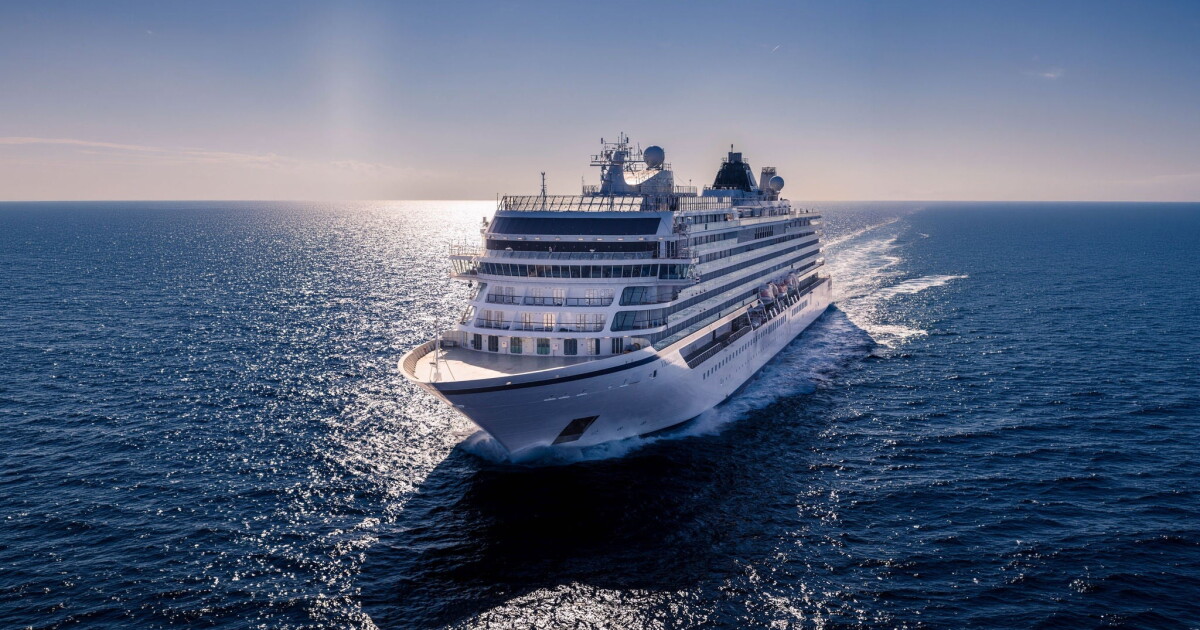
A cruise ship spends its days tied up in port, burning diesel just to keep the lights on. The Viking Libra is designed to keep them on for its 998 guests for about 10 hours using a fuel much more benign for the environment: hydrogen. The Libra is actually the world's first hydrogen-powered cruise ship, and Fincantieri just handed it over to Viking in Ancona, Italy.Viking claims the Libra will spend its first season sailing around the Mediterranean and northern Europe. But it doesn’t expect both the Libra and its sister ship – the Viking Astrea, still under construction – to start running on hydrogen until 2027.Cruises fueled by hydrogen could ease one of the biggest health problems these ships bring to the cities they dock in. In Juneau, Alaska, the city says a single cruise ship at berth for eight hours puts out more nitrogen oxides than 10,000 cars, citing figures from shore power company ABB. From up here, it's hard to tell the Libra is 784 ft (239 m) longViking Other places are less tolerant of these emissions. Norway will demand zero emissions from passenger ships of 10,000 gross tons or more, like the Libra, in its World Heritage fjords from January 1, 2032. And in the EU, cruise ships will have to plug into the grid at most major ports from 2030, according to green transport group Transport & Environment.The Libra's fuel-cell system comes from the manufacturing plant of Isotta Fraschini Motori, Fincantieri's fuel cell subsidiary. Liquid hydrogen feeds two containerized proton-exchange-membrane (PEM) fuel-cell units, which combine it with oxygen from the air to make electricity, with water as the only waste. Together they put out 6.3 MW, according to Fincantieri, and a 4.7-MWh battery handles peaks in demand. The hydrogen tanks can also be removed and trucked in, so the ship doesn't depend on hydrogen stations at the dock.The Libra is sold as a hydrogen ship, but it's really a hybrid. Its zero-emission mode lasts about 13 hours, three of them when sailing at 10 knots (11.5 mph, 18.5 km/h) and 10 hours docked. The rest of the time it runs on conventional engines. Fincantieri expects the vessel to cut its annual emissions by around 20% compared with a cruise ship running only on fossil fuels. Fincantieri floated the Viking Libra out at its Ancona yard back in March Fincantieri But the big question with hydrogen is always where it comes from. Neither company has stated whether it will be green (made with renewable electricity) or gray (made with natural gas in a process that emits CO2).The Libra isn't the first cruise ship to have experimented with fuel cells, though it is the first built to use them on a significant scale. The Viking Neptune (delivered by Fincantieri in 2022) had an experimental 100-kW hydrogen module. The same year, MSC World Europa debuted a 150-kW fuel cell running on liquefied natural gas. Both of those were very small scale indeed. MSC itself admitted its fuel cell produced "a small fraction of the energy we need."Elsewhere in the passenger ship world other vessels are already running on hydrogen. Norway's MF Hydra ferry has been carrying passengers on liquid hydrogen since March 2023 and San Francisco's Sea Change has been doing the same with compressed hydrogen since July 2024. Ships can also obviously turn off their engines in port in other ways, with a floating hydrogen power hub having completed its trials earlier this year. It's capable of feeding up to 5 MW to a ship at berth."Viking made the principled decision to invest in hydrogen, which offers a true zero-emission solution," said Torstein Hagen, now Viking's executive chairman, when the ship was announced in April 2025.Source: Viking
Hybrid hydrogen cruise ship is ready to take on 998 guests
Full Article
Original Source
Read the full article at Newatlas →KhanList aggregates and links to publicly available news content. We do not host full articles from third-party sources. Always verify important information with original sources.