
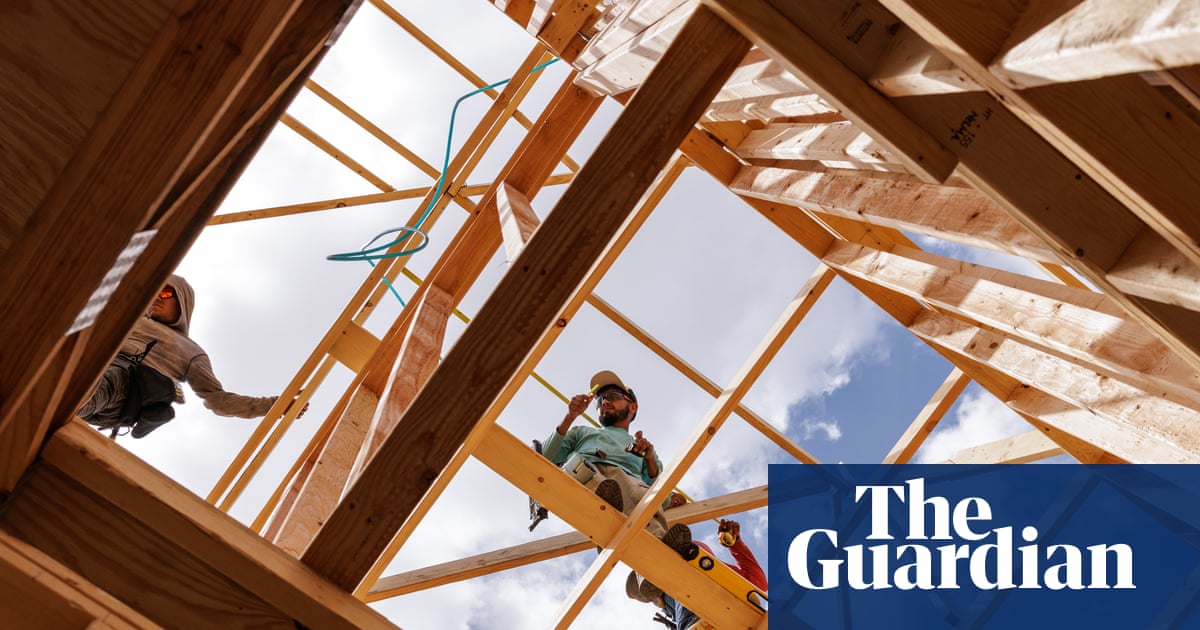
Every morning long before dawn, while America sleeps, legions of Texas construction workers grab their fluorescent vests and hard hats, sling ladders and tools into their trucks, and head down the highway for another day of grueling labour under the blistering sun.Elsewhere, before the first flush of daylight settles over Texas’s concrete sprawl, a separate army gets on the move in a fleet of shiny unmarked SUVs. They hover at gas stations, prowl around bodegas, pounce on the highways.They’re on their way to work too. But the federal agents who form this second army are on a different mission.Unlike the builders, they are not forging the US’s future one new starter home at a time. Their job is to pursue those who do the building: they follow the framers, track down the roofers, chase the cement masons and concrete finishers.They are hunters.“In Texas, you go deer hunting in the early morning,” said Jacob Monty, an immigration lawyer in Houston. “That’s what they are doing. They are hunting for construction workers, early in the morning, like you would an animal.”Texas and its construction workforce are the ground zero of Donald Trump’s latest mass deportation effort, dubbed ICE 2.0. As the US president has pivoted from last year’s militarized “invasions” of Los Angeles and Minneapolis to this year’s less visible but no less devastating stop-and-search tactics, he has found rich pickings in Texas.Texas is seeing by far the greatest number of ICE arrests in the country. More than 12,000 in July alone, almost double the number in the next most affected states, Florida and California.Workers constructing townhouses at a subdivision in Harlingen, Texas in September.Many of the detainees are Hispanic builders. Of every 10 construction workers in Texas, four are foreign born, most of whom are Hispanic and undocumented.“This is low-hanging fruit,” Monty said. “If you target Texas Hispanics in trucks, you have a good chance of nabbing an undocumented person, and feeding the mass deportation machine.”But there is a price to pay for ICE casting its dragnet through Texas barrios and building sites as it seeks to meet its new target of 3,000 immigration arrests daily. The street-level apprehensions are roiling the state, distorting its economy, forcing up house prices and the cost of groceries.Hispanic families are also being torn apart. Hardworking people are being pushed into the shadows, others disappearing as they flee the country or are deported. The foundations of new homes are lying unfinished, building sites empty.With the midterm elections just days away, and hugely consequential congressional races as well as the gubernatorial contest hanging in the balance, there are also political costs. Trump appears to be digging a hole for himself with Texas’s Hispanic voters.Latino Texans who were born in the US or have naturalised, and thus can vote, are increasingly angry and confused. Many of them voted for Trump two years ago, attracted by his promise of a stronger economy and a fortified border that would keep out “criminal” immigrants.They delivered Trump a historic victory, even in majority-Hispanic districts that had been Democratic strongholds for more than a century – voters like Sergio Benavides, 44, the owner of a home-building construction company in the Texas borderlands of the Rio Grande valley.A naturalised US citizen, he voted for Trump in 2024. He liked his campaign promises that he would lower prices and secure the border. When people warned him it would turn sour, he didn’t listen.He’s listening now. The prices of homes, food and gas have all gone up. Workers have to be paid more because so many have been deported. One of his subcontractors and his wife have disappeared, picked up by ICE, leaving behind three US-citizen children.“That makes me sad,” he said. “We are here to protect our families, send our kids to college, to learn and grow. This is not what I thought when I voted for Trump.”Benavides is part of a backlash that is showing up in the polls. Latino voters are turning against the president on the very issues that drew them to him – the cost of living, and immigration enforcement.A poll last month from Equis Research found that disapproval of Trump had risen to 63% among Texas Latinos. In the critical US Senate race, which could determine which party holds the upper chamber during Trump’s final two years in office, 58% of likely Latino voters intend to back the Democratic candidate James Talarico, while only 33% support the scandal-ridden Republican, Ken Paxton. This, in a state that last returned a Democrat to the US Senate in 1988.Latinos make up a third of Texas’s registered voters, the second-highest number in the country. And they know it.Construction workers among them.Marco Antonio Osorio’s day begins at 5am. Same routine, six days a week.A member of his crew comes to pick him up at his house in Houston. They drive around in their shared white truck gathering other crew, then head off to the site of a new apartment complex where they spend the next 10 hours laying TV and wifi fiber optic cables.Marco Antonio Osorio, 50, and his wife Cecilia Rodríguez, 45, pose for a portrait at their home in Houston, Texas, on 14 September 2026. Photograph: Danielle Villasana/The GuardianIt’s their speciality. They are good at it, and in demand. If only they were left to get on with it.Around the beginning of the year Osorio, 50, noticed a surge in ICE street activity. “There were so many more sheriff’s vehicles, state troopers, ICE on the highways weaving between cars checking plates.”As an undocumented Mexican who came to the US in 1993, aged 17, he knew he was vulnerable. But he thought he had some cover. His US-born daughter Gabriela is serving as a marine at Camp Pendleton in California. She has helped him apply for residency, and the paperwork is being processed.Still, he wasn’t taking chances. He changed his habits. No going out of the house unless for essentials. No nights out at the movies. He couldn’t stop working, or else how would he pay the bills? But now he wears a button-down shirt on the drive to the site rather than his fluorescent yellow vest. No point advertising himself as a construction worker with ICE on the hunt.He told his company he didn’t want to work outside Houston any more. The freeways to Austin and San Antonio were crawling with cop cars. “The company told me there weren’t any jobs here – either go out of town, or you don’t work.”Framed pictures of Osorio’s daughter, who serves in the US military, photographed at their home in Houston. Photograph: Danielle Villasana/The GuardianSo he took a job in Austin. On 10 June, as he was returning home after another 10-hour shift, a sheriff’s car did a U-turn on the freeway and pulled him over. The officer said it was because his truck had a faulty rear light, but Osorio asked himself how they could have known that as they were traveling in opposite directions. More likely, he thought, was that his vehicle has a clear front screen. “They could see we were Hispanic.”Within two minutes of the traffic stop, ICE SUVs blocked him in, front and back. The speed with which they appeared, Osorio realised, meant it had to be coordinated.He told them his daughter was a US marine. He showed the officers the receipt for his residency application. An ICE officer replied: “Oh, that doesn’t count.” They took him to a freezing cell, the notorious las hieleras, and from there to an immigration detention facility near the border. He spent 40 days in the wilderness of ICE custody, until Monty got him released for lack of due process.As he awaits his appeal, Osorio continues to work. Those bills keep coming, his children need feeding. On drives to work sites in Houston, he thinks about his daughter serving the country whose government wants him gone. He worries about his youngest child, an autistic boy, and what will become of him. He imagines returning to Mexico, a place he hasn’t known for 33 years.As he drives, he spots apartment blocks all over the city that he helped put up. And he’s proud. “See those – I worked there 10 years ago. Or those – we built them 15 years ago.”He thinks to himself: “This is my home.”Osorio and his wife say goodnight to their son and give him a blessing. Photograph: Danielle VillasanaLorenzo Salgado Araujo, 52, a Mexican national, had been in the US for 35 years, two longer than Osorio. A house framer, the skilled worker who puts up the wooden skeleton of new houses, he carried out his days with an identical drill. Out the door at 5am, pick up the crew, 10 hours of hard graft, then relax on the balcony of his self-built Houston home listening to tierra caliente music with Ñoño, his beloved dog whom he named after a podgy 1970s Mexican sitcom character.When ICE began to crank up its street arrests in February, Salgado spotted an opportunity. Many workers were too scared to leave the house, and new homes were standing half finished. A fearless entrepreneur, Salgado began accepting jobs that other undocumented framers like him would not contemplate.He took precautions. He swapped his construction vest for a suit jacket while driving to work. He removed the jumble of blueprints, invoices and receipts from the dashboard of his white van. It was like his mobile office on wheels, but it branded him as a building professional, so he cleaned it off.As time passed, and the ICE presence grew more oppressive, his three sons grew concerned. They are all American-born US citizens, and Salgado had high aspirations for them. They weren’t going to be builders like him – they were going to be educated, fulfill their own American dream. Ronaldo Salgado, the eldest, is a history teacher; Lorenzo Salgado Jr studied at the prestigious Tufts University and is now an engineer in Washington DC; and the youngest is at college, also studying engineering.Federal agents watch as people protest against ICE at the south Texas family residential center on 28 January 2026 in Dilley, Texas. Photograph: Joel Angel Juarez/Getty ImagesThe sons got together and prepared a plan for their dad. They gave him a phone number that he should call if ever he were stopped, and they made sure he carried a “know your rights” card in his wallet. They made him swear that he would never sign any ICE form, as they feared he would be hoodwinked into self-deporting.Lorenzo Jr had an additional reason for being worried. On 29 October 2025, he was walking to work in DC. It was early morning, around the time his father would be getting on the road. That day he had a big presentation to make to a government agency, the Federal Aviation Administration (FAA).As he was walking down Georgia Avenue in the direction of the White House, he saw two unmarked cars coming towards him. They passed him and then both turned around, stopping on either side of him in a pincer movement. His first thought was that he was about to be mugged. But then he realised they were federal agents. They asked him his name and where he was going. As soon as they heard his perfect English, saw his neatly buttoned shirt, and took on board his FAA destination, they backed off. “OK, go ahead, you’re good to go.”Lorenzo Jr has no doubts he had been ethnically profiled. He was shaken by the experience. It freaked him out about his dad. If they could stop him, a Tufts-educated engineer on his way to advise the US government in the nation’s capital, what could they do to his father, an undocumented framer?On 7 July, Lorenzo Jr got a call: his father had been stopped by ICE. He rushed to the airport and got on the first flight to Houston. Onboard the flight he saw a news report of an undocumented person in the city who had been shot by an ICE officer.As the plane was still mid-air, Lorenzo Jr refreshed the article. The headline had been revised from “shot” to “shot, killed”.I met Lorenzo Jr and Ronaldo Salgado in a coffee shop about 10 minutes from where their father had been shot through the window of his van after ICE mistook him for a Guatemalan national they were searching for. There was a memorial shrine to their father in a corner of the cafe, with his photo in the center surrounded by lit candles and rosaries, a few of his construction tools, a sombrero and the Mexican flag.Both sons were still clearly stunned. But they were reflective.Ronaldo talked about how his father had been hunted down by ICE “because he didn’t look a certain way. He didn’t match what an American is supposed to look like.”How cruel that was, he mused, considering that his dad had spent his entire life pursuing core American values. Ronaldo rattled them off: “Work hard. Pay your taxes. Have a family. Educate them. Good things will come to you.”Lorenzo Jr talked about how his father was killed by a government agent three days after the US celebrated its 250th birthday. On the Fourth of July, he himself had attended the fireworks in DC. He felt proud then to be an American. He recalled the history he had studied of Frederick Douglass, WEB Du Bois, Malcolm X, Martin Luther King and his biggest hero, Abraham Lincoln. He felt he was well on the way to achieving his own American dream.Three days later, he suffered what he describes as “extreme patriotic whiplash”. Now he has only one purpose: to get justice for his dad.Drive 350 miles south-west from Houston and you come to the border region of the Rio Grande valley. Life down here is a perfect fusion of Mexican and American. Tejano, they call it.The valley is dusty and hot. Midday temperatures frequently hit 105F (40.5C), rising to 110F. The day I visited a building site in Harlingen, about 10 miles from the border, it was already exceeding 100F, with the sun beating down mercilessly.A job site in Harlingen in September. With a limited workforce, sites are taking longer to complete.Four framers were working under a cloudless sky, erecting the second-floor wooden structure of a duplex house. They were swaddled in loosely fitting clothes to protect them from the sun, with heavy tools slung around their waists. They looked unperturbed by the heat, but then this was a normal working day – 10 hours a day, six days a week.The oldest of the four, the sombrero-wearing Joaquin, is the age that Salgado was when he was killed by ICE. Two months ago, Joaquin’s wife was taken away. She was hunted down on her way to work at a restaurant, and is now in detention awaiting deportation to Mexico.“Now I’m scared they will grab me,” Joaquin said in Spanish. “We have three kids, born here, who will take care of them?”His crewmate, Fortino, 38, his face hidden behind large ski glasses, is also undocumented. Two of his uncles have disappeared. “Right now, nothing is safe,” he said. “In Mexico we were taught to put our trust in God and go to work. But every single day we are looking over our shoulders, thinking that maybe today is the day they catch us.”Joaquin at a construction site building wooden framing. Photograph: Michael Gonzalez/The GuardianThe third crew member, Alexis, 33, has a green card. That doesn’t stop him feeling anxious. He drives to the site now only in ordinary civilian cars, never in white vans or trucks and never with tools visible, and he regularly changes the route.I asked him what he thinks of the argument that Trump made to the American people: that American jobs should be for Americans, not for those unlawfully residing here. Alexis laughed.“Sure, that’s fine,” he said, also in Spanish. “But most Americans don’t do the work. They won’t do it. This is hard work, under the blazing sun. No shade. Educated Americans, they demand an office job with air-conditioning. So it’s us Latinos who do this work.”The fourth crew member, 20-year-old Isaias, chimed in. He is a US-born citizen. Americans, he said, were used to having it easy. “Nacen en cuna de oro” – they’re born with a silver spoon in their mouths.The four framers filled the air with the noise of banging and hammering and sawing. To my untrained ear, it seemed a healthy cacophony: the sound of a new neighbourhood, a new community, being born.But for Ronnie Cavazos, 49, the manager of the site, the noise is symptomatic of sickness. There isn’t enough of it. It should be decibels louder. The four framers working on the house, there should be three times as many of them. Last week the site was entirely empty, he couldn’t find any crews. All his subcontractors had ceased operating.“We don’t have enough guys to do the work – they’ve been picked up, or are too scared to leave the house, or they’ve given up and gone back to Mexico.”Sites that were taking six months to complete are now taking 10 months. Overheads are going up. In the summer he had to pause construction for 60 days; there were no framers to call on.Cavazos is doing all he can to protect his workers, and encourage them back on site. He has erected a fence right around the 16 duplexes he is building to keep ICE out. He expects it’ll cost him $30,000 in fencing alone, but it will be worth it if it buys some peace of mind.Ronnie Cavazos ties a rope around a fence at an active construction site in Harlingen, Texas, on 16 September 2026. Builders in the Rio Grande valley have turned to temporary fencing around their job sites in hopes of warding off ICE agents from crossing on to private property without a judicial warrant. Photograph: Michael Gonzalez/The GuardianHe led me inside an unfinished duplex and showed me a Murphy door under the stairs. It leads to a space where workers can hide should ICE turn up.One day his construction manager called Cavazos and alerted him to an ICE agent trying to enter the site. “I told him, ‘Get the fuck off my property!’ A lot of my workers ran away. Some went and hid behind the Murphy door.”A few months ago he had a crew sleep on site. They were so afraid of being pulled over as they drove to work, they decided to sleep right there on the concrete foundations until the job was done.“This is America,” Cavazos said, shaking his head. “What the fuck! This is America.”Cavazos is chair of the South Texas Builders Association (STBA), the largest such alliance in the Rio Grande valley. He and his fellow construction leaders have decided enough is enough.“It’s time to speak up,” Cavazos said. “A lot of people have been too afraid of what Trump will do to say anything. To stay quiet is not American. If we can’t tell the truth, what the fuck are we doing?”In July, STBA, with the American Business Immigration Coalition Action that advocates for comprehensive immigration reform, staged what they called a “rally in the valley”. The gathering, close to the border in Pharr, Texas, concluded with a warning for Trump and the Republicans: if you carry on hunting our people, you will feel our wrath.Benny Melendez, the owner of a small construction company in Weslaco, Texas, handles government relations for STBA. He voted for Trump in 2024, but since then 10 of his workers have been taken by ICE. As a result, his home-building projects are going up at half speed, and completed homes are costing $30,000 or more above the usual price.As part of his lobbying duties for STBA, Melendez began gathering smartphone footage of ICE raids and posting them on social media. They show masked police and ICE agents swarming over building sites, without a warrant, apprehending workers. In one video, a framer can be seen running off the site with agents in hot pursuit, like a fox and hounds.In another a police officer escorts several workers, hands cuffed behind their backs, from a site. “We’ll be back for the guys on the roof,” the officer threatens, adding: “It’s hot up there.” “We’re used to it, it’s what we do,” one of the workers replies. “We probably built your house.”Melendez made his own video to add to the collection, in which he vents his fury as a one-time Trump voter. At the start of the video we see Melendez fully masked, dressed in a black tactical utility uniform. He pulls off the mask and throws it to the ground. “Only cowards hide under a mask,” he exclaims. Next he discards his heavy armor flak jacket and replaces it with an orange construction vest and hard hat. “These are the tools we need to make America great again.”Melendez told the Guardian that for him, the Trump administration’s assault on the Rio Grande valley amounted to a humanitarian crisis. “The dignity of our community is being walked all over.”An ICE agent makes an arrest after a traffic stop made by a Texas department of public safety officer in Mustang Ridge, outside Austin, on 16 April 2026. Photograph: Austin American-Statesman/Hearst Newspapers/Getty ImagesSTBA executives decided earlier this year to blast that same message directly at the Trump administration. A delegation of seven STBA leaders, including Melendez and Cavazos and the association’s CEO, Mario Guerrero, demanded a face-to-face meeting with the Department of Homeland Security in Washington.I wanted to hear about that meeting, so I visited Guerrero at the hub of his construction company in Edinburg, Texas. There was no mistaking his loyalties: the stars and stripes and flag of Texas dominated his office.Guerrero describes himself as a fourth-generation Mexican-American, and a proud patriot, who voted for Trump in 2016, 2020 and 2024. “I’m probably more American than JD Vance. More American than Marco Rubio. Definitely more American than that damn Stephen Miller,” he said.He voted for Trump because he was incensed by the record number of undocumented immigrants who crossed the border under Joe Biden, and because he thought Trump, as a businessman, would strengthen the valley’s economy.But he has been dismayed since Trump’s return by the soaring prices, and by the number of hardworking, law-abiding immigrants that the administration has detained.Guerrero told me what happened when he joined the STBA delegation to DC. They were given just 15 minutes to address top DHS officials, who sat impassively along one side of a long mahogany table.ICE was spreading fear throughout the valley, the Texans, lined up on the other side, began. Agents were storming on to building sites without warrants, arresting people with work permits, using unmarked SUVs to hunt concrete trucks, then carting off all the workers as they poured foundations.Shortly before the allotted time was up, the Texans were invited to give closing words. Guerrero took this as his cue. He locked eyes with the top ICE official right across the table from him. He informed him that he had voted for Trump every time he was on the ballot.“We’re not getting what we voted for, man,” he said.“You know what you guys are doing is fucked up. If you carry on like this, your administration is going to lose.”
‘Hunted like animals’: inside Trump’s war on the people who build America
Full Article
Original Source
Read the full article at Theguardian →KhanList aggregates and links to publicly available news content. We do not host full articles from third-party sources. Always verify important information with original sources.