
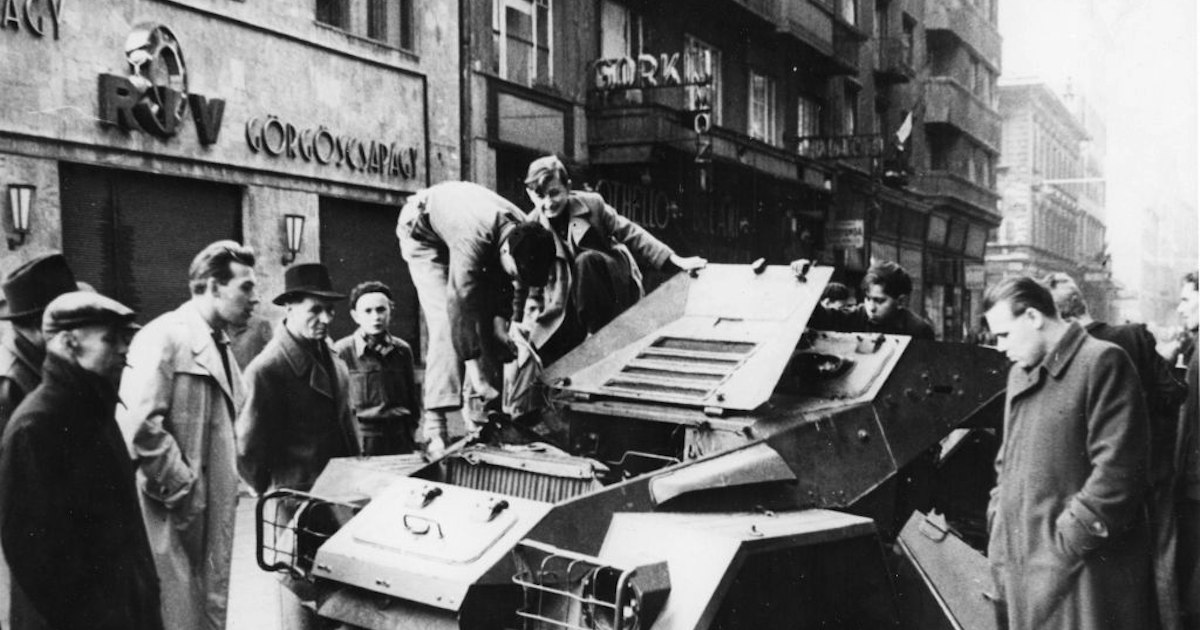
History Its tortured history reminds us of the fragility of liberty. Photo by United States Information Agency/PhotoQuest/Getty Images Seven decades ago, the Soviet Union launched Operation Whirlwind, crushing the Hungarian Revolution, which had overthrown communist rule. Reformer Imre Nagy led the country in its fight against Soviet control. For that he paid with his life. However, popular commemoration of his role in 1989 spurred the collapse of communism not just in Hungary, but throughout Eastern Europe and in the Soviet Union as well. Hungary’s agony, like that of so many of its neighbors, was rooted in the First World War. The Austro-Hungarian Empire was allied with Wilhelmine Germany and collapsed as the Great War proceeded to its devastating conclusion. Hungary emerged as an independent state but lost much of its territory. It suffered through a brief spell of social democratic governance, an even briefer dalliance with Soviet-style communism, and then extended, semi-fascist rule under Miklós Horthy, who served as “regent” to the vacant monarchy. Unfortunately, the latter sought to reclaim lost territory by joining the Axis invasion of the Soviet Union. By 1943 he was looking for an exit, only to be ousted by the fascist Arrow Cross Party, whose control lasted just five brutal months, before the Red Army overran the country. People voted against local communists, but Moscow decided the issue otherwise, leading to the creation of the Hungarian People’s Republic in August 1949 under Mátyás Rákosi. Tens of thousands of Hungarians were arrested and imprisoned, with some sent to the Soviet gulag. Despite the Soviet occupation, proud patriotic people throughout Eastern Europe chafed at alien communist rule. Some subject populations grew not just discontented, but violent. Hungary proved the most dramatic case. In July 1956, the hardline Rákosi was ousted. But swapping oppressive communist dance partners was not enough for the Hungarian people. On October 23, some 20,000 students gathered in Budapest to demand change. As they marched their numbers swelled tenfold. Many protesters waved Hungarian flags from which they had excised the communist coat of arms. Along the way they downed an 82-foot monument of Joseph Stalin “gifted” to them five years before, when the Soviet dictator still ruled. Rákosi’s successor, Erno Gero, rejected their demands and called for Soviet intervention. János Kádár replaced him, and Imre Nagy, a reform communist, reclaimed his position as premier. Red Army units, after sporadic combat, withdrew from Budapest, and revolutionaries targeted former communist security personnel. Nagy declared Hungary’s neutrality and withdrawal from the Warsaw Pact. However, on October 31 the Soviet leadership decided to intervene. Red Army units returned to Budapest on November 4 and were opposed by much of the Hungarian army—most soldiers backed the revolution—and civilian irregulars. It took the Soviets a week to seize the capital. Elsewhere, including in the industrial city of Dunaújváros, revolutionaries held out longer. An estimated 2,500 Hungarians were killed, including more than 1,500 civilians caught in the fighting. Some 20,000 were injured. The Soviets anointed Kádár as their man in Budapest, and he unleashed a brutal wave of repression. The regime executed Nagy and another 228 revolutionary leaders, as a lesson to all other leaders in socialist countries, it was said. The Communist Party and army were purged. Some 22,000 Hungarians were imprisoned. More than 200,000 fled, crossing the then-open border. (Many ended up in America.) Over the years, Kádár built a system of “Goulash Communism,” which offered modest economic reform combined with continued political repression. However, as elsewhere in Eastern Europe, by the 1980s the population was increasingly restive. The rise of Mikhail Gorbachev in the Soviet Union made change possible. In 1988 Kádár was forced into retirement. Several reform communists came to the fore. Reported the Christian Science Monitor: The idea was taboo only a few months ago, something so removed from reality as to never come up even in private coffeehouse conservations. Now it is front page news in the official press. The idea is nothing less than transforming this East European communist country into a multiparty democracy. Some leading Hungarian communists say the switchover could come within two years. Most others put the change in the more distant future. Either way, the mere fact that a Communist Party is considering the possibility of opposition parties and free elections represents an unprecedented development in this part of the world, showing just how far the example of the Soviet Union’s glasnost (openness) and perestroika (restructuring) has stretched the limits of the possible. “Reform is moving so fast here, sometimes I can’t believe it,” says Ivan Lipovecz, editor-in-chief of the respected HVG weekly. “It’s all of a sudden like a dam burst.” The second revolution came even more quickly than expected. The following year the increasingly assertive opposition organized a ceremony on the 31st anniversary of Nagy’s execution to rebury him and four of his colleagues with full honors. The revolutionaries had been placed in unmarked graves to prevent even informal commemoration of their sacrifice. In 1988, the police had violently dispersed a small public tribute to the dead. As reform pressure increased, the communist leadership split over whether to honor the 1956 revolutionaries. Károly Grósz, Kádár’s successor, refused to rehabilitate Nagy, but politburo member Imre Pozsgay, a radical reformer, called the revolt a “popular uprising.” The regime agreed to allow reburial of the dead. Pozsgay and three other liberal party leaders attended in their capacity as government ministers. On June 16, 1989, at least 100,000—some estimates were double that number—people witnessed the observance, which was the first time that the revolutionaries’ families could mourn openly. Reported the New York Times: “Many in the crowd looked up in shock and seemed to be holding their breath to hear at so public a ceremony, in so sumptuous a setting, words of such astonishing candor. The Government network televised the ceremony live.” Playing a major role was 26-year-old Viktor Orbán, then spokesman for the Federation of Young Democrats and later prime minister. He lauded Nagy for having “identified himself with the wishes of the Hungarian nation to put an end to the Communist taboos, blind obedience to the Russian empire and with the dictatorship of a single party.” Orbán went on to criticize the communist reformers as latecomers to the cause: “We cannot understand that those who were eager to slander the revolution and its prime minister have suddenly changed into great supporters and followers of Imre Nagy,” Orbán said. “Nor can we understand that the party leaders, who made us study from books that falsified the revolution, now rush to touch the coffins as if they were charms of good luck.” Subscribe Today Get daily emails in your inbox The ceremony had no formal political impact. However, the party abandoned plans to declare martial law, unsure of the military’s willingness to fight against its own people. After the government tore down the electrified border fence with Austria, the regime’s weaker version of the Berlin Wall, the infamous Iron Curtain was no more. Since residents of the Soviet satellite regimes could travel freely within the bloc, Budapest’s decision triggered a flood of refugees, especially from East Germany, undermining the other Soviet satellite regimes, which all fell before year’s end. The Hungarian people proclaimed the third Republic of Hungary on October 23, 1989. Soviet troops went home early the following year. Permanently. With ever more Americans bizarrely rating “socialism” favorably today, we should remember the high price paid by Hungarians to escape real socialism. Hungary’s tortured history reminds us of the fragility of liberty. Tragically, the Hungarian people lost their battle for freedom 70 years ago. However, their loss planted seeds for the ultimate destruction of Moscow’s satellite system and Europe’s liberation from communism.
Hungary’s Lesson: Beware the Dangers of Socialism
Full Article
Original Source
Read the full article at Theamericanconservative →KhanList aggregates and links to publicly available news content. We do not host full articles from third-party sources. Always verify important information with original sources.