
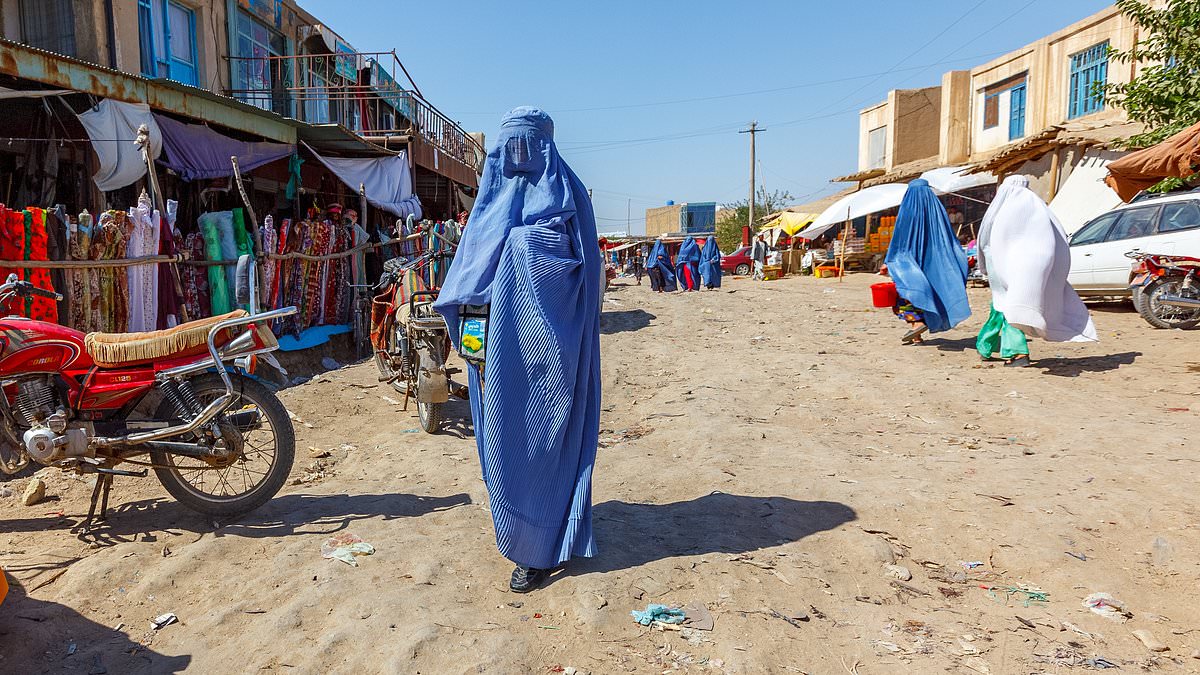
Hundreds of Afghans have been detained for sporting Western haircuts, trimming their beards and violating face-covering rules as part of the Taliban's latest brutal crackdown. At least 443 arrests were carried out by the Taliban's morality police from July to September, according to a new United Nations report. The detentions were mainly linked to alleged violations of the Taliban's rules surrounding men's hair and beards and women's dress codes. In one case, two barbers were detained for a month in August for allegedly trimming men's beards and giving their customers 'Western' haircuts. The UN also documented more than 50 instances of Taliban morality police arresting, detaining or cautioning women - including young girls - accused of violating face-covering requirements over the same period. On July 10 in the city of Herat, morality police detained 10 women for not wearing chadors - a large, full-body cloak worn by some Muslim women. Separately, a 13-year-old girl was detained overnight for not complying with hijab requirements, while a man was detained because his 12-year-old daughter was not wearing a burqa.The crackdown also targeted people who failed to attend prayers and played or listened to music, according to the report. Pictured: An Afghan woman wearing a burqa walks along a market in Andkhoy, Faryab Province, northern Afghanistan File image: A Taliban security personnel stands guard outside a mosque in KabulThe newly reported figures come as the Taliban has been ramping up its psychological abuse in Afghanistan in a bid to enforce its strict Sharia law rules. Last month, around 16 Afghan women and girls were rounded up and dragged into a van by female morality police. Footage showed a woman - believed to be a Taliban official - attempting to force another woman into a vehicle. The detained woman could be seen resisting, while a male Taliban officer and several more women watched from inside the van. The reason for the arrests was unclear, but it came a month after the Taliban rounded up at least nine women in the city of Herat, despite them all wearing hijabs. According to a Herat resident, women are becoming increasingly afraid to leave their homes, telling US-based Afghan broadcaster Amu TV: 'They harass women everywhere under the pretext of enforcing morality. 'Women are being detained, intimidated and subjected to psychological abuse, yet no one is listening.' Since returning to power in August 2021, the Taliban has steadily expanded restrictions on women and girls – including bans on secondary and university education, limits on employment and increasingly strict regulations governing their appearance and movement in public.Herat, long regarded as one of Afghanistan’s most socially and culturally vibrant cities, has undergone significant changes.The human rights arm of the UN delivered a damning assessment of conditions in Afghanistan in a report released in March, warning that life for ordinary Afghans, especially women and girls, has severely worsened under the Taliban.Presenting the report, UN Human Rights chief Volker Türk said: 'The cascade of edicts and laws announced by the authorities since coming to power in 2021 is having a crushing impact on the Afghan people, particularly women and girls.'Women remain excluded from all education above primary school age, following a ban on higher education since December 2022.In November 2025, medical graduation examinations were held without the participation of women for the second consecutive year, after having been banned from medical institutes since December 2024.Women deemed not to be complying with the chador requirement – the traditional Islamic full-body cloak – have been removed from public transport and denied access to public markets and services.Meanwhile, a new law demands that girls wait until puberty before seeking to get out of a marriage, and also requires mediation for women seeking to escape an abusive husband.'The authorities have, in effect, criminalised the presence of women and girls in public life,' Mr Türk said. 'Discrimination affects their healthcare, their access to civic space, and their freedom of movement and expression.''Afghanistan is a graveyard for human rights,' he concluded.
Hundreds of people including children are detained by Taliban for 'Western' haircuts, trimmed beards and failing to wear the burqa
Full Article
Original Source
Read the full article at Dailymail →KhanList aggregates and links to publicly available news content. We do not host full articles from third-party sources. Always verify important information with original sources.