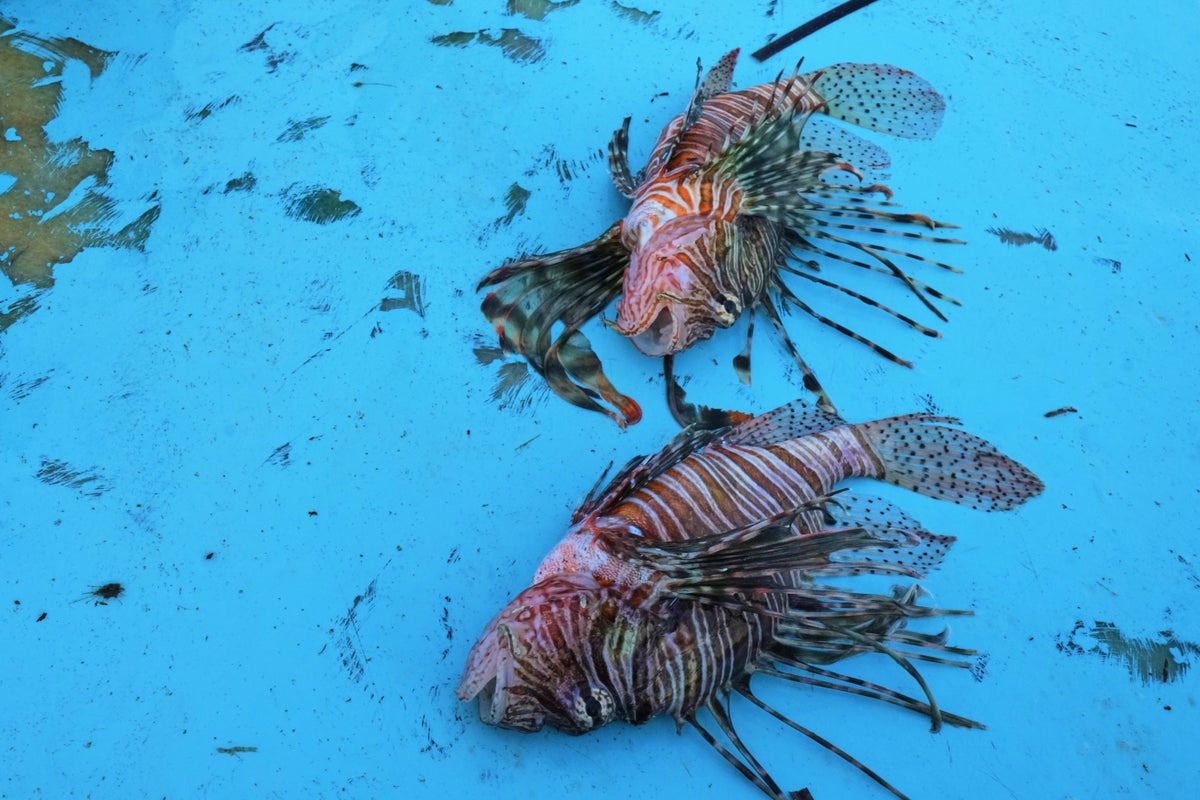
The Mediterranean sea is changing - and we won’t be able to reverse it.Hundreds of invasive new species are flooding the sea thanks to warmer waters caused by climate change, killing fish that were there first. The sea is now an inviting new home for invasive species like the spotted puffer fish, a voracious predator and the ‘worst invader’.These species are now heading toward France and Spain after entering the Mediterranean through the Suez Canal.Pufferfish, a warm-water invasive species, were first spotted in Greek waters some 20 years ago and are wreaking havoc with the country's fishing industry (AFP/Getty)Scientists say climate change, caused mainly by burning oil, coal and gas, is making the Mediterranean Sea hotter.As biodiversity diminishes, coastal communities will struggle to make ends meet in the ways they’ve known for generations.“The Mediterranean of our grandfathers, of our elders, and of the Greeks, of ancient Greece is lost forever. So many of those changes are irreversible,” said Ernesto Azzuro, a marine biologist with the Italian National Research Council's Institute for Marine Biological Resources and Biotechnology.Climate Mediterranean Sea Hotter Waters (Copyright 2025 The Associated Press. All rights reserved)Scientists have designated the Mediterranean as a climate change “hot spot,” with its waters expected to warm by 2 to 6 degrees Celsius (3.6 to 10.8 degrees Fahrenheit) by 2100. Heat waves are likely to become more frequent and more extreme, according to the Mediterranean Experts on Climate and Environmental Change, an independent network of scientists.Ronan McAdam, an oceanographer with the Euro-Mediterranean Center on Climate Change, said a key factor in the warming is that the sea is an enclosed basin and warmth can’t dissipate like in the vastness of the oceans.The U.N. food and agriculture body’s General Fisheries Commission for the Mediterranean said such invasive species have been present for decades, but their spread accelerated after the early 2000s, coinciding with rising sea temperatures. For example, the lionfish was first recorded in the eastern Mediterranean in 2012 and has expanded rapidly westward.“The Mediterranean will be even poorer, even with less species, simply because climate change is really making this part of the Mediterranean, especially the eastern part of the Mediterranean, really unsuitable for native species,” Azzuro said.Cyprus, due to its proximity to the Suez Canal, was first to feel the impact of these invasive fish. Lionfish supplanted indigenous stocks like the red mullet to the dismay of fishers, who have seen local varieties popular with customers greatly diminish.Then there are rabbitfish that can devour algae from the sea bottom, destroying the habitat for many indigenous species."We know what should be done. We should reduce the use of fossil (fuels)," said Piero Genovesi Papik, a zoologist with Italy’s Higher Institute for Environmental Protection and Research. “But that’s definitely an urgent matter for the humanity, and we all know the solutions, but of course they require a global and joint vision.”Climate Mediterranean Sea Hotter Waters (Copyright 2025 The Associated Press. All rights reserved)Azzuro said about 1,000 invasive species have been identified in the Mediterranean, with 800 of them firmly established.The changes are stark. Azzuro said the shallows of the eastern Mediterranean have lost 93% of their mollusk population. Along the Adriatic coast, once abundant with mussels, nearly all have died off because of the sea temperatures that at times have exceeded 30 degrees Celsius (86 degrees Fahrenheit).From Venice in the north to Bari in the south, “the die-off was spectacular,” he said. “Unless we … find population able to survive through these different climates, the future of mussels is not a happy future, at least in the Adriatic Sea.”Azzuro said his institute and its partner a few years ago launched a campaign, “Beware of those four,” to raise awareness about the dangers that invasive species pose to human health.For instance, puffer fish is toxic and potentially lethal if consumed by humans. The lionfish's poisonous spikes can badly hurt anyone who’s stung.Experts say the spread of invasives can't be reversedScientists are discussing how coastal communities can cope. One way is to commercialize invasive species that are edible. Another is to pay fishers to catch inedible ones like the puffer fish so they can be incinerated. Some species, like the lionfish, have “clear economic benefits because it’s sold at very high prices, especially in some countries,” Azzuro said. But fishers haven’t taken advantage of the invasive dusky spinefoot, whose population has grown significantly in Italian waters.Papik, the zoologist, said that while it’s “too late” to reverse the spread of invasive species in the Mediterranean, there are practical ways to mitigate the impact.Climate Mediterranean Sea Hotter Waters (Copyright 2025 The Associated Press. All rights reserved)First is to prevent their further migration by enforcing an international treaty obliging national authorities to treat ballast waters inside incoming ships that may carry such species.“This is something that is technically doable and that can reduce the number of ... new alien species by 95 to 99%,” he said. Another tactic is treating ship hulls with special paint that thwarts unwanted hitchhikers from latching on.Papik also said fishing policies are being amended that would allow native species to reclaim some of their number, like growing mollusks that are less susceptible to the alien blue crab.“In the coming years, I think that the challenge will be to restore, to find new ways to restore the environment,” Papik said.
Hundreds of invasive species are flooding the Mediterranean – and they are traveling north
Full Article
Original Source
Read the full article at Independent →KhanList aggregates and links to publicly available news content. We do not host full articles from third-party sources. Always verify important information with original sources.