
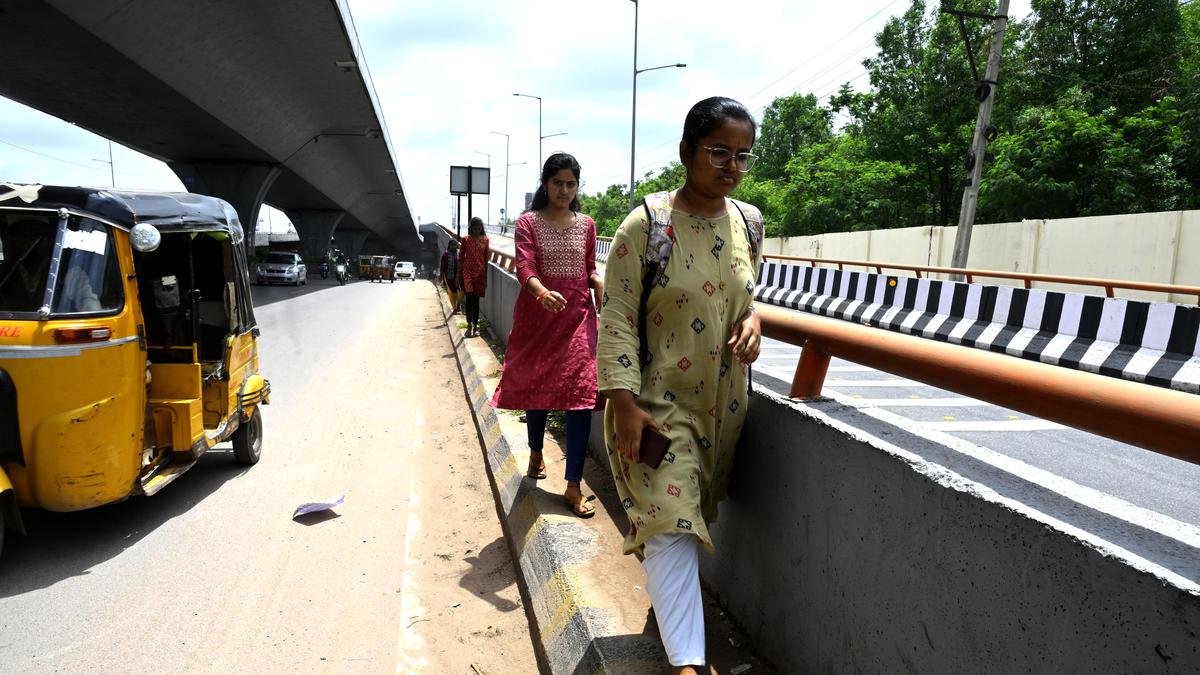
Pedestrians walk along the narrow roadside beneath an elevated flyover in Attapur in Hyderabad on August 1, 2026. Hyderabad Unified Metropolitan Transport Authority plans to restrict people from spilling over onto the roads through design intervention. | Photo Credit: NAGARA GOPAL Hyderabad is set to become a pedestrian friendly city by 2050. This was the plan laid out by B. Jeevan Babu, Managing Director of the Hyderabad Unified Metropolitan Transport Authority during the four-day Indian Roads Congress. For that date on the horizon, 120 locations have been identified for skywalks, Foot over Bridges (FoB) and other pedestrian infrastructure facilities. Gaps in pedestrians infrastructure being examined“The Comprehensive Mobility Plan for 2050 is nearing completion. Its scope includes assessing pedestrian infrastructure gaps and demand, walking access to [Hyderabad] Metro, MMTS, bus stops and terminals, road safety and pedestrian crashes, links to land use and activity centres, and investment priorities. The final report is expected in one or two months,” said Mr. Jeevan Babu, showing a presentation that showed the gaps and fixes proposed.A few corridors for initial changes“We have road space, but that is not properly used. The usability is divided. Pedestrian issues with roads are not properly addressed and vehicular movement is dominating the road. So, we are planning to have space for all. This will create development of roads hierarchy and usage. We have identified a few corridors for the initial changes,” he said.A few locations which are nightmare for Hyderabad pedestriansHe shared two locations that are a logistical nightmare for pedestrians in Hyderabad: the Secunderabad Station and Rathifile Bus Station area, and another at JNTU and Lulu Mall area. Two other locations where skywalks are planned include the coaching centres zone in Dilsukhnagar and the IT workplaces in Hitec City.1-km skywalk to connect Metro, railway and bus stations in SecunderabadThe intervention in Secunderabad — a 1-kilometre skywalk — will bring about an integration of the Secunderabad East and West Metro Station, the railway station and the three bus stations of Secunderabad, Rathifile and the Uppal bus station in the area. It will provide a continuous elevated pedestrian corridor reducing the number of people crossing the road and risking their lives.“So, this is a concept of multimodal integration. This is to actually encourage people to use pedestrian infrastructure to reach from the railway station to their destination. And we are restricting people from spilling over onto the roads through design intervention,” he said giving an outline.2.63 km intervention in KukatpallySimilarly, the intervention in Kukatpally, albeit a longer one at 2.63 km, will connect the JNTU Metro station, JNTU campus and the neighbourhood commercial zones of Rythu bazaar and Lulu Mall.“Rapid urbanisation and increasing vehicle ownership have created significant pedestrian safety and congestion challenges at major commercial and office zones like L.B. Nagar, Dilsukhnagar, Hitec City and Ikea Hyderabad. Existing pedestrian infrastructure is inadequate, resulting in unsafe at-grade crossings, traffic conflicts, and poor first-and-last mile connectivity,” said Mr. Babu.Along with these interventions, new parking police, street design guidelines, multi-modal integration guidelines are also on the anvil.“Ultimately, the vision and goal is to transform Hyderabad into an economically competitive, world-class, quality city with public transport-first approach and appropriate non-motorised transport facility for everyone,” said Mr. Jeevan Babu. Published - November 25, 2026 12:50 pm IST
HUMTA promises space in Hyderabad for pedestrians, other road users by 2050; identifies 120 locations for skywalks, FoBs and other infra
Full Article
Original Source
Read the full article at Thehindu →KhanList aggregates and links to publicly available news content. We do not host full articles from third-party sources. Always verify important information with original sources.