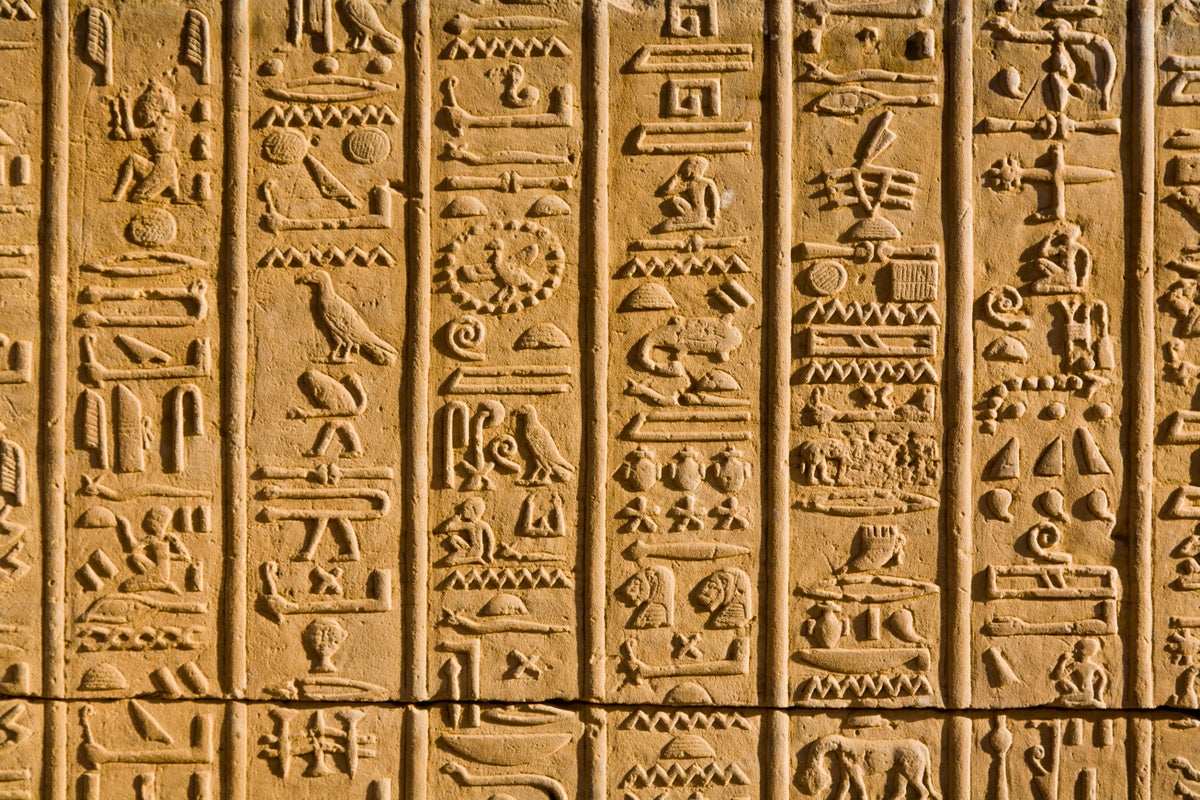
Humanity’s ‘golden age’ of language may have occurred 2,000 years agoDuring a lost ‘golden age’ of language, humans may have spoken tens of thousands of different tongues, a new study suggestsHieroglyphs from the Temple of Kom Ombo in Egypt. Stuart Dee/Getty ImagesOur planet’s inhabitants speak more than 7,000 languages, each a unique repository of knowledge, culture and history. But today’s linguistic diversity may be only the shadow of a time when humans conversed in 10 times as many tongues.For two millennia, from 1000 B.C.E. to C.E. 1000, our planet was a veritable Tower of Babel, according to a study published today in Science. During that brief “golden age,” as the authors put it, the number of languages soared into the tens of thousands. Then a rapid decline set in, possibly driven by the rise of hegemonic, multinational states such as the Roman Empire. “You have this slowly brewing linguistic and cultural diversity,” says the paper’s lead author Damián Blasi, who studies language evolution at Harvard University. “At some point, a few of these [languages] explode, and they wipe out everything that’s around them.”Because most ancient languages left no record, Blasi and his team reconstructed their history indirectly. The researchers began with the start of the Holocene, 12,000 years ago, when, experts estimate, the global population was between about four million and seven million. Assuming that hunter-gatherer groups were roughly the same size then as they are now and that each group spoke its own language, there were likely 5,000 to 6,000 languages worldwide.On supporting science journalismIf you're enjoying this article, consider supporting our award-winning journalism by subscribing. By purchasing a subscription you are helping to ensure the future of impactful stories about the discoveries and ideas shaping our world today.To trace the path of linguistic diversity from that moment to the present, Blasi’s team computationally modeled thousands of possible trajectories. A clear pattern emerged across the different models: As agriculture allowed the world to support more people, the number of languages steadily grew to a peak of between 20,000 and 75,000 tongues around 2,000 years ago before entering a plummet that continues today—every few weeks, a language follows its last speaker into the grave.Though the current rate of language death is often attributed to the past 500 years of colonial expansion, which often sought to eliminate Indigenous languages entirely, this study suggests that the first large-scale societies had a similar homogenizing effect. “It takes much less than a colonial powerhouse to destroy linguistic diversity,” Blasi says.Linguists tend to assume that the languages we speak today reflect the sounds and grammatical structures that human brains or bodies can accommodate. But if our sample is limited to a sliver of what once existed, Blasi says, who knows how many linguistic possibilities we’re missing? “I think this hints at a potentially much richer and more exotic phenotype of language,” he says.Still, not everyone buys the “golden age” scenario. Lyle Campbell, a linguist at the University of Hawaii, who was not involved in the study, says Blasi’s team is “grappling with stuff in the remote past that is hard to get a solid purchase on.” Many variables, such as how large ancient ethnolinguistic groups were and how agriculture influenced them, are impossible to establish with certainty. While this research “may even be on the right track,” Campbell says, it’s “highly speculative.”Assuming legions of languages did coexist, it’s also unclear whether neighboring ones would have been truly distinct. Johanna Nichols, a linguist and a professor emerita at the University of California, Berkeley, who was also not involved in the new paper, argues that as so many small communities butted up against one another, their speech may have shaded into an amorphous web of mutually intelligible dialects. “In a world with few people and [language] varieties that overlap and mingle,” she says, “it’s just a big continuum.”It’s Time to Stand Up for ScienceIf you enjoyed this article, I’d like to ask for your support. Scientific American has served as an advocate for science and industry for 180 years, and right now may be the most critical moment in that two-century history.I’ve been a Scientific American subscriber since I was 12 years old, and it helped shape the way I look at the world. SciAm always educates and delights me, and inspires a sense of awe for our vast, beautiful universe. I hope it does that for you, too.If you subscribe to Scientific American, you help ensure that our coverage is centered on meaningful research and discovery; that we have the resources to report on the decisions that threaten labs across the U.S.; and that we support both budding and working scientists at a time when the value of science itself too often goes unrecognized.In return, you get essential news, captivating podcasts, brilliant infographics, can't-miss newsletters, must-watch videos, challenging games, and the science world's best writing and reporting. You can even gift someone a subscription.There has never been a more important time for us to stand up and show why science matters. I hope you’ll support us in that mission.
Humans may have spoken 10 times as many languages 2,000 years ago
Full Article
Original Source
Read the full article at Scientificamerican →KhanList aggregates and links to publicly available news content. We do not host full articles from third-party sources. Always verify important information with original sources.