
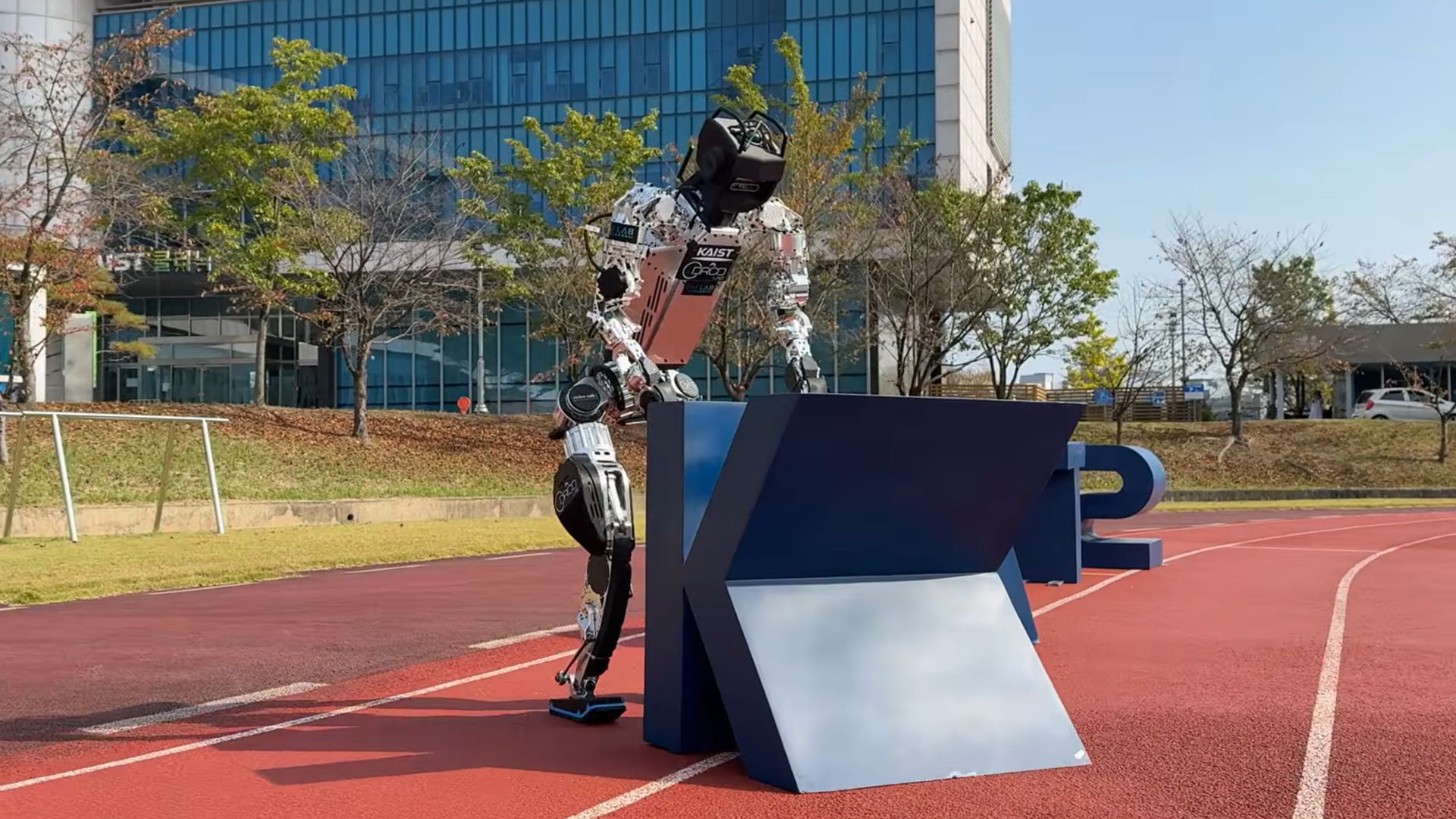
Researchers at the Korea Advanced Institute of Science & Technology (KAIST) have demonstrated an updated version of their humanoid robot, showing its ability to handle heavy objects using visual feedback. The Humanoid v0.9 robot can push objects weighing up to 77.2 pounds (35 kg) and lift loads of up to 44.1 pounds (20 kg), according to a demonstration released on October 19. The demonstration highlights the team’s efforts to improve humanoid manipulation through learning-based control methods and visual feedback during physical interactions with objects. Recently, KAIST researchers showcased a humanoid robot capable of advanced lower-body movements, including high-speed running and Michael Jackson’s iconic Moonwalk. Humanoid masters manipulation KAIST’s Humanoid v0.9 combines whole-body movement with object manipulation, demonstrating the ability to push objects weighing up to 77.2 pounds (35 kg) and lift loads of up to 44.1 pounds (20 kg). The demonstration shows the robot using onboard visual feedback to arrange objects into the letters “KAIST.” Developed by KAIST’s Dynamic Robot Control & Design Laboratory (DRCD Lab) in collaboration with RAILAB, which developed its arms, the platform integrates locomotion, manipulation, and learning-based control. The new video, titled Whole-Body Locomanipulation with KAIST Humanoid v0.9, focuses on how the robot coordinates its body and arms while interacting with objects. Rather than treating walking and manipulation as separate tasks, the approach brings them together so the robot can move its body while applying force through its arms. According to the team, the coordination is important because pushing or lifting an object changes the forces acting on a humanoid’s body. Pushing a heavy load requires the robot to maintain balance while applying force, whereas lifting requires it to support the object’s weight and control its posture throughout the movement. The robot’s onboard visual feedback provides information about the objects and their positions during these interactions. In the demonstration, it uses this feedback while arranging objects to spell “KAIST.” The task combines visual perception with physical interaction, requiring the robot to adjust its movements as it handles the objects. The pushing and lifting capabilities represent two distinct aspects of its manipulation performance. During pushing, the force required to move an object depends on factors such as friction and the surface on which it rests. Lifting, by contrast, requires the robot to support the object’s weight directly. These figures therefore should not be treated as interchangeable measures of payload capacity. The demonstration establishes the loads handled in the showcased tasks, but does not provide enough information to determine the robot’s maximum sustained lifting capacity or performance under different operating conditions. Learning-based control KAIST says the robot’s interaction skills were developed using deep reinforcement learning and learning from human demonstrations. These methods provide different approaches to developing robot behavior, allowing researchers to train control policies through experience and use demonstrations to guide how tasks are performed. Deep reinforcement learning trains a control policy through repeated interactions with an environment and performance feedback. In humanoid robotics, this approach can help develop coordinated movements that account for the robot’s body dynamics and interactions with external objects. Learning from human demonstrations offers another way to develop skills by using examples of how a task should be performed. The KAIST update combines these learning approaches with onboard visual feedback to support object manipulation. However, the available demonstration does not specify the training setup, how responsibilities the divided between the learning methods, or the precise control architecture used during execution. It also does not show whether the robot can reliably perform the same tasks across different objects, surfaces, and environmental conditions. The latest update builds on KAIST’s earlier Humanoid v0.7 platform, which highlighted high-speed locomotion and movements such as Michael Jackson’s Moonwalk. The v0.9 demonstration shifts the focus toward physical interaction, showing how the platform can combine movement with the application of force to external objects.Get the latest in engineering, tech, space & science - delivered daily to your inbox.Jijo is an automotive and business journalist based in India. Armed with a BA in History (Honors) from St. Stephen's College, Delhi University, and a PG diploma in Journalism from the Indian Institute of Mass Communication, Delhi, he has worked for news agencies, national newspapers, and automotive magazines. In his spare time, he likes to go off-roading, engage in political discourse, travel, and teach languages.
Humanoid robot pushes 77-pound loads and lifts 44 pounds in new demo video
Full Article
Original Source
Read the full article at Interestingengineering →KhanList aggregates and links to publicly available news content. We do not host full articles from third-party sources. Always verify important information with original sources.