
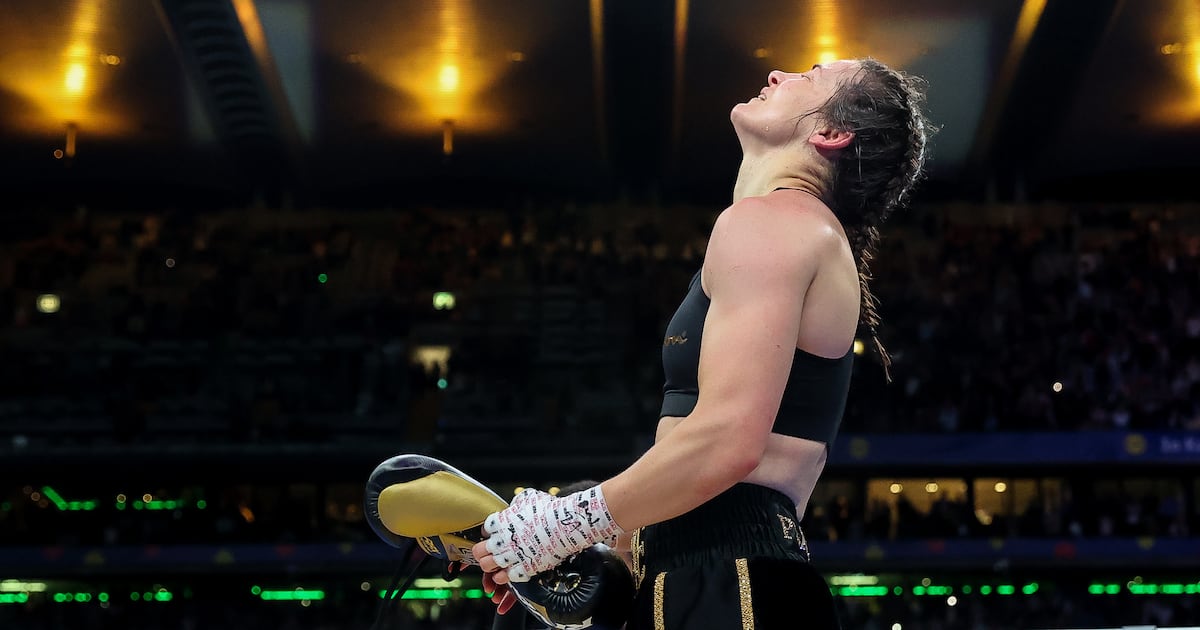
A couple of years ago, I went to a community meeting called to discuss how the suburb where I live might mark its centenary. A number of themes were suggested for exploration and debate. Among them were family stories, the role of sport, the changing environment and the place of religion. There seemed to be little or no appetite for discussing religion among those present, who ranged in age from their 20s to their 70s. This was despite the fact that, to judge by the photographic record, public displays of faith had been central to life in the area for its first 60 years or so. Processions, novenas and visits by bishops didn’t just figure large. They predominated.I am not a Christian, but this willed amnesia seemed faintly chilling. Derek Scally explored it in his book, The Best Catholics in the World, arguing that when the authority of the institutional Catholic Church collapsed, Irish people walked away from it without reckoning with the culture that had given it such power, or with their own place in that culture. What remains, in some quarters at least, is at best an ambivalence or at worst a deep discomfort about public professions of faith, which have all but disappeared from the language of mainstream politicians and civic leaders.It’s this history which gives modern Irish secularism much of its particular flavour. The British sociologist Grace Davie once described her compatriots as believing without belonging, holding on to a private faith while drifting away from the churches. Irish Catholicism long worked the other way round. It was about belonging far more than believing. So when people left, many walked away from an institution rather than from beliefs they had ever examined closely. What such a culture never cultivated was a language for personal faith, which may be why talk of a relationship with God can still sound oddly foreign to some.READ MOREThree weeks ago, Katie Taylor gave thanks to God in front of 83,000 people at Croke Park at the end of the last fight of her career. Taylor has never been shy about her evangelical Christianity. Before every bout, she and her mother, Bridget, would recite a psalm together. But in 2018 she was quoted in The Irish Catholic as saying that Irish society was “open to everything except for God”.[ ‘What am I for?’ Katie Taylor faces the same retirement question we all do, just soonerOpens in new window ][ Parents of schoolchildren in Dublin and Cork back religious-ethos changeOpens in new window ]When Taylor won Olympic gold in London in 2012, John Waters, then a columnist with this newspaper, took Irish broadcasters and journalists to task over their handling of her. Whenever she mentioned Jesus, he said, her interviewers carried on as if the remark had not been made and quickly moved to safer ground. He was scathing, too, about the habit of describing her as “simple” and “humble”, which he read as a thinly veiled way of deprecating her beliefs. This was, he said, a symptom of a culture that had lost the capacity to take faith seriously.Is there something in the Irish Catholic mindset, lapsed or otherwise, that recoils from talk of a personal relationship with God? Or is there, as Waters suggested 14 years ago, a particular sort of cultural cringe among the secularised elites in the media and public life? Possibly a bit of both. Although there was no sign of the Croke Park crowd being anything other than enthusiastic when Taylor thanked God for her career.In fact, there is little evidence that Taylor’s professions of faith ever grated with the general public, who may recognise in them the same register they hear every weekend from Premier League footballers in Britain, NBA stars in the US and entertainers of every kind. From Pacific Island-born rugby players forming prayer circles after a match to US golfer Scottie Scheffler ranking faith above golf at Portrush last year, the language of born-again evangelicalism and affirmation of faith is a familiar feature of the pop-cultural and sporting landscapes.Irish society was never quite as monoculturally Catholic as some narratives suggest. Coverage of U2’s 50th anniversary this week has recalled that the band came together in a Church of Ireland school that took pupils of all faiths and none. [ U2 are sometimes dismissed as do-gooders, but the last 50 years have proven it is no actOpens in new window ]Three of the four members were deeply involved in Shalom, a charismatic Christian fellowship, to such an extent that they considered abandoning their musical careers in the early 1980s. Their faith coloured songs such as Gloria, but in interviews they mostly kept it at arm’s length, not surprisingly given how unfashionable such talk was in the post-punk world.U2 play their final gig at Mount Temple Comprehensive. Photograph: U2 Charismatic Christianity had an Irish history before it had an immigrant one. But immigrant communities have brought Pentecostal worship, loud, joyful and participatory, to converted warehouses, business parks and hotel function rooms across the country. Even so, talk of personal salvation may still raise queasy thoughts for some of born-again Protestantism and evangelical churches in Northern Ireland. Yet for younger generations, with no memory of Ian Paisley in full cry, the language of salvation is less likely to sound like a sectarian battle cry.There are other stirrings. Conor McGregor, responding to Taylor’s appearance on The Late Late Show last year, posted that Ireland was “forever Catholic”, apparently oblivious to the fact that she is not a Catholic at all. The episode would be risible were it not for its underlying tone of menace. The radical right in Europe and the United States has been eager to don the mantle of the church militant in pursuit of an anti-Muslim agenda.[ Dave Hannigan: Conor McGregor has found God, a severe case of the Russell BrandsOpens in new window ]As it happens, the three fastest-growing belief groups in Ireland in recent years have been Hindus, Orthodox Christians and those declaring they have no religion. People often discuss multiculturalism as if it were simply a matter of language and flags. For many, it is also a matter of faith. Immigrant communities in prosperous countries tend to be more religious than the societies that receive them. That is one reason London is now the most religiously observant region of Britain. Against that backdrop, cultural post-Catholic secularism often looks intellectually incurious and narrow-minded.While affirmations of personal faith have become part of the texture of some corners of modern Irish life, they remain conspicuously absent from others. Part of the reason may be that a society that has not made space to discuss the faith of its grandparents lacks the vocabulary to make sense of anyone else’s. Katie Taylor’s God was never going to be everyone’s. Still, when people tell us what they believe, the least we can do is listen.
Hugh Linehan: Is Ireland still a place ‘open to everything except for God’?
Full Article
Original Source
Read the full article at Irishtimes →KhanList aggregates and links to publicly available news content. We do not host full articles from third-party sources. Always verify important information with original sources.