
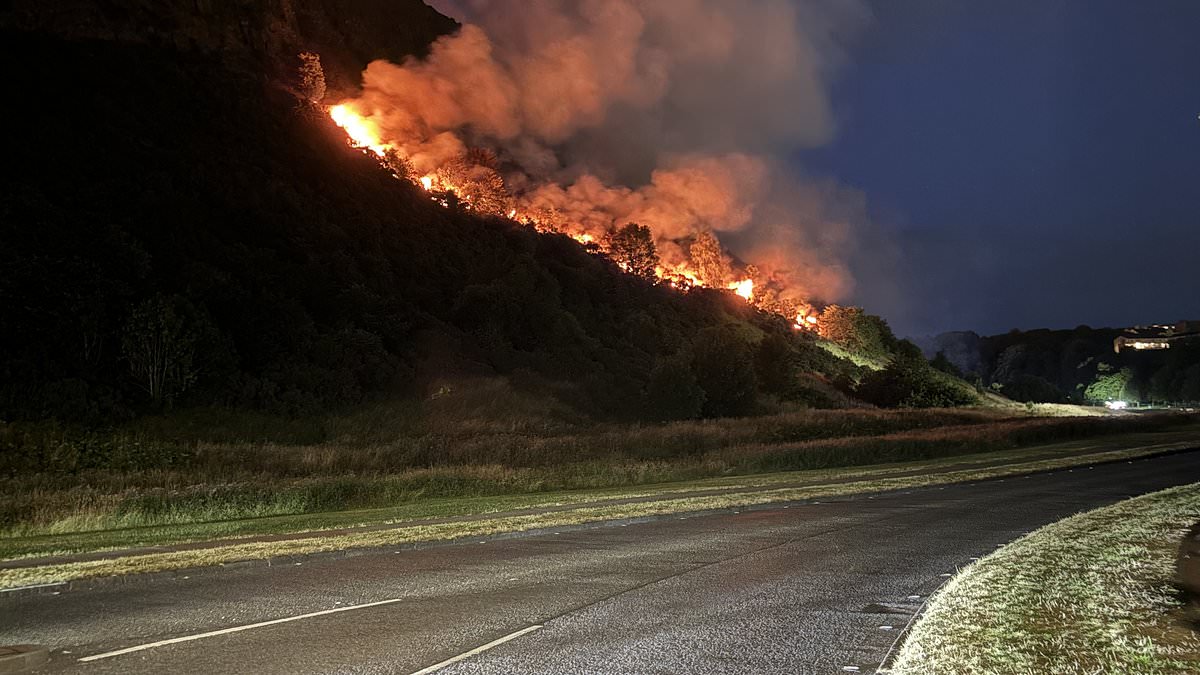
Fire crews are continuing to battle a blaze on Arthur's Seat in Edinburgh as tinderbox Britain reckons with the fury of the latest 'firewave'.More than 250 wildfires and grass fires have broken out across the country in the last two weeks thanks to bone-dry conditions.In Scotland's capital, at least six fire appliances were sent to Arthur's Seat, the large extinct volcano that overlooks the city, at 6.38pm on Sunday night.Emergency crews remain at the scene today, Police Scotland said, with locals advised to keep windows and doors closed. Queen's Drive, which encircles the beloved hillside, has been closed to traffic.Images from this morning showed much of the hillside had been scorched bare by the flames overnight, while fire crews are continuing to dampen down smouldering pockets of scrubland.Jon Henderson, of the Scottish Fire and Rescue Service, told BBC Radio Scotland that crews will likely remain on scene for several days.'The feeling from the ground there is that we will probably be there for a couple of days continuing to tackle it and dampen out hotspots,' he said.'Our focus at the moment is dealing with the fire and the response but there will be a full fire investigation.'The difficulty we have with wildfires is that they can be difficult to assess where they started because of the scale and sometimes these do happen naturally.'A fire broke out at Arthur's Seat in Edinburgh overnight (pictured), with several fire engines dispatched to tackle the flames Fire crews remain on the scene today and are likely to remain there until later this week to dampen down the smouldering scrubland Fire crews are also continuing to tackle a blaze at Glenmore in Scotland's Cairngorms National ParkIn the Cairngorms, emergency services have been battling a wildfire since Wednesday that they have been able to 'surround' as they battle to contain its spread.Homeowners have been evacuated over the course of five days as the blaze has decimated grassland at Glenmore, in the heart of the national park.Gavin Miles, of the Cairngorms National Park Authority, called the fire's containment 'very encouraging', though stressed that crews remain on the ground today, assisted by firefighting helicopters.Elsewhere, a huge firefighting operation remains underway on Tintwistle Moor near Glossop, where Derbyshire Fire and Rescue Service has been tackling a major moorland fire since 24 June.The blaze has affected around 260 hectares (642 acres) of land, and crews are likely to remain on the moor into later this week.At Rustic Stomp country music festival near Wareham, Dorset, some 43,000 square feet of heathland was destroyed in a blaze caused after a camping stove set fire to a tent.Dorset fire chiefs warned campers against using stoves, open fires and barbeques while 'conditions are so dry'.Promoter Jason Galaz said on social media: 'Big respects to the Wareham Fire Crew and to the community for an instant response. No one was hurt. Everyone got lucky, but it could have been a different story.'Don’t cook in dry fields. Don’t throw cigarettes. I don’t know yet what happened, but don’t do dumb s***.' A firefighting helicopter uses a bucket of water to tackle a wildfire in the Cairngorms in Scotland over the weekend A dramatic image released by Derbyshire Mountain Rescue Team shows the impact of the wildfires on Tintwistle Moor near Glossop Temperatures today are expected to reach no more than the mid-20s, granting Britons some mild respite after the third heatwave of the yearIt comes as temperatures continue to remain relatively high across Britain despite the easing of the third heatwave this year.In all, the country has sweated its way through 28 days of temperatures above 30C so far in 2026, with more expected to come.Experts have warned that the country's heatwaves are now perfect brewing conditions for wildfires as the climate breaches the so-called '30-30-30' rule: air temperatures over 30C, humidity below 30 per cent, and 30kmh (18mph) winds. A lack of rainfall - more than two weeks without a drop in central and south-east England - is turning fields and forests into prime kindling that could go up with the aid of an errant cigarette or barbecue ember.The National Fire Chiefs Council (NFCC) has urged people to avoid using disposable barbecues where possible, discard cigarettes safely, and take litter home.A spokesperson said at the weekend: 'Most wildfires are preventable... by making simple, responsible choices.'Next week, the Met Office says rain will reach some northern parts of the country but there are signs of high pressure that would signal a return to hot, dry conditions in the south. However, it has urged caution over predictions by the US National Weather Service's Global Forecast System that temperatures could climb back into the low 30s from July 27, to as much as 38C by the end of the month.Its own forecast covering 22 to 31 July nonetheless indicates temperatures are likely to remain above average, with the potential for further hot spells.And the forecaster has warned that temperatures of high 20s and into the 30s in summertime is now likely to be the new normal, rather than an errant phenomenon. Mike Kendon, a climate information scientist with the forecaster, issued the foreboding warning: 'We are right now living in a time of historic and unprecedented change... the climate of the 20th century has now gone.'
Huge inferno rips through Arthur's Seat in Edinburgh as 'firewave' grips Britain
Full Article
Original Source
Read the full article at Dailymail →KhanList aggregates and links to publicly available news content. We do not host full articles from third-party sources. Always verify important information with original sources.