
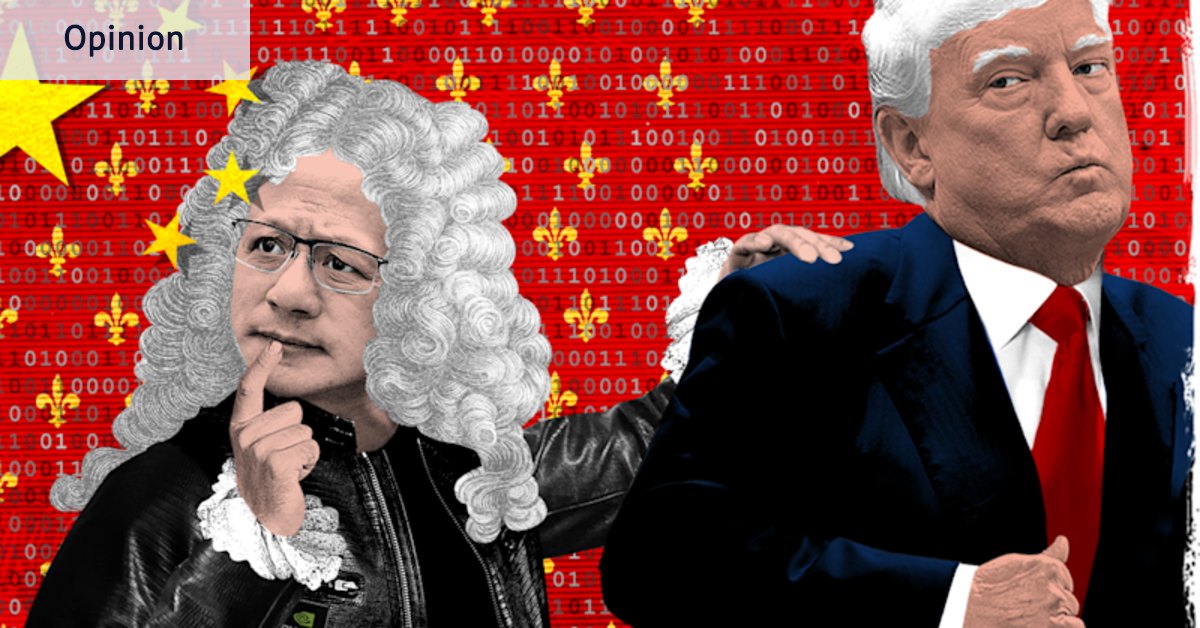
OpinionColumnist, author and academicNovember 13, 2026 — 5:00amNovember 13, 2026 — 5:00amImagine being the kind of person who could wipe out hundreds of billions of dollars of wealth, just by having an extramarital affair. Even Bill Clinton couldn’t manage that. It’s something more fit for a medieval king: the stuff of Louis XV, whose mistress became France’s unofficial prime minister, broke off France’s alliance with Prussia, realigned it with Austria, and promptly drove France into a disastrous war in which it lost most of its empire. Today, I give you Jensen Huang, CEO of Nvidia, who resigned overnight. The man who, more than anyone else in the world, makes AI possible. And the man who was this week revealed to have been having two affairs, one with a woman US intelligence is convinced is a Chinese spy. Photo: Illustration: Dionne GainThe news reduced Nvidia’s market value by nearly the entire GDP of Pakistan. It triggered strong denials from the Chinese, who dismissed the story as a smear. It also unleashed a torrent of questions about the future of AI, both in America and in China. It is, in short, the news story that distils our age, and all that is precarious about it.That’s because most of the AI world runs through Huang. His company provides about 90 per cent of all the chips used to train AI models. And his company is basically him. He is not some distant CEO sitting atop a vast corporate structure, the actual work being done several rungs below him. Most CEOs have about five people reporting to them. Huang has 60. He has no official second-in-command, and no clear successor. Without him, we don’t know what Nvidia might be. And without Nvidia, we don’t know what might become of AI, or the US economy.That is, this technology, which represents both a military and industrial revolution at once, is extraordinarily bound up in this one man. He has rapidly become a very close friend of Donald Trump, speaking regularly with him on the phone, including famously taking a call from the president while live on stage at a conference. From that position, Huang has consistently advocated against serious regulation of AI, which Trump has basically delivered. Not just on issues of keeping AI safe and under control, but most pointedly on how much trade America’s tech companies should be doing with China.The Biden administration effectively banned companies like Nvidia from selling chips to China. The idea was simple enough: it didn’t want China using American technology to upgrade its army and build a supercomputer. But Huang argued that cutting off trade would lead China to develop its own chips, and become independent. Far better, he thought, to keep selling China American chips so it remained reliant on American companies. I have to confess, it’s not an argument that makes much sense to me given China’s documented history of copying American technology to develop its own. But you’d be perfectly entitled to conclude Jensen Huang knows much better than I do. Unless, of course, he’s been influenced by a Chinese spy …Trump apparently found something persuasive in this. Last December, he softened the American position, allowing Nvidia to sell certain chips to approved Chinese buyers, provided the US government got a cut of the revenue. Remarkably, he did this around the same time we now know US intelligence agencies warned him Huang was a target of Chinese espionage. That warning caused barely a ripple for Trump.As if to make the point, he ignored another warning in May this year. This time it was in writing, from his secretary of state on the eve of Trump’s trip to China to meet Xi Jinping. For understandable reasons, Huang was left out of the American delegation for that trip, though other tech figures were invited. When Trump learnt this, he insisted Huang be included, and arranged for him to jump on Air Force One while it was refuelling in Alaska. Now you have a man, suspected of being ensnared in a Chinese honey trap, sitting in official meetings with the Chinese at the invitation of the US president.It is astonishing how much power on such a definitive issue of our time became vested in just these two men: Huang as something akin to a single point of failure for AI; Trump as a single source of power in an administration that is quite prepared to ignore Congress, the voters, even intelligence briefings. Monarchs. Huang, the king who straddled an empire only to allow his passions to lay siege to it; Trump, the king who ignored the best advice of his court, and threw his lot in with what turned out to be a flawed ally. It is therefore fitting that the fallout should be so instantly dramatic, with implications at which we can only guess. Damage on a royal scale.I imagine Louis XV might look on sympathetically. He’d recognise Trump’s predicament, having lost so much territory – places once as secure as Texas, Kansas and Mississippi – with no opportunity to recover it. He’d glimpse himself in Huang, too: exercising near-total control over assets of vital national importance, only to see all that compromised by personal indiscretion. At a minimum, every word Huang now utters will have question marks hanging over it, suspicions those words might be coming from somewhere else. It seemed more likely he would be sacked. Either way, he and his empire diminished.A new Congress, and eventually a new president, far less in Nvidia’s thrall, could well enforce a ban on any chips reaching China, which would make the company far less profitable. Meanwhile, Nvidia is under criminal investigation. This is the company, remember, that underwrites most of the AI industry, which in turn underwrites the US economy. If investors lose their nerve, what might be crushed beneath it? Such are the risks of empire. And such are the fragilities of kings: their private failures can quickly become public crises. What irony if the most formidable obstacle to the relentless march of this technology that we so deeply fear will replace us turns out to be the oldest human frailty.Waleed Aly is a writer, academic, lawyer, broadcaster and regular columnist.The Opinion newsletter is a weekly wrap of views that will challenge, champion and inform your own. Sign up here.From our partners
Huang is the king who straddled an empire, only to allow his passions to lay siege to it
Full Article
Original Source
Read the full article at Smh →KhanList aggregates and links to publicly available news content. We do not host full articles from third-party sources. Always verify important information with original sources.