
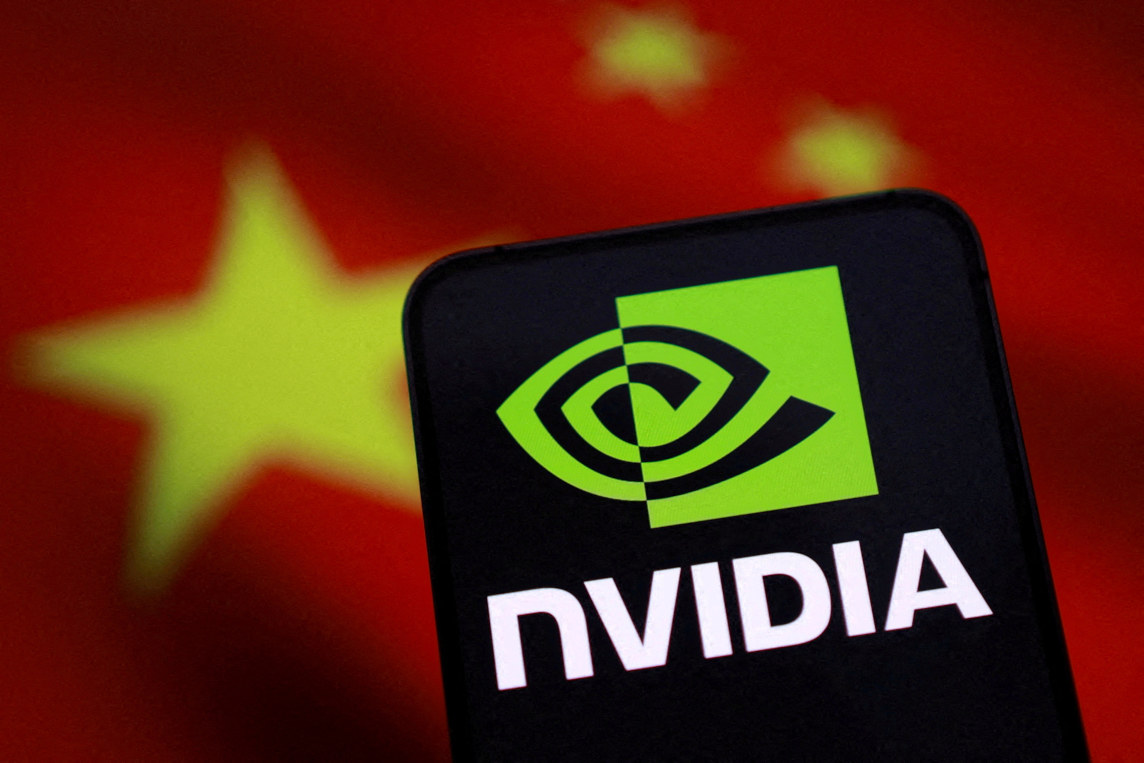
NVIDIA AND CHINA. The Nvidia logo and Chinese flag are seen in this illustration taken August 27, 2025. Dado Ruvic/Reuters The projects reveal the scale of continuing demand for Nvidia hardware even as Washington seeks to curb Beijing's access to the technology powering the global AI boom Nvidia claims US export controls have excluded it from China's AI data-center market, yet over $3 billion in Chinese projects utilizing its restricted processors have been identified. A review found that Nvidia technology is still deeply embedded in various Chinese sectors, including local government ventures and universities, despite the company's market share in China dropping to zero. The ongoing demand for Nvidia's technology raises concerns for Washington, as export controls tighten and scrutiny increases following the resignation of Nvidia's co-founder amid a scandal. This is AI-generated. Read the article for full context. Report any errors. BEIJING, China – Nvidia has said US export controls have effectively shut it out of China’s AI data-center market, but a Reuters review has identified more than $3 billion in Chinese computing projects built around the American chipmaker’s restricted processors. The projects, stretching from China’s wealthy coastal technology hubs to remote western provinces, reveal the scale of continuing demand for Nvidia hardware even as Washington seeks to curb Beijing’s access to the technology powering the global artificial-intelligence boom. The Reuters review examined more than 150 Chinese procurement notices, investment plans, construction contracts and corporate disclosures, identifying projects and equipment agreements with a combined reported value exceeding 23 billion yuan ($3.2 billion). The findings paint a detailed picture of how deeply Nvidia technology remains embedded in China’s AI expansion. They reveal the company’s technology reaches well beyond China’s largest tech firms, into local government-backed ventures, universities and regional computing centres. The estimate includes planned investments and signed contracts as well as completed installations. It covers buildings, power systems and other infrastructure, and does not reflect spending on Nvidia chips alone. China’s commerce ministry and Nvidia did not immedietely respond to Reuters request for comment. The findings come a day after Nvidia co-founder Jensen Huang resigned as chief executive amid a scandal over his relationship with a Chinese businesswoman suspected by US authorities of intelligence ties to Beijing. Huang, a vocal advocate of easing export restrictions, said last year Nvidia’s market share in China had fallen from 95% to zero. The company has also excluded China data-center computing revenue from its forecasts, citing regulatory uncertainty. That does not mean Chinese demand has disappeared. While Nvidia’s statements address its own ability to compete and sell directly in China, the documents Reuters reviewed show Chinese customers continuing to plan purchases and, in some cases, operating restricted processors. Sunny Cheung, an analyst at the Washington-based Jamestown Foundation, said Reuters’ findings reinforce his own view on enforcement: “Washington must stop focusing solely on who buys the chips on the surface and start examining who ultimately uses the computing power—and for what purpose.” Billions in the pipeline Across China, developers and institutions are advancing billions of dollars in AI data-centre projects designed around restricted Nvidia H100, H200, and H800 processors. These range from massive regional computing hubs to retrofitted commercial sites — such as a facility in northwestern Gansu province that was expected to install thousands of Nvidia chips before year-end, though it remains unclear if those processors ever arrived. While some facilities are already operational or under construction, operators are exposed to potential delays, supply disruptions, or costly redesigns around domestic chips as export controls tighten. Huang’s departure could deepen these vulnerabilities by weakening Nvidia’s lobbying leverage as US lawmakers press for tighter controls. Washington’s dilemma Washington began restricting Nvidia’s advanced AI processors in 2022 and subsequently tightened controls on modified chips developed for China, including the H800. In January, the Trump administration moved to review H200 export licences for eligible Chinese customers individually, subject to conditions. Nvidia’s August filing said it was effectively excluded from China’s data-center computing market. But an IDC report cited by Reuters in October estimated Nvidia still accounted for 34% of Chinese AI-accelerator shipments in the first half of 2026. The figures measure different things and do not establish how the restricted hardware identified in the Reuters investigation reached Chinese users. The scrutiny has intensified since Huang’s resignation on Thursday, following allegations involving Alice Huang, a former executive associated with Singapore-based Nvidia cloud partner Megaspeed. Megaspeed has denied illegally diverting Nvidia chips to China. Nvidia’s board launched an independent investigation, saying it had no reason to believe company secrets or US national security were compromised. There has been no public finding that Jensen Huang violated export-control laws. The Chinese projects identified by Reuters have not been linked to Megaspeed or the allegations involving Huang. – Rappler.com How does this make you feel? Loading
Huang exit, US scrutiny imperil $3 billion in Chinese AI projects reliant on Nvidia
Full Article
Original Source
Read the full article at Rappler →KhanList aggregates and links to publicly available news content. We do not host full articles from third-party sources. Always verify important information with original sources.