
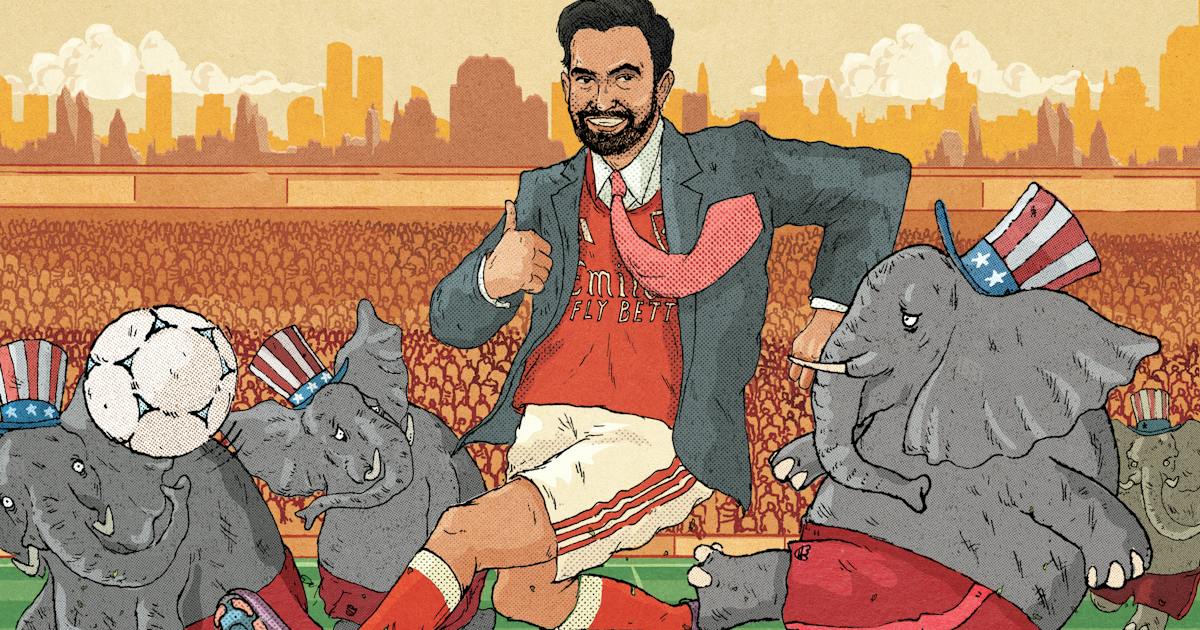
On a brisk late-October afternoon on Coney Island, the home field of the minor league, Mets-affiliated Brooklyn Cyclones was taken over by a more international pastime. Miniature soccer nets polka-dotted the baseball diamond as amateurs sent soccer balls streaking across the mosaic horizon of Luna Park’s usual attractions: the Wonder Wheel, the Cyclone, the Thunderbolt. They had come here to battle one another in the second Cost of Living Classic, a free-to-enter five-a-side soccer tournament hosted by the city of New York and its mayor—and die-hard fan of the English Premier League’s Arsenal FC—Zohran Mamdani.Players in the tournament were split into beginner and advanced divisions, then randomly assigned to teams with names like “Affordability Arsenal,” “Corruption Attackers,” and “200,000 Potgoals Filled”—a reference to the thousands of potholes the mayor has filled in his term thus far, which are among his signature accomplishments.Over the course of the afternoon, behind classic global soccer jams like “Baianá” and “Waka Waka,” the tournament was gradually whittled down to just two teams per division, with “Place the PK” duking it out with “Affordability Arsenal” in the beginners’ finale. “The mayor’s watching,” the emcee warned both teams over the loudspeaker as they set up for overtime, before “Place the PK” ultimately prevailed in penalty kicks.The tournament was the latest in a long string of efforts from the New York City mayor to fold sports culture into his political platform. It’s also the result of a larger belief that politics is most effective when it meets people where they already are. “At a personal level, sports is just a huge part of my life. It’s how I understood myself and the world,” Mamdani told me as we stood in Maimonides Park’s spartan press box, watching the pickup tournament below. “On a political level, it’s also a reflection of the fact that that’s the case for so many New Yorkers. Sports is what they live for, they dream of, they breathe, and we can’t think of it as separate from our politics because it is political whether or not someone can afford to go and watch their team.”Mamdani at the 2026 Cost of Living Classic in Brooklyn, New YorkCOURTESY OF MAYOR’S OFFICEA recreational league soccer player, Mamdani keeps in touch with friends by playing pickup basketball now that he’s mayor. And sports are not just a key part of his administration; they are essential to understanding the mayor’s approach to politics itself. He has hosted watch parties, built new tennis courts and soccer fields, and used every opportunity to connect sports with his progressive values. It helped, of course, that New York had a summer for the ages this year, as the Knicks won their first NBA Championship since 1973 and the city co-hosted eight World Cup games, including the final, at MetLife stadium in nearby Rutherford, New Jersey.For decades, sports have been the cultural domain of the right, and in recent years they have emerged as a staple of MAGA conservatism. President Donald Trump routinely campaigns with athletes like Brett Favre and Danica Patrick and attends Ultimate Fighting Championship events—one of which took place on the White House lawn in July, as part of the administration’s celebration of the 250th anniversary of the Declaration of Independence—and football games, which he uses as an extension of his own pugilistic politics. In New York, Mamdani and his allies are building a progressive counterbalance that privileges egalitarian ideals, public infrastructure, and accessibility. In less than a year, there are already signs that it’s working.The right has typically used sports as a kind of stage on which to display its values. “Republicans root their politics much more around these mythic images,” said historian Rick Perlstein, who has written several books about the conservative movement, including Nixonland and Reaganland. “These simulated gladiatorial combats,” Perlstein said, “suit a certain kind of right-wing vision of the world, binary thinking, good versus evil, playing by the rules.” For half a century, stretching from die-hard football fan Richard Nixon to the UFC-obsessed Trump, conservatives have had a decided edge, particularly by embracing patriotism, rugged individualism, and violence.Trump has not only continued that tradition but, as Perlstein describes it, launched it into the “stratosphere.” He regularly appears alongside current and former players and coaches and has a particular affinity for football players, boxers, and other practitioners of combat sports. He has a long-standing alliance with the UFC’s CEO, Dana White. White played a key role in Trump’s 2024 victory, first by engineering a series of appearances at UFC fights that helped rehabilitate his image after January 6, and then by brokering appearances on a series of podcasts with huge followings among young men, a cohort that helped propel him to victory.At one of Trump’s first public appearances as president-elect in 2024, a UFC fight night at Madison Square Garden, attendees told me his yearslong relationship with the UFC had helped convince them of his relatability, his everyman nature. These appearances helped pull off a political magic trick of sorts and project an aura of masculinity and strength despite his being an overweight, older politician who had spent his long life ensconced in luxury. They also served as a key tool of a larger political project rooted in violence and domination.“ Being able to appear just a handful of months after that insurrection, when still most Republicans wouldn’t speak to him … and to be cheered the way he was, was significant,” said Karim Zidan, author of The Ultimate Strongmen: MMA and the Rise of the New Authoritarian Right. Those appearances, Zidan argued, “ were pivotal to Donald Trump’s reelection.”Historically, Democrats haven’t been able to use sports to nearly the same effect. During his 2008 and 2012 campaigns, Barack Obama touted endorsements from LeBron James, Magic Johnson, and Muhammad Ali, and used his pickup basketball prowess to tout an everyman image. But few in the party have embraced sports as a vehicle for identity politics and metaphor as Republicans have. Mamdani isn’t just trying to use sports differently; he’s trying to get his fellow Democrats and progressives to view sports differently. “The very understanding of what leisure and rest [are] is the result of political fights that have been won and sustained,” Mamdani told me.If Mamdani’s evocation of leisure and rest hearkens back to some of the earliest fights of the progressive movement, it also helps explain what events like the Cost of Living Classic are really about. The point isn’t just to underscore his argument that New Yorkers’ lives should be more affordable; it’s to give people something meaningful to do on their day off.“[Politics] shouldn’t just be nuts and bolts. It should also be fun and joyous,” Mamdani’s press secretary, Joe Calvello, told me. “ As someone who believes in excellence in government, that means making sure working-class New Yorkers can actually enjoy their city.” Calvello, a former Division I lacrosse player, is one of several figures in the administration who resemble their boss, which is to say he’s a jock and a sports fan. Calvello described Trump’s embrace of the UFC, in particular, as an “extremely savvy play.”Mamdani has embraced sports from the moment he took office earlier this year. Understanding the significance of hosting the World Cup in ways most previous mayors likely would not have, Mamdani announced watch parties and family-friendly fan zones in all five boroughs, opened temporary playing fields, and called out FIFA for “price gouging.”At the same time, he showcased a pragmatic streak that has defined the first year of his term as mayor. Although he criticized FIFA publicly, he did so while working behind the scenes to secure 1,000 affordable tickets he then raffled off to New Yorkers. At New York’s first World Cup game, he split his time between New York Governor Kathy Hochul’s skybox and the people who won discounted tickets. When the mayor attended game 3 of the NBA Finals, he did so on his own dime, coughing up $1,000 for a standing room ticket.During the U.S. Open later in the summer, he pulled off the same maneuver and got over a thousand discounted tickets from the United States Tennis Association. Hundreds of thousands of people entered raffles for these tranches of discounted tickets, which double as evidence that Mamdani is following through on his core campaign promise: to make one of the most expensive cities in the world more affordable.The USTA also pledged hundreds of thousands to refurbish public tennis courts across the city. These projects are just as important as the tranches of discounted tickets. Indeed, building and maintaining sporting infrastructure across the city has been a key part of Mamdani’s mayoralty. The newly minted “Renew Crew” has repaired dozens of basketball, handball, and tennis courts, outfitted lights for nighttime play, and extended a pilot program that keeps soccer fields open until the early hours of the morning.It is astronomically cheaper and faster to renovate a tennis court or switch out the net on a basketball hoop than it is to build public housing or renovate a subway station. These types of sporting renovations sit squarely within the purview of the mayor’s powers, meaning that he can enact them quickly and efficiently without requiring coordination with other governmental or regulatory bodies.The idea that sports provide an opportunity to reach people who aren’t reached by ordinary political messaging is at the center of much of Mamdani’s sports policy. Just as important is the opportunity for public programs and infrastructure to bring together people who might not ordinarily interact—and to allow more to watch sporting and cultural events that can be expensive to stream, let alone attend.“Think about the story of travel soccer across this country. Of a lot of club sports for kids,” Mamdani told me, referring to the prohibitively high—and rising—cost of many private youth sports. “There’s so much of a class dynamic to it that is often overlooked,” he continued. “We should want people to be playing sports. It is good for their body. It is good for their mind. It is good for our society, and yet we’re making it something that people can be priced out of.”For Mamdani, these efforts achieve several goals simultaneously: They reach voters who might not be plugged into politics, push the mayor’s affordability-based agenda, and make the government present in ways it often isn’t. Indeed, much of his politics can be understood as a kind of war against abstraction. Just as the mayor makes a big deal of filling potholes, events like the Cost of Living Classic exist as evidence that New York City’s government is visibly, actively present in its communities and cultural life.Across the ideological spectrum, politicians typically use sports mainly for electoral ends: Fandom and athletic pursuits can emphasize relatability or highlight youth and virility, while celebrity endorsements aim to harness one kind of fandom in service of another. Mamdani and his administration are up to something altogether different: They are using sports as a tool to highlight broader initiatives around affordability, access, and public infrastructure. Events like the Cost of Living Classic aren’t just meant to interact with constituents who might otherwise tune out politics; they’re intended to serve as a form of civic engagement itself. Rather than trying to convince people to trust him because he loves sports, too, Mamdani is making it easier for them to share with one another the sports they love.Maya Handa—who was tasked with managing the logistical implementation of the World Cup, which brought more than 1.2 million people to the New York-New Jersey area—agrees that progressives have often steered clear of involving themselves in sports. There’s some perception that sports bring out an ugliness, a factionalism, or an aggression, Handa said. “But actually, sports also bring out ... teamwork and joy … and a kind of patriotism that can be good.”Addressing the crowd shortly after the conclusion of the Cost of Living Classic, Mamdani made a similar pitch. “ It’s a political question whether or not New Yorkers can afford to have fun. It’s a political question whether or not New Yorkers can get out there and be a part of the people’s game,” he said. “And we want this to be a city where soccer isn’t just something that you can watch on TV or watch highlight reels of, but it’s also something that you can actually be a part of.” For what it’s worth, the mayor had provided confetti and champagne—the nonalcoholic kind—for the winners.
How Zohran Mamdani Uses Sports to Spread the Gospel of Progressivism
Full Article
Original Source
Read the full article at Newrepublic →KhanList aggregates and links to publicly available news content. We do not host full articles from third-party sources. Always verify important information with original sources.