
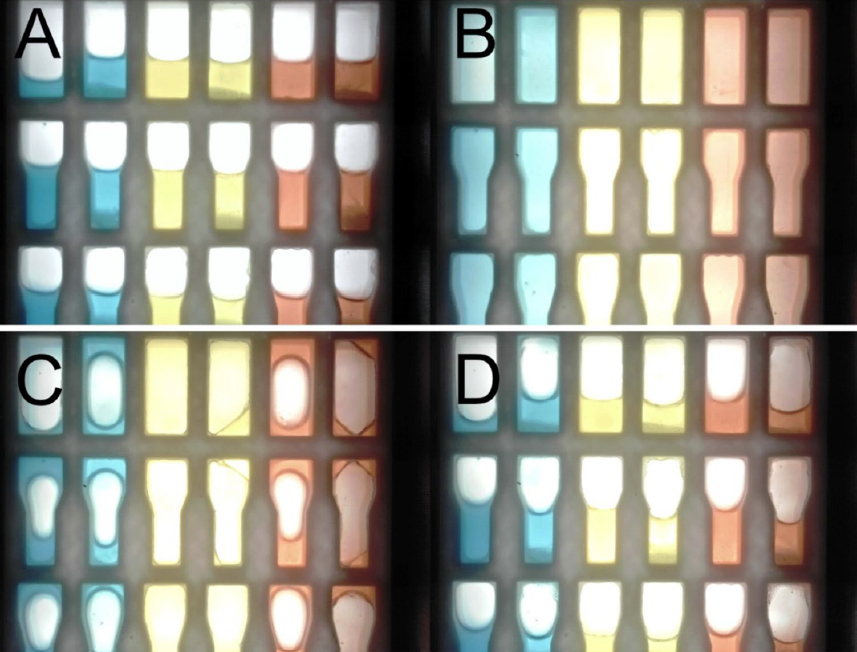
Growing fresh food on the Moon is going to be crucial if astronauts there are ever going to eat anything other than freeze-dried rations. Since husbanding animals on the lunar surface is…difficult (to put it mildly), most mission planners believe that plants are the solution. But we still don’t entirely understand how one of the most fundamental materials to plant growth, water, operates under partial gravity. A team of researchers, led by Karl Hasenstein of the University of Louisiana at Lafayette, and including John Kiss of the Florida Institute of Technology, and Christopher McKay of NASA’s Ames Research Center, recently published a paper in Microgravity Science and Technology that lays out the physics for how water behaves at lunar gravity. Growing plants in space isn’t a new idea. The International Space Station has played host to the Veggie facility and the Advanced Plant Habitat (APH) for years. Some researchers even germinated Arabidopsis (thale cress) seeds in actual lunar dirt returned from the Apollo missions. But water behaves differently on the ISS, where it experiences only microgravity. And there are some major hurdles to overcome to get plants to use water in real lunar soil outside a controlled laboratory environment. On Earth, fluid dynamics is dominated by gravity. It pulls water through soil very predictably. In microgravity, capillary forces rule, which makes it difficult to hydrate the roots of plants, or aerate them properly. But the Moon experiences low gravity, where liquids operate in a regime not quite like either Earth gravity or microgravity. But it’s also notoriously difficult to test without being on the Moon itself. Wired video on whether we can grow plants on the Moon. Credit - WIRED YouTube Channel For now at least, being on the Moon itself is almost a non-starter. So researchers have to come up with clever ways to run experiments in simulated lunar gravity. Traditional techniques like drop towers or parabolic arc flight offer a few seconds to at most a few tens of seconds of lunar gravity at a time. That’s not really long enough to truly see how liquids react. So instead, the researchers took advantage of a capability on the New Shepard 29 (NS-29) mission back in February 2025. After its booster separation, the uncrewed capsule activated its reaction control thrusters and began spinning at around 11 RPM. This generated an artificial centrifugal acceleration of around 1.76 m/s2 - in other words, it generated lunar gravity. And this experiment lasted around two minutes. Which might not seem like long, but it’s orders of magnitudes longer than even parabolic arc flights. Inside the NS-29 capsule was the researchers’ autonomous experiment, which was a 3D-printed housing with 18 different fluid-filled test cavities with an Arducam camera and some LED backlight. The test cells were loaded with three different liquids - deionized water (dyed yellow), a 30% glycerol solution (dyed blue), and a 0.8% saline solution (dyed red). BBC story on how to grow plants in space. Credit - BBC News YouTube Channel Different cavities contained different wall geometries (vertical, 15 degrees, and 20 degrees), and the researchers watched how the liquid tracked the curved surface of each of the cavities - a property called the liquid’s meniscus. From there, they could use a series of hydrodynamic equations to calculate surface tension, capillary length, and other important physical parameters of these liquids in lunar gravity. There were several notable features that came out of the experiment. The most obvious was the curvature of the meniscus changed under the lower acceleration of lunar gravity. It was more rounded compared to the flatter profiles seen in regular Earth gravity. Another notable feature was that the lower gravity allowed thicker liquid films to cling to the walls more effectively, creating higher liquid columns than would be expected in Earth gravity. The researchers did notice a discrepancy as well - both the measured surface tension and capillary length were smaller than the theoretical values listed in textbooks. The authors ascribed this to the microscopic texture of the 3D-printed chamber itself, which acts like a series of conduits, enhancing the wettability of the material. It could also have been partially caused by the rigors of space flight, such as seal leaks or other wall interactions. SciShow Space video on growing plants on the Moon. Credit - SciShow Space YouTube Channel While the experiment was focused on the changes in the liquid properties from different gravities, the researchers did extrapolate that thinking out into putting water into actual lunar soil. Raw lunar dust is notoriously difficult to work with hydraulically. Its top layer is extremely dry and hydrophobic, resisting water as it tries to infiltrate. Further down, larger grain sizes create larger holes for water to drain off into. Eventually it has to pool somewhere, creating stagnant reservoirs that could suffocate a plant's roots from lack of oxygen. One potential solution to this is to use glycerol as a regulator. In the experiment, the authors noted that the glycerol demonstrated much better “wetting” capabilities than the other two solutions, and it's already been safely demonstrated as an osmotic regulator for plants. In the future, lunar plant beds might be directly fed glycerol as well as water. That’s still a long way away, and there are other potential solutions, such as hydroponics. But to truly scale the operation of a lunar base, researchers estimate that a crew of six would require 650 square meters of functional crop growing area. That is a lot of hydroponics to get out of Earth’s gravity onto the Moon. But now at least we’re one step closer to understanding how we might be able to truly grow large amounts of food in the soil available on the Moon itself. Learn More: Florida Tech - New Research Shows How Water Would Behave on the Moon K. H. Hasenstein, J. Z. Kiss, & C. P. McKay - Assessing Water Dynamics at Lunar Gravity UT - Plants Could Grow in Lunar Regolith Using Bacteria UT - Gardening for the Moon
How Will Water Flow on the Moon?
Full Article
Original Source
Read the full article at Universetoday →KhanList aggregates and links to publicly available news content. We do not host full articles from third-party sources. Always verify important information with original sources.