
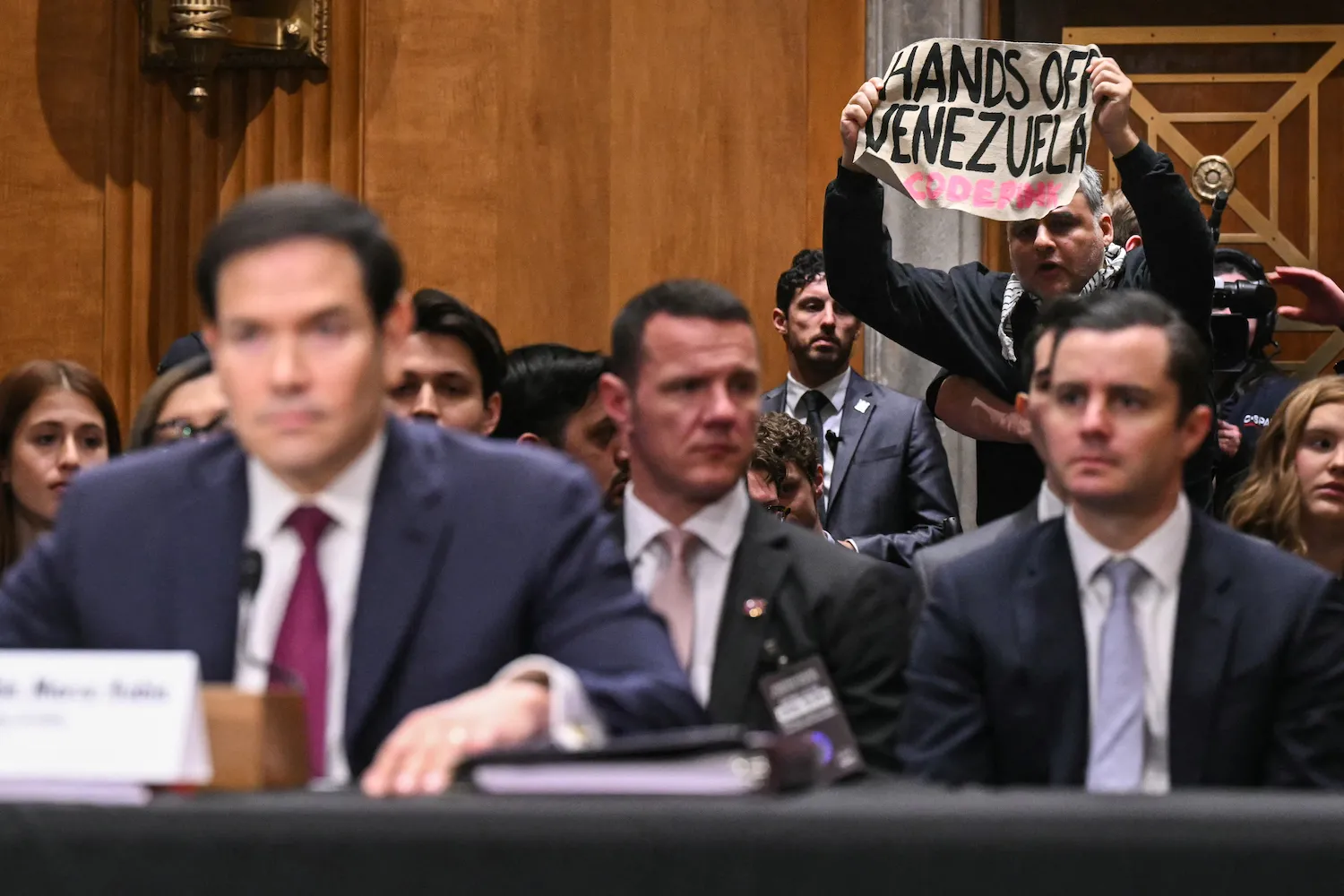
Welcome back to Foreign Policy’s Latin America Brief. The highlights this week: Democrats lay out plans to challenge U.S. President Donald Trump’s approach to the region, Paraguay’s president abruptly resigns, and Salvadoran troops deploy to Haiti. The Democrats’ resounding victory in the U.S. midterm elections on Tuesday could spell change in the Trump administration’s approach to Latin America. It has also kicked off a debate about how the next U.S. president might approach the region. Latin America has already received significant attention from U.S. lawmakers pushing for foreign-policy accountability for President Donald Trump. They have called for subpoenas related to Trump’s opaque oil deal in Venezuela, introduced a resolution to block deadly boat strikes in the region, and demanded hearings on deportee detentions in El Salvador. Without legislative majorities, those efforts have moved slowly. That will change in January, when the new Congress is sworn in. With control of Congress, Democrats could aim to “shut down” Trump’s boat strikes by attaching a funding prohibition to must-pass legislation, former State Department legal advisor Brian Finucane told FP’s John Haltiwanger. As an example of this tactic, Finucane pointed to Congress’s 1973 threat of a government shutdown to halt the U.S. bombing of Cambodia. Republican Rep. Thomas Massie, who will leave office in January, has said he plans to introduce articles of impeachment for Defense Secretary Pete Hegseth as soon as next week, unless Hegseth resigns first. Unnamed Republican sources told CNN that they expect the attempt to pass. Massie is targeting Hegseth primarily over the Iran war, alleging that the conflict contravenes the War Powers Resolution. The defense secretary is also a vocal champion of the boat strikes in the Western Hemisphere and has said he is trying to elevate “lethality” over “legality” in military operations. Without Hegseth, the metrics for whether the United States views the strikes as a success could shift. A bigger earthquake would be the early departure of U.S. Secretary of State Marco Rubio, who is steering Trump’s Venezuela policy. The Independent reported on Thursday that Rubio was “on resignation watch” as he mulled a run for president in 2028; the White House and State Department have denied the report. Though Democrats hope their oversight will moderate Trump’s foreign policy, some analysts have argued that the opposite is possible. After Republican losses in the midterms, Trump may double down on an area where the executive branch has more leeway to act alone. But the U.S. president could face new pushback from foreign leaders who see him as a lame duck. Right-wing Latin American presidents who have otherwise hewed close to Trump showed a taste for acting independently last week, when most swiftly recognized left-wing Brazilian President Luiz Inácio Lula da Silva’s reelection victory. (Trump has yet to do so.) The midterms mark the unofficial start of the 2028 U.S. presidential campaign, with prospective candidates already staffing up. Recent weeks have seen a round of think pieces by policy wonks about how the next U.S. administration should run its Latin America policy. Last month, the Council on Foreign Relations, which has seeded staffers to both parties, published proposals that included expanding some elements of the U.S.-Mexico-Canada trade deal to northern South America, building out a more robust critical minerals strategy, and supporting a democratic transition in Venezuela that outlasts intense U.S. control. On the progressive side of the spectrum, Matt Duss, a former advisor to U.S. Sen. Bernie Sanders, recently edited a collection of foreign-policy essays. One proposes burden-sharing on immigration policy among countries across the hemisphere. Another calls for a return to U.S. efforts to fight crime by prosecuting high-ranking white-collar criminals. Latin America still has two more years of the so-called Donroe Doctrine to endure. But its staying power looked weaker after Tuesday. Friday, Nov. 6, to Tuesday, Nov. 17: Pope Leo XIV visits Uruguay, Argentina, and Peru. Sunday, Nov. 29: Ecuador holds midterm elections. A line of police officers in dark uniforms, helmets, and protective gear stand side by side holding riot shields in front of a modern white building flying multiple red, white, and blue striped flags. Riot police stand guard in front of Paraguay’s Congress in Asuncion, Paraguay, on Nov. 5.Daniel Duarte/AFP via Getty Images Peril for Peña. Paraguayan President Santiago Peña abruptly resigned on Thursday after the collapse of a digital bank that left millions of people in the country unable to access money from their accounts. Until last year, Peña was an investor at Ueno Bank’s parent company. He named an executive linked to the bank as Paraguay’s central banker in 2023. A series of investigations in recent weeks revealed that Ueno may have grown in prominence through connections with people in power. Regulators took control of Ueno on Tuesday. Much of the political spectrum turned against Peña this week, even as he denied wrongdoing and said most of the bank’s customers would get their money back. On Wednesday, protesters took to the streets, including in front of the presidential palace. The next day, the top power broker in Peña’s party, Horacio Cartes, came out in support of an impeachment trial against the president. Peña announced his resignation on Thursday shortly before being impeached, saying he was stepping aside for “the stability of our country.” Vice President Pedro Alliana is expected to take over until Paraguay’s next presidential election in 2028. Green shipping pilot. The Brazilian Port of Santos began regularly using ethanol-based shipping fuel for a small number of ships last month, becoming the first port in Latin America to do so. The move comes amid a slow global rollout of low-carbon fuels in the shipping sector—and jockeying among producers about which types of fuel will become widespread. The International Maritime Organization aims for 5 to 10 percent of shipping fuels to come from no or low-carbon sources by 2030 as part of a draft target up for an approval vote next month. In the meantime, countries that produce biodiesel and ethanol are making the case that their fuels should be adopted as part of those efforts. Proponents of biodiesel argue that ship engines do not need to be refitted to use their fuel, while ethanol—made from starch, corn, or sugar alcohol—requires a retrofit. That is what the cohort of ships stopping in Santos have undertaken. Baseball’s regional roots. Last week, the Milwaukee Brewers won the U.S. baseball World Series against the Tampa Bay Rays. The final featured players born in Cuba, the Dominican Republic, Mexico, and Venezuela, as well as the United States. It was a showcase of the sport’s deep roots in Latin America, former U.S. diplomat Steven E. Hendrix wrote in Foreign Policy. Strained political relations between the United States and Latin American countries have often complicated baseball ties. Trump’s first-term “maximum pressure” strategy on Cuba blocked an MLB deal to ease the signing of players. And amid Venezuela’s political crisis over the last decade, many U.S. baseball academies in the country withdrew. The Brewers’ Jackson Chourio, from Maracaibo, Venezuela, made it to the United States through a more roundabout route, first playing baseball in the Dominican Republic. “Baseball is not a substitute for diplomacy, trade agreements, or immigration policy,” Hendrix wrote. But he argued that it shows a powerful cultural interconnectedness. In another sign that baseball has become not just America’s pastime but also Latin America’s, Venezuela defeated the United States in the World Baseball Classic in March. Which of the following National Baseball Hall of Famers is not from the Dominican Republic? Aparicio is from Venezuela. No One Has a Plan for American Decline by Nick Danforth Don’t Read Too Much Into These Midterms by Emma Ashford Everyone Got Pete Hegseth Wrong by Emma Ashford A woman in a white collared shirt, light-colored pants, and a baseball cap walks outdoors, accompanied by several men in dark suits and a person in military camouflage uniform near black vehicles. Peruvian President Keiko Fujimori walks visits the Terrorism Confinement Center in San Vicente, El Salvador, on Oct. 29. Alex Peña/Getty Images Peruvian President Keiko Fujimori was in El Salvador last week to visit the country’s Terrorism Confinement Center, a maximum-security prison known by its Spanish acronym CECOT. Her trip follows a visit last month by Costa Rican President Laura Fernández. Both Fujimori and Fernández are expanding their own countries’ prison infrastructure in an anti-crime push. They also hope for the popularity boost that Salvadoran President Nayib Bukele experienced after he carried out a mass detention campaign beginning in 2022, targeting suspected gang members and criminals. Now, Bukele is exporting more than sweeping detentions. He dispatched more than 2,000 security forces to Haiti over the past few weeks to fight gangs in the country, most of whom are not bound by a United Nations Security Council-approved framework that governs visiting forces. Since 2024, Haiti’s interim authorities have welcomed international security reinforcements to help with anti-gang efforts. Many have operated under a framework approved by the U.N. Security Council, though private military contractors are also common. Four Salvadoran troops were working under the U.N.-backed framework in mid-October when they were ambushed by Haitian gangs and disappeared. Bukele said he would send in extra forces to recover them. The prospect of a large-scale confrontation with Salvadoran troops led a Haitian gang leader this week to plea for outside mediation.
How Will the Blue Tsunami Affect Latin America?
Full Article
Original Source
Read the full article at Foreignpolicy →KhanList aggregates and links to publicly available news content. We do not host full articles from third-party sources. Always verify important information with original sources.