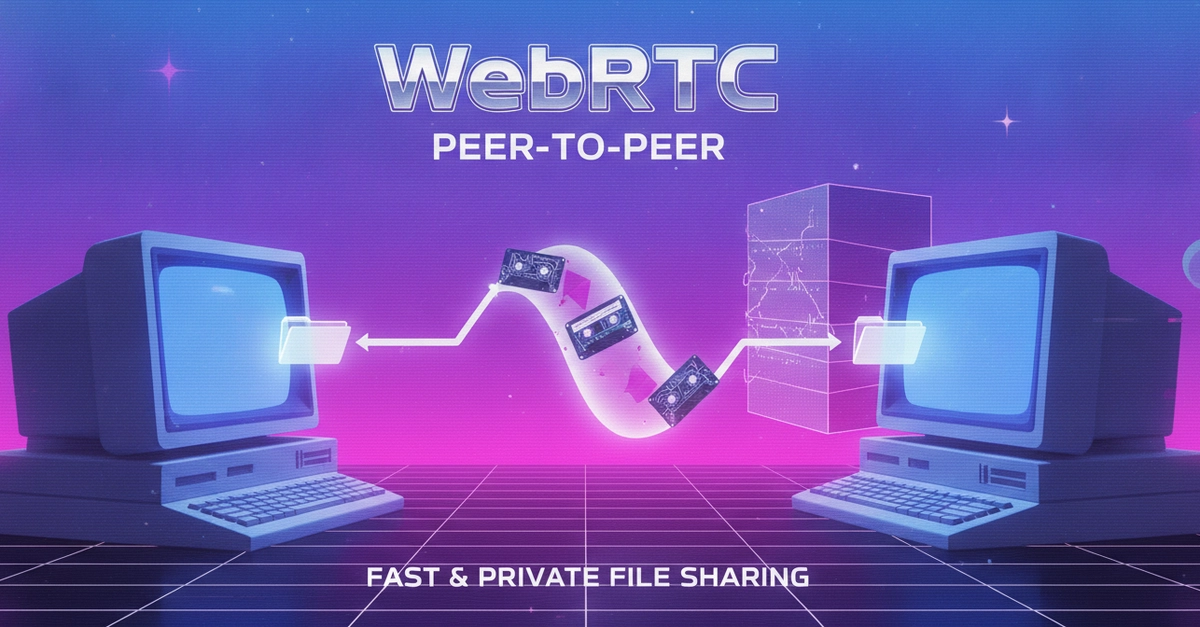
Sharing content between devices sounds like a simple problem. You copy some text on your laptop, open your phone, and realize there is no easy way to move that information. Maybe it is a code snippet, a temporary file, a URL, or a piece of text you need immediately. Traditional solutions usually rely on cloud storage: Upload data to a server Store it temporarily Download it on another device This works, but it introduces additional complexity: Your data needs to travel through third-party servers Temporary information may be stored longer than expected Users need accounts and complicated workflows WebRTC provides another approach: direct peer-to-peer communication. What is WebRTC? WebRTC (Web Real-Time Communication) is an open technology that enables browsers and applications to exchange data directly between devices. Originally designed for real-time communication such as: Video calls Audio communication Screen sharing WebRTC also supports direct data transfer through the RTCDataChannel API. This makes it possible to build applications where devices can communicate without sending every piece of data through a centralized server. How Peer-to-Peer Data Transfer Works A simplified WebRTC data transfer flow looks like this: Device A | | 1. Create connection request | Signaling Server | | 2. Exchange connection information | Device B | | 3. Establish direct P2P connection | Encrypted Data Channel Enter fullscreen mode Exit fullscreen mode The signaling server is only responsible for helping devices discover each other. After the connection is established, the actual data can flow directly between peers. Why Peer-to-Peer Sharing Matters For many everyday tasks, users do not need a full cloud storage system. Examples: Sending a code snippet from a desktop to a laptop Moving a URL from a phone to a computer Sharing a small document during development Transferring temporary files between personal devices In these situations, speed and privacy are often more important than long-term storage. A peer-to-peer approach provides several advantages. 1. Faster Transfers When devices communicate directly, data does not need to travel through a large storage infrastructure. This can reduce latency, especially for users on the same network. 2. Better Privacy With traditional file sharing: User → Cloud Server → User Device Enter fullscreen mode Exit fullscreen mode The server becomes part of the data path. With peer-to-peer communication: User Device → User Device Enter fullscreen mode Exit fullscreen mode The communication is more direct. 3. No Account Required Many temporary sharing scenarios do not need: User accounts Password management Permanent storage A lightweight connection can solve the problem immediately. The Challenges of Building WebRTC Applications Although WebRTC is powerful, building a reliable application requires solving several problems. NAT Traversal Most devices are behind routers or firewalls. To establish connections, WebRTC uses: ICE (Interactive Connectivity Establishment) STUN servers TURN servers when direct connections fail The goal is to find the best possible communication path. Connection Management Real-world networks are unpredictable. Applications need to handle: Connection failures Device switching Network changes Browser compatibility User Experience A technically correct WebRTC implementation can still fail if the user experience is complicated. Users usually want: Open Connect Share Not: Create an account Configure settings Upload files Manage storage Building Simpler Cross-Device Experiences Modern users often work across multiple devices: Desktop computers Laptops Phones Tablets The problem is not always file storage. Sometimes users simply need a temporary bridge between their devices. This idea inspired us to build Textunnel, a privacy-focused cross-device sharing tool designed for quickly moving text, code, links, and files between devices. Instead of creating another cloud drive, the goal is to make device-to-device communication simpler. The Future of Peer-to-Peer Applications As browsers become more capable, peer-to-peer technologies will continue to create new possibilities: Decentralized collaboration tools Private communication platforms Local-first applications Real-time developer workflows WebRTC is not only a technology for video calls. It is a foundation for building faster, more private, and more user-controlled applications. For developers building the next generation of productivity tools, peer-to-peer communication is worth exploring. This idea inspired us to build Textunnel...
How WebRTC Enables Fast and Private Peer-to-Peer File Sharing
Full Article
Original Source
Read the full article at Dev →KhanList aggregates and links to publicly available news content. We do not host full articles from third-party sources. Always verify important information with original sources.