
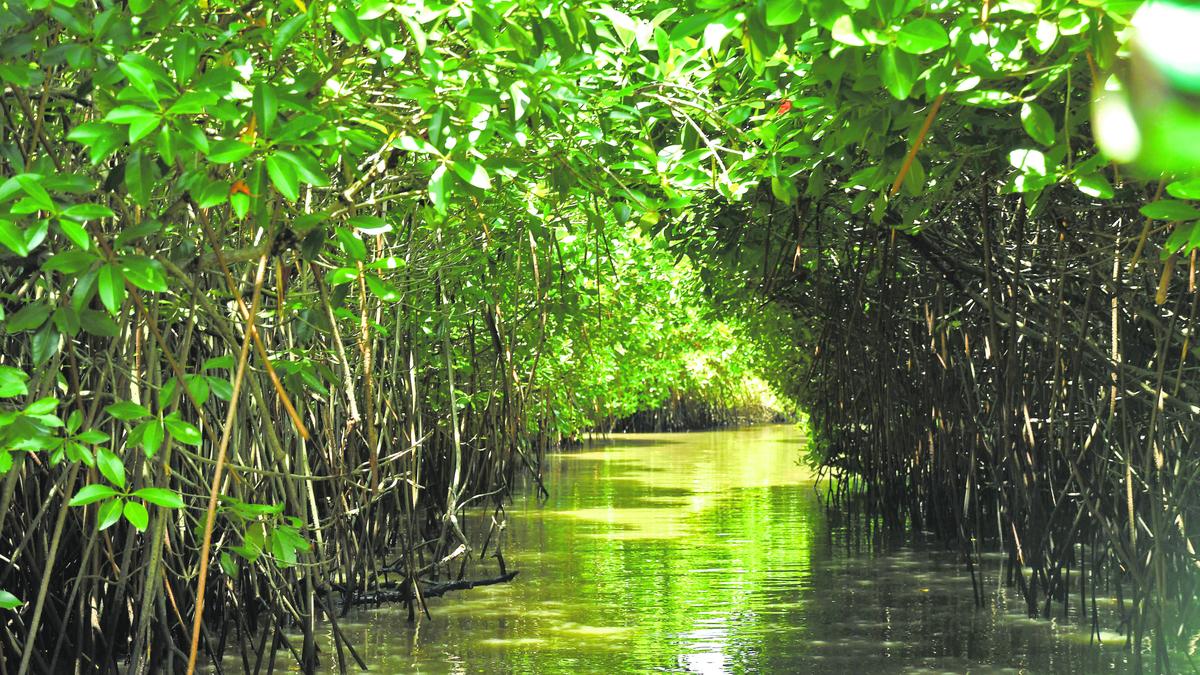
Ecosystem service-wise economic value (in ₹ crore)Provisioning services (Fish, Crab, Shrimp): 3.47Coastal protection function: 147.17Nutrient cycling: 10.53Oxygen regulation: 181.22Carbon sequestration (annual flow): 26.86Biodiversity conservation: 19.48Recreational and tourism value: 484.25Carbon stock value (vegetation): 387.77Soil organic carbon: 1224.63Total Economic Value (TEV): 2,485.38How valuable are mangroves? A recent study of the Pichavaram mangrove ecosystem estimated its Total Economic Value (TEV) at ₹2,485.38 crore ($289 million), with a per-hectare value of ₹1.83 crore, reflecting the ecological, economic and social benefits it provides.The Pichavaram Mangrove Forest is deemed one of the most ecologically significant coastal wetland ecosystems in India and plays a vital role in supporting biodiversity conservation, fisheries productivity, coastal protection, climate regulation, blue carbon sequestration, and livelihood security for coastal communities.“Mangrove ecosystems provide a wide range of provisioning, regulating, supporting, and cultural ecosystem services that contribute significantly to ecological sustainability and human well-being. Despite their importance, many ecosystem services remain undervalued in conventional development planning because several ecological benefits are non-market in nature and are not reflected in market transactions,” says the study, ’Economic Valuation and Blue Carbon Assessment of Ecosystem Services (ESV) in the Pichavaram Mangrove Forest’.Increasing climate change impacts, biodiversity loss, and coastal vulnerability have further emphasised the need for comprehensive assessment of the ecological and economic contributions of mangrove ecosystems, it added.In 2024, the International Union for Conservation of Nature (IUCN), in what it termed the“first global assessment of a full ecosystem functional group across the planet using the Red List of Ecosystems,” said 50% of mangrove ecosystems in the world are at risk of collapse. The study, by M. Balasubramanian, associate professor, Centre for Ecological Economics and Natural Resources, Institute for Social and Economic Change, Bengaluru, was funded by the Deputy Conservator of Forests, Forest Genetics Division, Coimbatore. It was based on primary and secondary data; primary information was collected from 302 households across five mangrove-dependent villages: MGR Thittu, Kalaignar Nagar, Chinnavaikal, Patriadi, and Mudasalodai.Carbon reservoir“The blue carbon assessment highlights the critical role of the Pichavaram Mangrove Ecosystem as a significant natural carbon sink and a valuable climate regulation asset. Field measurements and carbon stock analysis indicated that the mangrove vegetation stores an average of 79.449 tonnes of carbon per hectare, equivalent to approximately 291.33 tonnes of CO2 per hectare,” says the study.The analysis further revealed that mangrove sediments constitute an even more substantial carbon reservoir. The average soil organic carbon stock of 251.14 tonnes of carbon per hectare was estimated to generate an economic value of ₹90.24 lakh per hectare, resulting in a total soil organic carbon value of ₹1,224.63 crore. When vegetation and soil carbon pools are combined, the total blue carbon asset value of the Pichavaram Mangrove Ecosystem is estimated at ₹1,612.40 crore“These findings clearly demonstrate that the majority of blue carbon is stored below ground in mangrove sediments, emphasising the importance of conserving both mangrove vegetation and soil systems. The substantial blue carbon value underscores the ecosystem’s contribution to climate regulation, carbon sequestration, and long-term ecological sustainability, while also providing strong justification for integrating mangroves into climate finance mechanisms, blue carbon initiatives, and natural capital accounting frameworks,” the study added.IntegrationThe study recommends the integration of ecosystem service valuation into coastal development planning and environmental decision-making, recognition of mangroves as critical nature-based solutions for climate adaptation and disaster risk reduction, and the development of blue carbon financing mechanisms, carbon credit programmes, and Payment for Ecosystem Services (PES) schemes.It also advocates the incorporation of mangrove values into the Natural Capital Accounting and Green GDP frameworks, the promotion of sustainable livelihood opportunities through fisheries, eco-tourism, community-based conservation, and mangrove restoration, and strengthening climate resilience and biodiversity conservation through long-term ecosystem-based management strategies.
How valuable are mangroves? Study on Pichavaram ecosystem pegs it at ₹2,485.38 crore
Full Article
Original Source
Read the full article at Thehindu →KhanList aggregates and links to publicly available news content. We do not host full articles from third-party sources. Always verify important information with original sources.