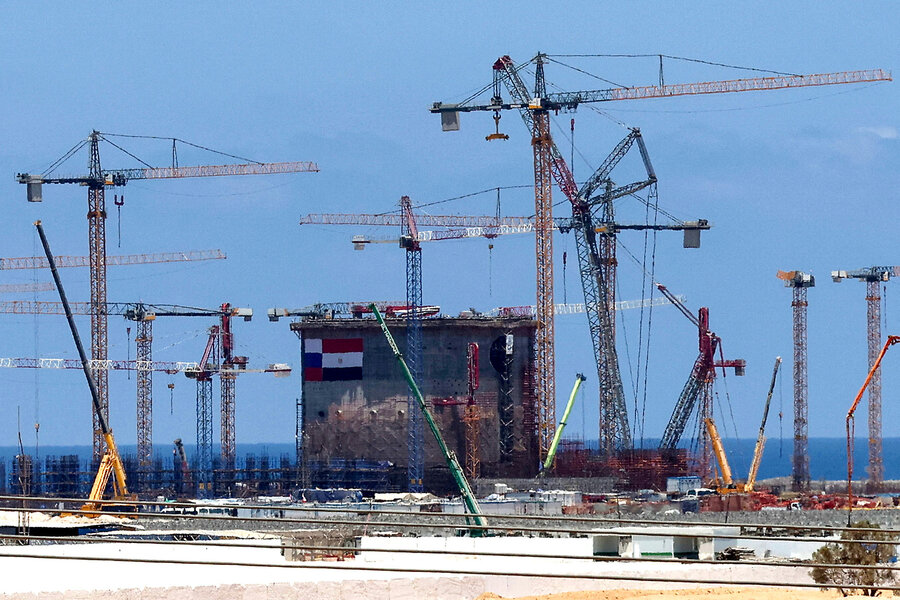
When Turkey and Egypt began building nuclear power plants with Russian technology over the past decade, the United States asked both countries to commit to never enriching uranium to fuel a nuclear weapon.Both refused.Now, in the wake of the U.S.-Saudi nuclear deal announced July 22, which leaves the door open to Saudi Arabia’s eventual weapons-grade enrichment of uranium, both Turkey and Egypt are likely blessing the day they said “no” to Washington. Why We Wrote This In the wake of the U.S.-Saudi nuclear deal, other countries are asking whether they, too, need to develop nuclear power. Experts say that proliferation could also lead them to think eventually about developing nuclear weapons. A nuclear power race appears to be underway in the Middle East, and many countries are keeping a close eye on what their neighbors in the region are doing, nervous that others might develop nuclear weapons before them.Experts say the proliferation of nuclear-power projects in the Middle East is just one piece of evidence of a global shift in perceptions of the technology. In an era of galloping energy demands – coinciding with the rising impact of global warming – more countries are seeking to add nuclear power to their energy sources.But much more worrisome, they add, is an accompanying shift in thinking on the development of nuclear weapons and the eventual need to join the club of nuclear-armed states in a world of mounting instability, fading traditional security alliances, and a retrenching Pax Americana. Evelyn Hockstein/Reuters/File Saudi Crown Prince Mohammed bin Salman meets with President Donald Trump at the White House, Nov. 18, 2025. “I don’t think we’re going to see any country moving immediately in response to [the U.S.-Saudi] deal to abandon their international obligations and make a dash for the bomb,” says Kelsey Davenport, director for nonproliferation policy at the Arms Control Association in Washington. “But I do think more states are going to move to hedge their bets and take the steps they sense may now be necessary to respond to the security threats they perceive they increasingly face.”In the Middle East, but also in northeastern Asia and even Europe, the tandem pressures of rising instability and a retreating American superpower – for many the longtime security guarantor – are prompting countries to question the durability of the U.S. nuclear umbrella and the need to consider other nuclear options, analysts say.It’s a scenario that could put more countries, including those in the world’s most volatile regions, on the path to obtaining nuclear weapons. “For long-term nonproliferation prospects,” Ms. Davenport adds, “this is not looking good.”Dire warnings of a world of dozens of nuclear-armed states have accompanied the development and spread of civilian nuclear power generation since the 1950s. President John F. Kennedy predicted there would be more than two dozen nuclear-armed states by the early 1970s.He was wrong. Today, there are only nine. And interest in nuclear power generation waned after several devastating incidents at power plants, most recently in Fukushima, Japan, in 2011.But more recently, as concerns about energy security have deepened with energy flow disruptions in the wake of Russia’s war in Ukraine and now the U.S.-Israel war with Iran, interest in nuclear power – and perhaps as an insurance policy, nuclear weapons – has surged.For example, last year, President Donald Trump agreed to lift the moratorium the U.S. had imposed on South Korea producing its own nuclear fuel, ostensibly for its own power generation. Now, the Saudi deal would open the door to uranium fuel production in as little as two years and grant a waiver from intrusive international inspections. Protesters in Seoul, South Korea, hold signs reading "Nuclear Free" during a rally marking the 15th anniversary of Japan's Fukushima nuclear disaster, March 11, 2026. Underlying the surging global interest in nuclear power and eventually nuclear weaponry, some experts say, is a waning of the established postwar thinking about the existential threat nuclear proliferation poses to humanity.“It’s absolutely true that the fears of the dangers accompanying nuclear generation have waned in recent years,” says Henry Sokolski, executive director of the Nonproliferation Policy Education Center in Washington. “Part of that is the loss of the prominent thinkers ... who kept the potentially dire consequences of following this path in a dangerous world in the forefront.”Enter the U.S.-Saudi nuclear agreement, which appears to open the door for states pursuing nuclear power to go further to develop the full uranium fuel cycle, culminating in the fuel for a nuclear weapon.“This is significant because the international community is at a proliferation crossroads,” says Ms. Davenport. “Given rising concerns about the stability of the international security order, the Saudi deal can’t help but encourage more states to hedge their bets for nuclear weapons.”The destabilizing uncertainty is only exacerbated by a failing unity among the nuclear powers – the U.S., Europe, Russia, and China – on how to address mounting proliferation challenges.“The success of the international nonproliferation regime was the result of the relative unity of the [U.N. Security Council’s permanent members] in acting to build pressure on states tempted to build the bomb,” Ms. Davenport says. “That consensus no longer exists.”Some experts caution that the Saudi deal still must be approved by both the U.S. House and Senate, and might not yet be in a final form. Doomsday hand-wringing over the agreement might be premature, they say – especially with Mr. Trump insisting the deal will only advance if Saudi Arabia normalizes relations with Israel, a potential poison pill for the Saudis.But others say concluding a deal with such far-reaching ramifications in a region in the midst of a globally impactful war invites additional disaster.“You’re granting a path to enrichment in a couple of years to one side of the Gulf, while on the other side you’re demanding there be no enrichment for what, 20 years, while oh by the way Egypt and Turkey are watching from the sidelines as they build their nuclear infrastructure,” Mr. Sokolski says. “Gee, what could possibly go wrong?”Some experts underscore the limitations the deal would place on any future Saudi development of nuclear activities – the agreement is basically the sale to Riyadh of Canadian-U.S. company Westinghouse’s nuclear power plants and their operation. They also say that it becomes incumbent upon the U.S. to fortify its regional diplomacy to discourage risky proliferation.“If this deal goes forward, it becomes crucial for the administration to make sure the neighbors have a clear understanding of just how constraining this deal is,” says Daniel Benaim, a former deputy assistant secretary of state for Arabian Peninsula affairs, who is now a distinguished diplomatic fellow at the Middle East Institute in Washington.For some, the biggest risk would come if others in the region simply don’t trust the restrictions the Saudi deal purports to include.Noting Mr. Trump’s good relations with most leaders in the region, including Turkey and Egypt, one former State Department official says it will be up to the administration to communicate “how this deal does not signal a green light for some free-for-all of U.S.-blessed nuclear enrichment.”
How US-Saudi deal could encourage other countries to consider nuclear weapons
Full Article
Original Source
Read the full article at Csmonitor →KhanList aggregates and links to publicly available news content. We do not host full articles from third-party sources. Always verify important information with original sources.