
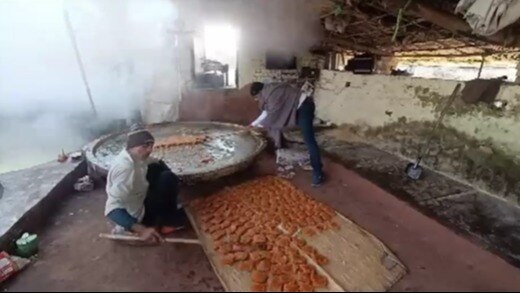
Under the Centre's Pradhan Mantri Formalisation of Micro Food Processing Enterprises (PMFME) scheme, one food product is identified in each district to help farmers and small food businesses access support for processing, branding and marketing.The ODOP approach tries to build on that local specialisation rather than treating food production as a one-size-fits-all sector. (Photo: India Today)Uttar Pradesh's One District One Product (ODOP) approach is not limited to handicrafts and manufactured goods. A separate Central government scheme applies the same idea to food and agricultural products, identifying a signature food product for each district and building support around it.The Pradhan Mantri Formalisation of Micro Food Processing Enterprises (PMFME) Scheme, launched in 2020 under the Aatmanirbhar Bharat Abhiyan, follows the "one district, one product" principle specifically for food products.The idea is to identify products that are already grown or produced at scale in a district and then help farmers, small food-processing businesses and producer groups build better processing, branding and market access around them.For Uttar Pradesh, this covers all 75 districts and a wide range of products, from mint and mango to aonla, Kala Namak rice and jaggery. WHAT IS PMFME'S ODOP APPROACH?Under the PMFME scheme, each district identifies one food product that has a strong local production base.The product can be a fruit, vegetable, grain or traditional food item. The focus is not only on production but also on what can be done after the produce leaves the farm — processing it, improving its value, creating common infrastructure and finding larger markets. In February 2024, the Ministry of Food Processing Industries released the ODOP list covering 713 districts across 35 states and Union Territories. The list includes products for all 75 districts of Uttar Pradesh.This gives each district a particular food product around which support can be organised.WHICH DISTRICT, WHICH PRODUCT?The list reflects the diversity of Uttar Pradesh's agricultural economy.Mentha, or mint, has been identified for districts including Barabanki, Rampur, Sambhal and Sultanpur.Aonla, or Indian gooseberry, has been identified for Amethi, Fatehpur, Pratapgarh and Rae Bareli.Mango is the identified product for several districts, including Lucknow, Mau, Sitapur and Unnao.In eastern Uttar Pradesh, Kala Namak rice has been identified for districts including Gorakhpur, Maharajganj, Siddharthnagar and Sant Kabir Nagar.Jaggery has also been identified across several districts, including Ayodhya, Baghpat, Bijnor, Meerut, Muzaffarnagar and Pilibhit.The same product can therefore be associated with more than one district where it has a significant production base.WHAT DOES THIS MEAN FOR FARMERS AND SMALL BUSINESSES?Identifying a product is only the first step. The larger aim is to help the people producing and processing it build businesses around it.Under PMFME, farmers, Farmer Producer Organisations (FPOs), cooperative societies and Self-Help Groups (SHGs) linked to the identified products can access support for infrastructure, branding and marketing, as well as technology upgradation.The scheme was allocated a total budget of Rs 10,000 crore for 2020-2025, shared between the Centre and the states.For small producers, the district-level approach can help address one of the biggest challenges in food processing — fragmentation.Individual farmers and small processing units may not have the resources to invest in processing facilities, develop a brand or reach buyers outside their local market. Bringing producers of the same product under a common district identity can make it easier to build shared facilities and organise marketing.The focus is therefore not just on what a district produces, but on what can be done to increase the value of that production.FROM FARM PRODUCE TO MARKETABLE BRANDSThe longer-term objective is to take products that are strongly associated with particular districts and give them a wider market identity.The ODOP approach seeks to bring smaller producers together so they can benefit from scale in areas such as procuring inputs, accessing common facilities and marketing.It also provides for the development of national brands for select products in partnership with organisations such as NAFED and TRIFED.One example is Madhumantra, a brand developed for multiflora honey from Saharanpur.The idea is to move beyond selling a product simply on the strength of where it comes from. Processing, packaging, branding and organised marketing can help turn a locally important product into something that can be sold to consumers in larger domestic markets.For farmers and small food-processing businesses, that can be important. Producing a crop at scale does not automatically guarantee that the producer captures a larger share of its value. Better processing and market access can help bridge that gap.WHY THE DISTRICT-LEVEL APPROACH MATTERSUttar Pradesh's agricultural economy is spread across districts with very different production strengths. A product that is central to one district may have little significance in another.The ODOP approach tries to build on that local specialisation rather than treating food production as a one-size-fits-all sector.Mint from Barabanki, aonla from Pratapgarh, mango from Lucknow and Kala Namak rice from eastern Uttar Pradesh can each have a different production base and market. Giving each product a defined identity allows government support and private enterprise to be organised around what each district already does well.The approach also creates a link between agriculture and food processing. Instead of stopping at the farm gate, the focus extends to processing, packaging, branding and finding buyers.That is particularly relevant for small producers, who may have a good product but limited access to the infrastructure and markets needed to scale it.The PMFME scheme's ODOP approach is therefore less about simply putting a label on a district's produce and more about building an ecosystem around it.For Uttar Pradesh, the ambition is to take products that are already rooted in local agriculture and give them a better chance of reaching consumers beyond their traditional markets — turning district-level production into stronger food businesses and, in some cases, recognisable brands.- EndsPublished By: Koustav DasPublished On: Aug 18, 2026 15:46 IST
How UP's ODOP food scheme is widening markets for farmers
Full Article
Original Source
Read the full article at Indiatoday →KhanList aggregates and links to publicly available news content. We do not host full articles from third-party sources. Always verify important information with original sources.