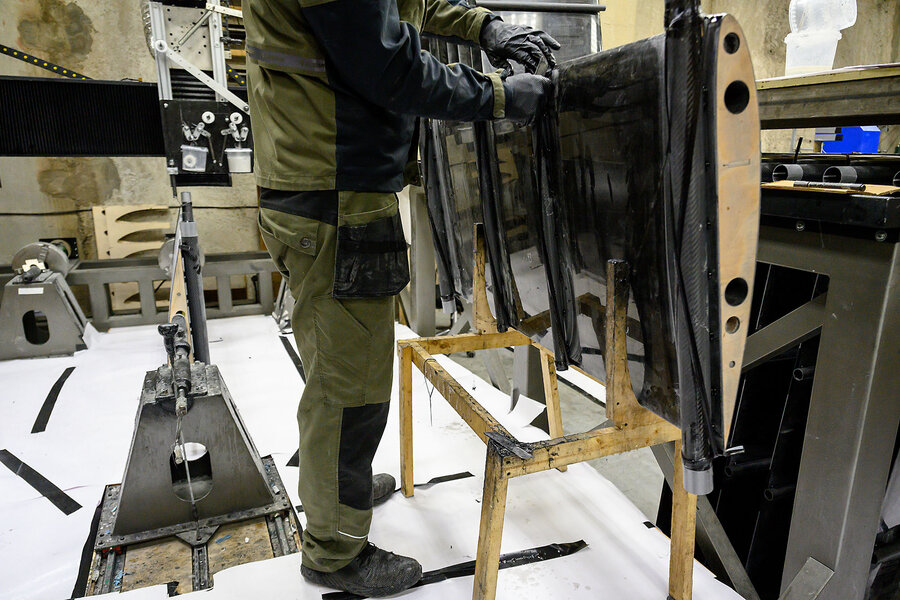
The secret drone factory in Ukraine is a tightly packed hive of energy that smells of epoxy.Here, engineers use 3D printers, composite materials, and carbon fiber to build the drones for strikes deep inside Russia that are turning the tide of war.Ukraine’s strategic campaign to increasingly target Russian military logistics hubs, energy depots, and refineries with barrages of explosive attack drones has shocked its larger adversary. Ukraine broke its own distance record earlier this month, when it struck the Omsk oil refinery, more than 1,550 miles from its border. Why We Wrote This The story of the Ukraine war this summer has been the shift – on the battlefield, and in the adversaries’ minds – wrought by Ukraine’s drone strikes deep into Russia. The goal is to end the war, to pave a path to a diplomatic resolution. It has slowed Russian advances on the battlefield, caused an acute fuel crisis, and even, some hope, begun to increase pressure that could eventually lead to a political resolution of this conflict. Valentyn Ogirenko/Reuters A Ukrainian Armed Forces service member looks at a deep-strike drone as it launches for a combat mission, at an undisclosed location in Ukraine, in 2026. The interior of this secret factory of the Fire Point company – whose drones account for some 60% of Ukraine’s deep-strike attacks inside Russia – is stacked with wing components and fuselages being tested and assembled.The company’s long-range FP-1 drones can carry warheads of up to 264 pounds, with a usual range of 1,100 miles, and strike with pinpoint accuracy. They are the primary tool of what President Volodymyr Zelenskyy calls “remote sanctions” against Russia, which launched an all-out invasion of Ukraine in early 2022 and has carried out devastating drone and missile strikes on Ukrainian cities ever since.Changing the “mindset of this war”They also serve as a made-in-Ukraine solution that far outstrips the capabilities of American and other Western missile systems so far supplied to Ukraine. Analysts say the near-daily strikes against Russia have given Ukraine the upper hand in the conflict for the first time since autumn 2022.On Tuesday, Mr. Zelenskyy met with U.S. President Donald Trump at the White House, to appeal for more U.S. air defenses to counter the Russian barrages.“We completely changed the mindset of this war,” says Denys Shtilerman, co-founder of Fire Point and its chief designer, in an interview at an undisclosed location in Ukraine.“First, we show to the whole world that Russia is not something that cannot be demolished,” he says. “Also, we saw the weakness of our enemy.” Scott Peterson/Getty Images/The Christian Science Monitor Denys Shtilerman, co-founder and chief designer of Ukrainian defense company Fire Point, stands for a portrait July 17, 2026. “We don’t need the excellent weapon,” he says. “We need the good weapon in the proper amount.” Fire Point now produces 300 drones per day and can “easily” reach 1,000, he says. Strikes against Russia – including targets in Moscow – sometimes involve hundreds of drones launched at a time, to overwhelm local air defenses.“The main idea must be simple, it must be cost-efficient, and it must be mass-produced,” says Mr. Shtilerman. “We don’t need the excellent weapon; we need the good weapon in the proper amount.”The result of their effectiveness is clear, in frequent videos of Ukrainian strikes on refineries and oil depots that have caused fuel shortages across Russia. Columns of black smoke rise from targets, often filmed by aghast Russians.The videos are the visual record of the latest evolution of this war, now in its fifth year. In recent weeks, Ukraine has also stepped up drone strikes against Russia-linked ships carrying oil and grain shipments in the Black Sea and Sea of Azov.In addition, Ukraine is ramping up midrange drone attacks to isolate the Crimean Peninsula, occupied by Russia since 2014, that are causing mass power outages and fuel shortages. Scott Peterson/Getty Images/The Christian Science Monitor Ukrainian workers use 3D printing and carbon fiber at a secret factory to build drones for the Fire Point defense company. Directing some deep-strike attacks is an unassuming Ukrainian officer with a denim shirt over a black T-shirt and the call sign “Schultz,” who fought Russia’s incursion in the eastern Donbas in 2014 and today commands an unmanned-aerial-vehicle battalion of the 413th Separate Regiment.Ukraine’s strikes should be “relentless,” he says, because they “give Russians the opportunity to feel that this war is not far, that it is near, that it’s on their borders, that it touches their soft underbelly.”“For now, I see that the main diplomatic leverage that our country has, in terms of settling this war, comes out of such [drone] operations,” he says. “The psychology of the Russian population is that, unless they feel it in their homes ... unless they see it on their streets, they would conduct this war for decades more.”The key is stopping Russia from resupplying troops with ammunition, food, and transport, as well as “maximizing damage” to the financial system that supports the war. Scott Peterson/Getty Images/The Christian Science Monitor A Ukrainian officer, call-sign Schultz, commander of a battalion that conducts deep-strike drone attacks inside Russia, sits for a portrait in Dnipro, Ukraine, July 20, 2026. Ukraine’s strikes should be “relentless,” he says, because they “give Russians the opportunity to feel that this war is not far, that it is near.” “The Russian war machine is huge and constantly moving, and we aim to disrupt as many points of this chain as possible,” he says, adding that the shift in Ukraine’s fortunes on the battlefield is “a direct effect of our [deep- and mid-strike] operations.”Using Russia’s size against itIndeed, Russia’s mass barrages last winter of Ukrainian cities and energy infrastructure – designed to keep Ukrainians cold, in the dark, and hopeless during the most frigid winter of recent years – are now being answered by Ukraine.“There was an asymmetry that favored Russia, when Russia was able to do these combined attacks,” says Mykola Bielieskov, a research fellow at Ukraine’s National Institute for Strategic Studies in Kyiv.Russia’s attacks with Shahed drones supplied by Iran first came in autumn 2022, and increased the following spring, helping to trigger the start of Ukraine’s own attack drone program.“It took us more than two years to develop this capability, to increase production, to weaken Russian air defenses ... to finally use the Russia vastness against Russia,” says Mr. Bielieskov.Where Russia’s size once created a safety buffer, he explains, it is now a liability. “They simply don’t have enough surface-to-air missiles, combat planes, [or] radars to understand what is going on in their own airspace,” he says. Smoke billows after Ukrainian drone attacks, according to local authorities, in Podolsk, Russia, July 20, 2026. Half a year ago, “no one could have predicted this dynamic of the war; everyone was talking about Ukraine losing another chunk of the [eastern] Donetsk region, or [southern] Zaporizhzhia region,” Mr. Bielieskov says.Ukraine’s deep-strike capability is much more significant than previous advances hailed at the time as “game-changing,” he argues. They include the arrival of U.S. missile systems that had shorter ranges and smaller warheads, and were subject to American restrictions.For now, Mr. Bielieskov notes, Ukraine remains “vulnerable” because of a shortage of adequate air defenses.Among some 20 Ukrainian drone-making firms, Fire Point is also working on an air defense missile. And the United States recently granted a license to Ukraine to produce Patriot interceptors.Fire Point has also developed a cruise missile, the FP-5 Flamingo, which is jet-powered and can carry a 2,500-pound warhead 1,900 miles.“It’s like a simultaneous, parallel race [to see] who inflicts bigger damage on the other side, and makes the other side negotiate on its terms,” says Mr. Bielieskov. That will take time, absent a large arsenal of ballistic and cruise missiles.“The ultimate goal is to have this war stopped,” he says. “The ultimate measurement of success” is a “political settlement.”Oleksandr Naselenko supported reporting for this story.
How Ukraine’s long-range drones are changing what’s possible in war with Russia
Full Article
Original Source
Read the full article at Csmonitor →KhanList aggregates and links to publicly available news content. We do not host full articles from third-party sources. Always verify important information with original sources.