
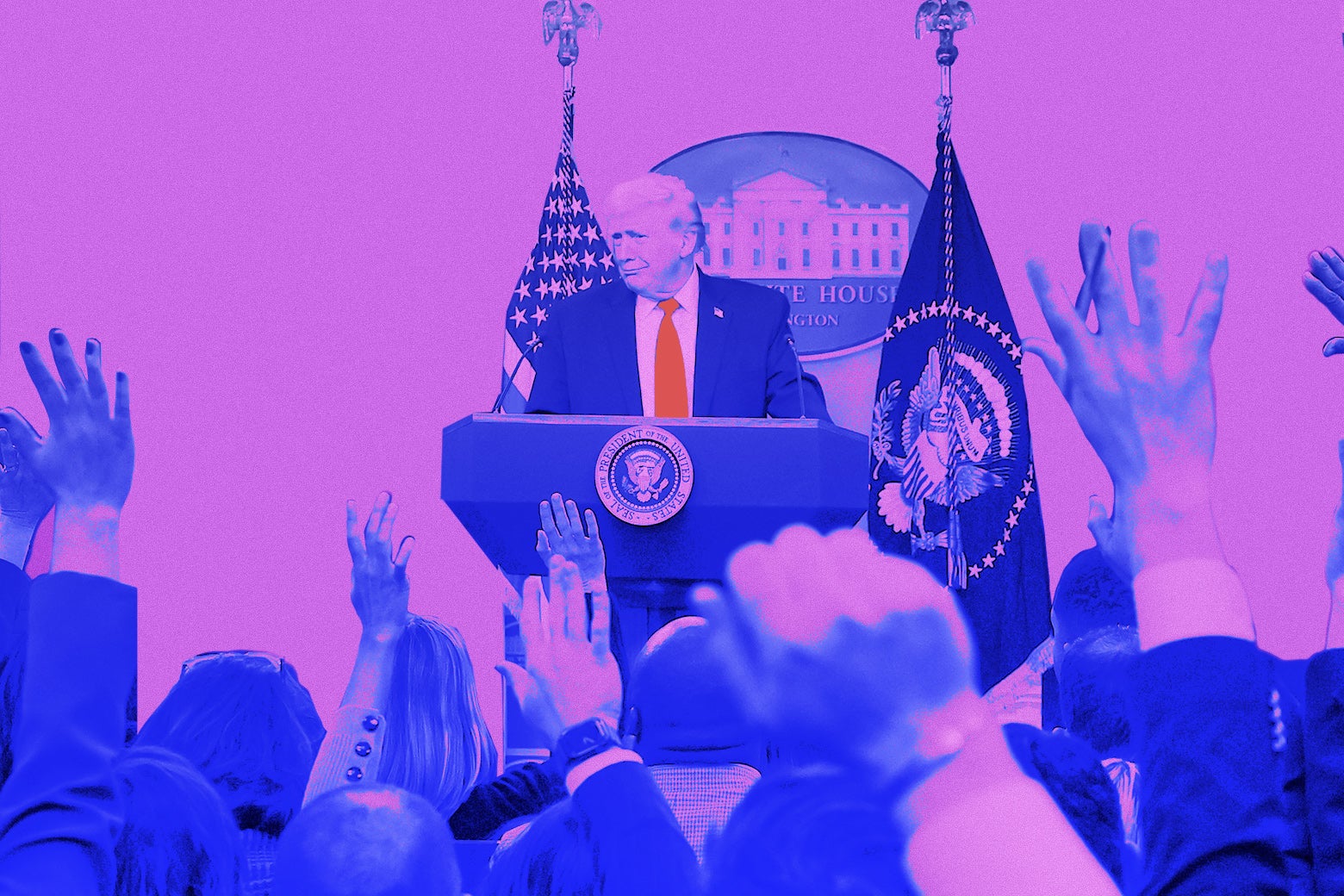
Jurisprudence By Enter your email to receive alerts for this author. Sign in or create an account to better manage your email preferences. Unsubscribe from email alerts Are you sure you want to unsubscribe from email alerts for Dahlia Lithwick? Sept 30, 20262:52 PM The White House press room. Photo illustration by Slate. Photo by Kevin Dietsch/Getty Images. Sign up for Executive Dysfunction, a weekly newsletter that highlights one under-the-radar story about how Trump is changing the law—or how the law is pushing back—and keeps you posted on the latest from Slate’s Jurisprudence team. The legal rubber met the authoritarian road last week with a full-frontal assault on the fundamental freedom of the press. Donald Trump ordered White House press passes to be revoked from three major news organizations because of their critical coverage of his administration. A federal judge ordered the White House to reinstate the passes, and they were reinstated, but those press organizations were banned from a state dinner Thursday night and CNN was kept off Air Force One on the weekend. It’s Schrödinger’s judicial order and on this week’s Amicus Podcast, Dahlia Lithwick welcomed Jameel Jaffer, the inaugural executive director of the Knight First Amendment Institute at Columbia University, to try to understand how we can live under a theoretical regime of press freedom that can be turned on and off by the president at will. Their conversation, lightly edited for clarity, follows. Dahlia Lithwick: So let’s start here. CNN, Politico, and MS Now, (formerly MSNBC), were denied access to the White House after the president decreed in a post on Truth Social that they would lose their ability to enter the building because of his feelings about their biased coverage. Last Wednesday, Judge Timothy Kelly of the D.C. Circuit held an emergency hearing in a lawsuit filed by the news outlets, and at around midnight, Judge Kelly issued a temporary restraining order to stop the White House ban for 14 days. The Knight Center, along with the Reporters Committee for the Freedom of the Press filed a brief in the case that was signed onto by news organizations. Can you tell us what issues you centered in that brief, and just lay out what relief it was that the plaintiffs felt was so urgently needed? Jameel Jaffer: This is a very unusual case in a number of ways. One of them is that there’s no dispute that the president has acted on the basis of viewpoint. You know, normally in First Amendment cases, there is a factual dispute about the motivations of government action. Often the disputes center on this question of why did the government do what it did. Why did it punish this news organization or punish this person? It’s quite unusual that the government says openly, “We’re doing this on the basis of viewpoint,” but that’s what President Trump has said here. He said it multiple times. The whole plan here was to kick out these news organizations from the White House press corps, on the grounds that their reporting was not the kind of reporting the president likes. So the only real question in the case is, does the president have legal authority to expel news organizations from the White House because he doesn’t like their reporting, Can you talk about the two First Amendment issues? I think they both ultimately come down to viewpoint discrimination, but there are two different First Amendment arguments. One has to do with, a retaliation theory.The president has taken this action in retaliation for the reporting these news organizations have done in the past. The president himself has made that clear, so one theory is that this is unconstitutional retaliation. The other theory is that The White House Press Corps is a kind of public forum under the First Amendment. A public forum is a kind of fancy First Amendment way of saying it’s a space that the government has opened up for certain kinds of expression. And once the government opens up a space for expression to the public at large or to journalists at large, then if the space is a public forum, the government can’t then expel somebody from it on the basis of viewpoint.And this is a principle that runs through a lot of different factual contexts.The institute that I run, the Knight Institute, sued President Trump in July 2017 over his blocking of critics from his Twitter account.We alleged that his social media accounts were public forums within the meaning of the First Amendment. We won that case, and the Trump administration had to unblock the critics who were blocked from his Twitter account. The argument here is that the White House press credential is basically giving you access to a kind of public forum in a metaphysical space that has been opened up to journalists for certain kinds of expression. In the same way that a city council can’t kick you out of a city council meeting because it doesn’t like what you have to say, or the school board can’t kick you out of a school board meeting because it doesn’t like what you have to say, or the president can’t block you from his Twitter account because he doesn’t like your criticism of his policies, the president can’t kick a journalist out of the White House press corps on the basis of viewpoint without violating the First Amendment. This public forum thing is a little bit complicated in this context because there are actually multiple public forums here. There are about 1,400 reporters who have “hard passes” that give them access to the White House grounds, and they can report from various spaces in the White House, based on their possession of that hard pass. An argument the courts have accepted in the past is that the hard pass represents a kind of admission ticket to a public forum. But then, within the White House, there are other spaces as well, real and metaphysical, which could be public forums as well. The White House press pool, which is a small subset of the reporters who have the hard passes, is a pool that reports on the president when he is in smaller spaces that don’t allow for the larger press corps to be with him. So on Air Force One, for example, or in the Oval Office, the White House press pool accompanies the president to those kinds of places, and when he travels, accompanies him. CNN is a broadcast member of the press pool and provides TV footage to the other members of the press corps, so do lots of other media organizations, because only a small number of news organizations are in the White House pool. So it’s a little bit complicated. There are multiple levels to this. But the issue in the brief we filed involving CNN, Politico, and MSNow is the hard pass that gets you onto White House grounds. I guess there’s also this claim distorting what you just said about both the precedent and the way we think about the First Amendment, that somehow a right of access to the White House is a privilege to be distributed to those who are worthy of it. That’s not supported in the case law, is it? There’s no dispute that the president has the authority to grant news organizations exclusive interviews. The president says, “I should get to decide who I speak to.” I think that that argument is fine as far as it goes. Again, nobody’s really taking issue with the president’s authority to invite whatever reporters he wants into the Oval Office to have exclusive conversations if he wants. The issue is that when the president has opened up a space to journalists at large, or to a large number of journalists, that takes on this special character under the First Amendment, it is characterized as a public forum. And it’s sometimes hard to draw a line between those two things: Is this an exclusive, or is it a public forum? But I don’t think that the hard pass really raises those difficult issues because, again, there are 1,400 people who hold a hard pass. There’s no argument that those people were selected on the basis of their ideology. To the contrary, it has always been the case that any bona fide journalist can get a hard pass, so long as they can get the security clearance from the White House.There are some hard questions in the doctrine, but this case doesn’t raise them. This case is very easy because it’s quite plainly a public forum within the meaning of the First Amendment. When they announce that “Well, yeah, we yanked some press passes, but Trump TV is streaming now 24/7 in real time,” this weird state-television is meant to be the curative? It’s just the opposite. It just underscores the higher level goal here is to ensure that the American public is fed a steady stream of government propaganda, either through the White House’s own app or from a press pool that has been purged of independent journalists. That’s the broader goal that is revealed by all of these moves. Donald Trump First Amendment Free Speech Jurisprudence Judiciary
How Trump’s Big Mouth Sabotaged His Press Ban
Full Article
Original Source
Read the full article at Slate →KhanList aggregates and links to publicly available news content. We do not host full articles from third-party sources. Always verify important information with original sources.