
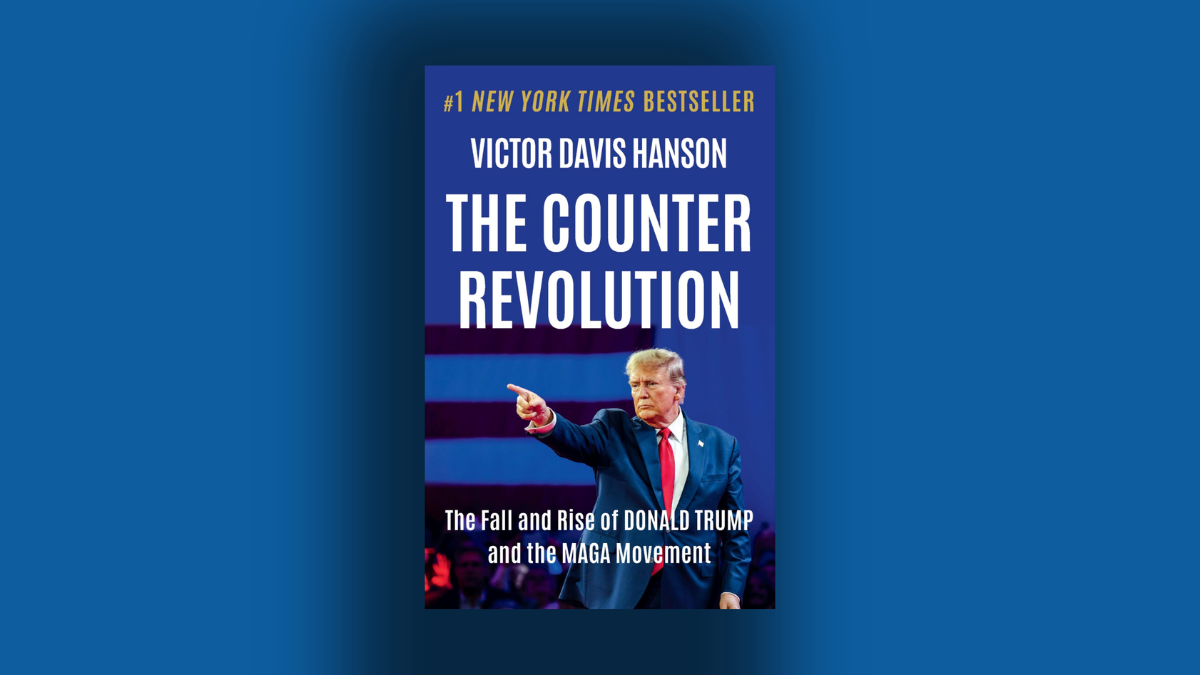
Americans love a comeback kid. It’s why we celebrate Muhammad Ali, who, after being stripped of his title and barred from professional boxing in 1967 for refusing the military draft, returned to reclaim the heavyweight championship in 1974 against George Foreman in the “Rumble in the Jungle.” It’s why we honor people such as Robert Downey Jr., who recovered from drug addictions and arrests to become one of the highest-grossing actors of all time. And, as prolific author and historian Victor Davis Hanson shows in his new book The Counter Revolution: The Fall and Rise of Donald Trump and the MAGA Movement, it’s also why so many Americans find President Donald Trump so compelling. Though American politics has had its fair share of comebacks — Nixon losing the 1960 presidential election only to win it in 1968; Grover Cleveland losing the presidency in 1888 and then regaining in 1892 — none can compare with that of Trump. Abandoned by many of his allies after the January 6 riot and hounded by a long list of investigations that seemed destined to end his career if not bankrupt him, Trump somehow overcame every doubter and waged a political campaign for the ages that ultimately returned him to the White House. Regardless of how it ends, it’s an incredible story, and Hanson deserves credit for giving us the definitive account. Remembering Every Scheme To Silence Him Hanson reminds us that after the results of the November 2020 presidential elections, things looked bleak for Trump. Appointees, both current and former, were competing with each other to prove their disdain for their seemingly ruined president. After the January 6 riots, which were exclusively blamed on Trump even though Nancy Pelosi was on record admitting, “I take responsibility for the security failures of the Capitol that day,” administration officials ran for the doors. Two days after January 6, Twitter banned Trump “for life” and Facebook followed suit six months later. When Trump tried to switch to the social media app Parler, Amazon, Apple, and Google all removed the app from their app stores. Even the banking industry largely closed its doors — Deutsche Bank announced it would no longer do business with Trump or the Trump Organization; Signature Bank closed two personal accounts held by Trump; and JPMorgan Chase and Bank of America said they would no longer finance future Trump Organization projects. “Popular wisdom held that his political career was over,” writes Hanson. Between 2021 and 2025, Trump was “targeted in five different courtrooms, facing ninety-one felony charges and some $500 million in combined fines.” In August 2022, the FBI raided his home, making him the only ex-president to enjoy that honor. When he ran for office again, almost half the states made attempts to ban him from the ballot. The sheer force of anti-Trump activity after 2020 — which included efforts by current and former members of the federal workforce, academia, mainstream media, and senior retired and active-duty members of the U.S. military — is incredible to consider, given, whatever one thinks of the man, his administration left behind a 1.2 percent inflation rate, near record-low peacetime unemployment, a secure border, and the Operation Warp Speed COVID-19 vaccine. Or consider how much energy was invested in vilifying Trump for the January 6 fiasco when compared to the several-month post-George Floyd riots, which in addition to prompting a mob attack on the White House, caused 35 deaths, $2 billion in damage, about 1,500 injured officers. Trump Derangement Syndrome is real. How Trump Came Roaring Back Given the forces arrayed against him, how could a seemingly politically impotent Trump have any chance of a resurgent campaign? Hanson lists several critical sources for this political resurrection. First, was his “boundless septuagenarian energy” — Trump staged more public campaign events than Kamala Harris and Tim Walz combined. Second, for better or worse, Trump seemed personally impervious to setbacks, never indulging in self-critical introspection. Third, the Democrats’ own platform was horrendously, embarrassingly terrible. Presidential candidate Kamala Harris sought to distance herself not only from her predecessor but her own record as vice president. Their desperation in attacking Trump, which reached the height of absurdity in its rhetoric, had the opposite effect. “The Democrats seemed strangely oblivious to this paradox: The more they searched for questionable ways to abort a Trump candidacy and later to neuter his administration, the more they only further empowered it,” writes Hanson. Indeed, the criminal and civil suits lodged against Trump not only tired the electorate but made him into a sympathetic character. Finally, there was the strength of his own campaign led by the indefatigable Susan Wiles, demonstrating not only a mastery of new media, but a keen sense of the winning issues: immigration, the economy, crime, trade, and hot-button, anti-woke cultural issues all polled in his favor. That message was so effective Trump was able to draw many influential characters into his orbit, among them Elon Musk, Tulsi Gabbard, Robert F. Kennedy Jr, Larry Ellison, Marc Andreessen, Ben Horowitz, David Sacks, and Bill Ackman. The multiple assassination attempts, catastrophic Trump-Biden debate, and Harris’s aversion to public speaking sealed the deal. Despite being outspent almost three-to-won by the Democrats and enduring largely negative media coverage, Trump’s team destroyed Biden’s candidacy and then handily defeated Harris, Trump improving his margin of voting share in 89% of all counties. “Trump’s reemergence as president after four long years of political exile marked the most dramatic political comeback in American presidential history,” observes Hanson. What’s Next? Hanson is refreshingly blunt about Trump’s weaknesses, noting his “mercurial disposition, his unorthodox methods, his unique appearance and blunt, often cruel speech, and his unfiltered stream-of-consciousness social media posting.” Nevertheless, a post-Trump MAGA must consider the “future health, longevity, and political viability of Trump himself” once he departs office in January 2029. Will his second term be deemed a success? Will Vance carry a MAGA agenda, or seek to distance himself from his political benefactor? Hanson is surely right to assess that it is extremely unlikely that the Republican Party will return to Bush-era orthodoxies that have been so thoroughly discredited, especially among conservatives. Because of this, the future survival of Trump’s peculiar brand of populist conservative politics will depend on the personal charisma and rhetorical skills of his successor, be it J.D. Vance, Marco Rubio, Ron DeSantis, or someone else. Fortunately for the Republicans, those qualities of Trump that most incite them — “all the coarseness that they loathe, and all the eccentricities and rudeness that they insisted would doom him” — were the same qualities that made him such a formidable adversary. Thus Hanson believes Trump’s legacy will haunt the Democrats long after he is gone. “Unless Democrats find another charismatic leader — on the level of Bill Clinton, Barack Obama, or Trump himself — and unless they move toward the political center, the Democrats are likely to lose any election that pits them against a workmanlike MAGA Republican candidate.” For this reason, Trump’s legacy isn’t only about the accomplishments in office, but how he permanently altered American politics. “By engraving, warping, and thereby emasculating the Democratic Party, Trump made it possible for Trumpism to outlast him.” Casey Chalk is a senior contributor at The Federalist and an editor and columnist at The New Oxford Review. He is a regular contributor at many publications and the author of three books, including the upcoming "Wisdom From the Cross: How Jesus’ Seven Last Words Teach Us How to Live (and Die)" (Sophia Institute Press, 2026). book reviewBooksComebackDonald TrumpPoliticsThe Counter RevolutionTrumpismVictor Davis Hanson
How Trumpism Will Outlast Trump
Full Article
Original Source
Read the full article at Thefederalist →KhanList aggregates and links to publicly available news content. We do not host full articles from third-party sources. Always verify important information with original sources.