
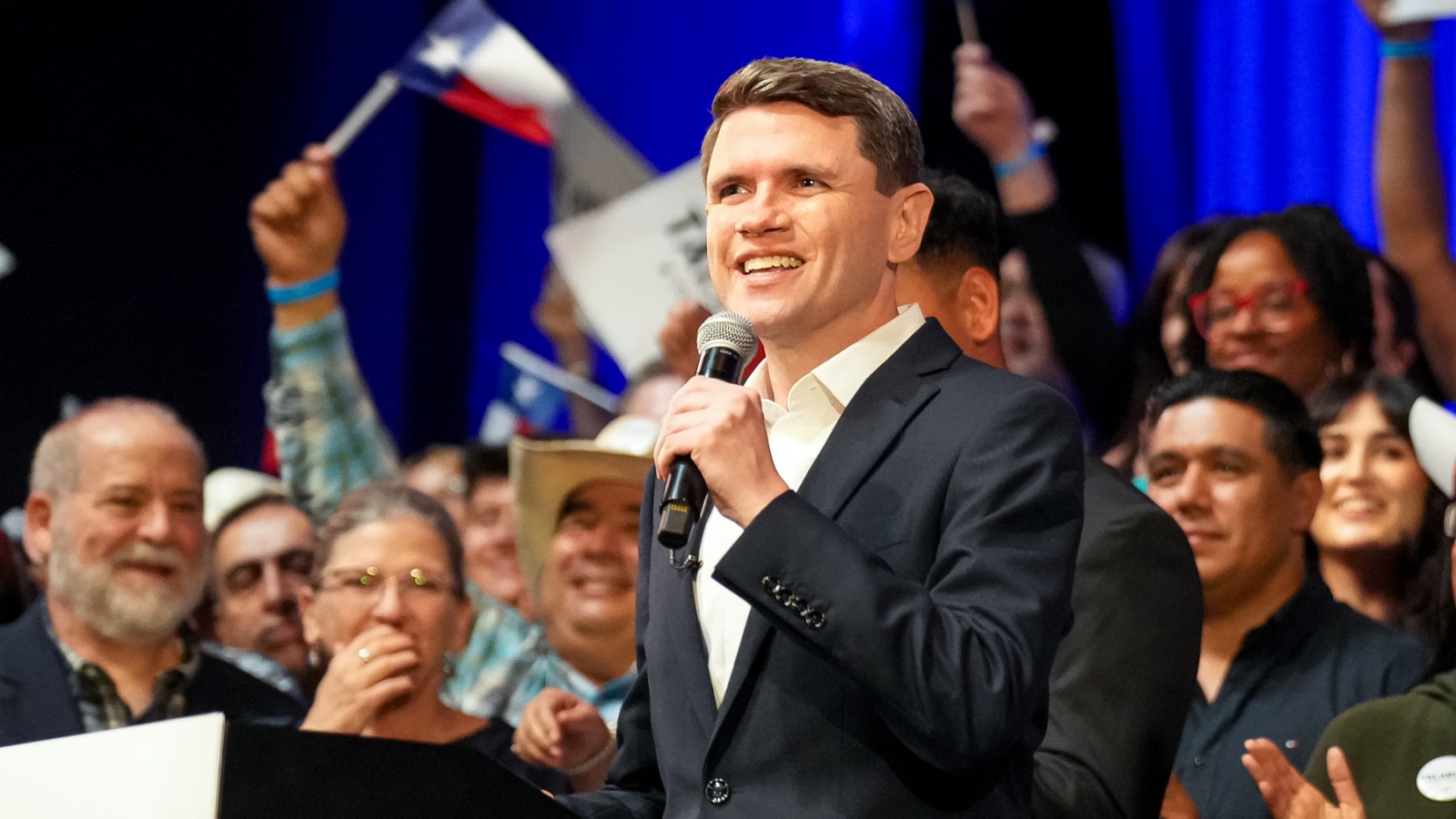
James Talarico and Adam Hamilton ran on faith and won big. Democrats can thank the president Two years ago, in the leadup to Kamala Harris’ failed run for president, I spent some time riding around Alabama and Georgia in a big blue tour bus with “Faith, Hope, & Love” plastered prominently along the side. The words come from a phrase in 1 Corinthians. The bus was being chartered by a group called Vote Common Good. The goal of Vote Common Good was to get people to vote for the candidates the group thought most likely to champion the common good — which just so happened to be Democrats, by and large. More specifically, the goal was to be achieved through chipping away at the idea that Republicans had a lock on godliness, that a Republican vote was, indelibly, a vote for God. The bus was manned by a friendly crew of disaffected evangelicals, barefoot musicians, megachurch outcasts, and racial justice warriors who believed that the Black church in America had gotten politics right, that Jesus’ frequent admonitions to feed the hungry, clothe the poor, and love thy neighbor aligned more with a blue ballot than a red one. As a progressive Christian, I believed firmly in their mission, but I thought it was a mission at the margins. And in some ways, so did they. “We like to tell ourselves we are in a 40-year project,” Doug Pagitt, a Minnesota-based pastor and the organization’s executive director, told me at the time, before going on to explain that while he believed that even a slight change in Evangelical voting patterns could make a difference in some key districts, he had no illusions about wholesale change. It had taken decades to build the Christian Right’s voting bloc. Even Vote Common Good’s most ardent disciples thought they were in for a long slog through the wilderness before they reached anything close to the Promised Land. Then came Tuesday’s election results and a parting of the Red Sea right up the I-35 corridor. James Talarico in Texas and Adam Hamilton in Kansas won their deep-red-state Senate elections in a landslide (by 12 and five points, respectively) in part because the Republicans deserved a reckoning, in part because Talarico and Hamilton were highly appealing candidates running against highly unappealing ones, and in part — large part — because their faith-based messaging found footing, especially in states where a majority of the population is church-going. Editor’s picks In fact, Hamilton and Talarico didn’t just provide a permission structure for Christian to make an exception and vote blue; they frequently framed their forays into politics as outgrowths of their faith and their Democratic positions as moral imperatives. On the campaign trail, Hamilton, the chief pastor of the largest church in Kansas and the largest United Methodist congregation in the country, frequently invoked biblical scriptures around fairness, justice, and equality. “I see a lot of people claiming to be Christians, and I wonder, ‘What Gospels are you reading?’” he told CBS. Talarico, a Presbyterian seminarian, has defended gun control, LGBTQ rights and abortion access — not in spite of biblical teachings but in fact because of them — and has proven a perfect religious counterpoint to authoritarian stances and Christian nationalism of his opponent, Texas Attorney General Ken Paxton. “When I open my Bible, I don’t see any verses about abortion, but I see more than 2000 verses about economic justice. I don’t see any verses about gay marriage, but I see hundreds of verses about welcoming the stranger and feeding the hungry and healing the sick and freeing the oppressed,” Talarico told me back in 2024. “There [has been] a concerted effort to move Christians away from the gospel and toward right-wing political objectives, but there’s very little scriptural basis for the agenda of Christian nationalist politicians in this country. Christian nationalists want us to think that Christianity is about dominating our neighbors, winning at all costs, indoctrinating children. Christians have a moral obligation to speak out against this perversion of our faith.” These are the types of arguments that have long been made by the Christian left, but were mostly drowned out in primaries long before they came close to reaching the national stage. And, ironically, without Trump, that trend may well have continued. Which is to say that in just a few years, the president’s profound corruption, incompetence, cruelty, and pandering to the religious right accomplished what otherwise may have taken generations: It opened a door for the religious left to make incredible inroads. Related Content The smartest thing the Democrats could do is endeavor to keep that door open. To maintain control in a blessedly post-Trump future, the party will need a unifying strategy beyond opposition to just one man. They will need a vision that moves beyond wedge issues and a coalition that is not dogmatic (and yes, I realize the irony in using this word). They will need, quite literally, some faith — by which I mean faith voters. “One of the big lessons of this election is that Democrats can expand the democracy-supporting coalition by including people of faith,” Pagitt, the Minnesota pastor, tells me. “The answer is not to make the party more religious, or to rely on running religious candidates. The goal is significant outreach to the many communities that make up the fabric of our society, and real inclusion of them.” Trending Stories This does not mean randomly posting Bible verses about the Lord’s power “that is at work within us,” as Hakeem Jeffries did in the wake of the election. It does not mean trying to beat the religious right at their own game and reaching for some form of performative Christian nationalism-lite. But it likely does mean putting forth more candidates whose values seem unassailable, and hewed to something other than the party itself. These values don’t need to come from religion, of course, but Tuesday’s election proves that it might not hurt the Democrats if sometimes they did. According to a recent Pew Research center poll, a majority of Americans believe in separation of church and state, and yet a majority also say that religion plays a positive role in society. Sixty-three percent of Democrats reported having a net positive view of religion (38 percent) or a neutral one (25 percent). For candidates whose faith is authentic — who don’t want to legislate their beliefs but who aren’t afraid to say that their morality is grounded in them — that faith could be seen as a bulwark against political transgressions, the selling out of the very people one is meant to represent. Indeed, America has a long and proud history of progressive Christians using the power of their faith to make life better for people in the here and now, from operating stops on the Underground Railroad to fighting against poverty, child labor, domestic abuse, and war. Here, there is a long and proud tradition of a social gospel that focuses on healing the actual world rather than storing up mansions in heaven with adherence to a hard-line, fundamentalist worldview, one in which extremism trumps love and human suffering hastens Jesus’ Second Coming. Though it hasn’t been the dominant religious narrative in Trump’s America, Talarico and Hamilton belong to that long and proud tradition. And that’s a second coming millions of voters would rejoice to see.
How Trump Opened the Door for the Christian Left
Full Article
Original Source
Read the full article at Rollingstone →KhanList aggregates and links to publicly available news content. We do not host full articles from third-party sources. Always verify important information with original sources.