
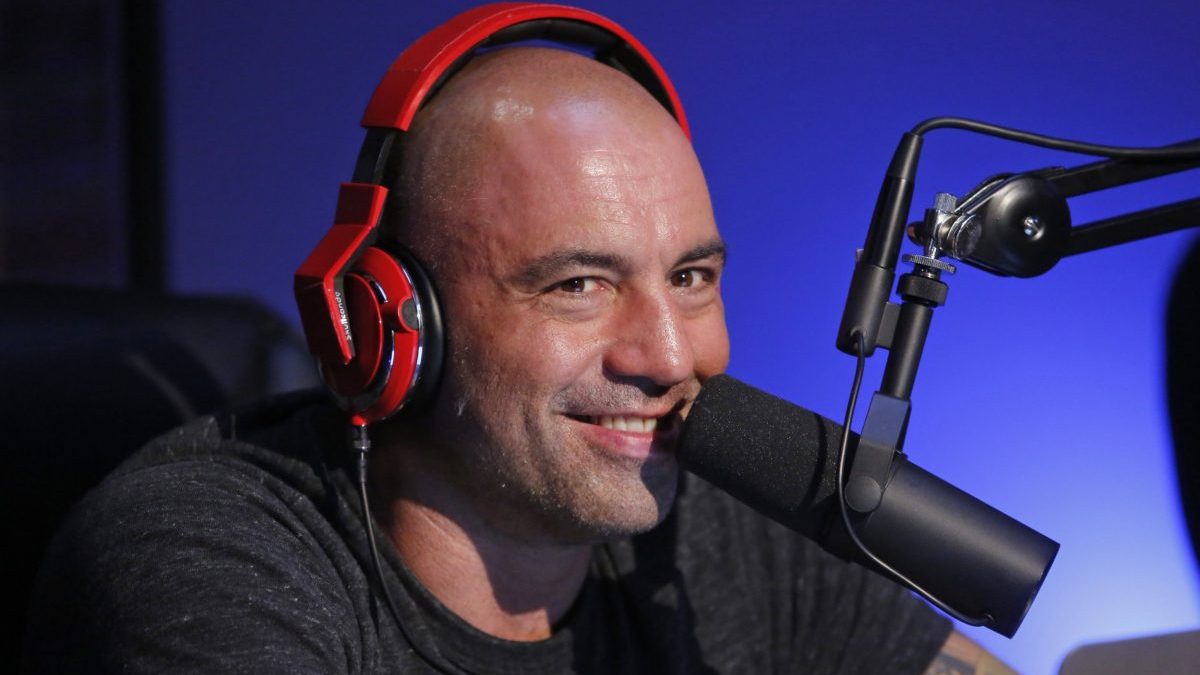
“It was the pod bros wot won it.” That could easily have been the headline in 2024, after Donald Trump stormed to victory in the presidential election with the testosterone-drenched help of the podcast manosphere and, in particular, its loudest voice, Joe Rogan. Back then the podcast king, who the Wall Street Journal described as “the most influential swing voter in America”, endorsed Trump. Rogan’s influence has only increased since. In March 2024, his podcast The Joe Rogan Experience had 14.5 million followers on Spotify. That has since grown to around 18 million followers. Alongside the likes of Tucker Carlson, former US Navy Seal Shawn Ryan and Dan Bongino, who served for nine months as Trump’s FBI deputy director, Rogan has become a leading light in the manosphere – a motley crew of podcasters and online influencers who became self-styled champions of traditional masculinity, anti-wokeism and, at one point, Maga politics. However, ahead of this month’s midterms, the 59-year-old comedian and wrestling commentator turned his back on the President. Trump “didn’t just lose the podcast bros”, said Rogan last week on his podcast, “he lost most of the country”. This assessment shows how the midterms not only upended the political geography of America, but also marked a shift in a conservative media ecosystem that used to be solid Maga. Joe Rogan was one of several members of the ‘manosphere’ who backed Trump in November’s election (Photo: Mandel Ngan/AFP) No demographic turned out to be more pivotal in the presidential election two years ago than men aged between 18 and 29, 55 per cent of whom backed Trump over his Democratic opponent, Kamala Harris. Support for Trump among young white men, millions of whom listen to Rogan and his fellow Maga-friendly podcasters, was even higher, at 63 per cent. In the midterm elections, however, at least 59 per cent of men aged from 18 to 29 voted Democrat, a massive swing away from the Republicans. Not only should we be talking of a blue tsunami but also a right-wing manosphere meltdown. Rogan, in his election post-mortem, itemised why one-time Maga supporters had deserted the President’s party. Number one was “a war that no one wants to be in”. Rogan also hit back against the Trump’s administration’s crackdown on unauthorised immigrants by “militarised police in the streets wearing masks”. It was not, he said, “a good thing to snatch people up out of their f**king taco stand that have been in the country for 20 years”. He has previously criticised the administration’s handling of the Epstein files and the Trump family’s money-making crypto schemes. All this was a far cry from 2024, when a week-and-a-half from Election Day Trump spent almost three hours chatting on air to Rogan about everything from UFOs to wind farms, the possibility of life on Mars to the military tactics of Confederate General Robert E Lee, which he likened to UFC cage fighters. That episode garnered 25 million listens, and more than 50 million downloads on YouTube, and came to be regarded as one of the most important media events of the 2024 election campaign – up there with Joe Biden’s catastrophic televised debate performance and the assassination attempt on Trump in Butler, Pennsylvania. Two years ago, the manosphere media blitz became a central prong of Trump’s campaign strategy to regain the presidency. Trump not only appeared with Rogan but took part in more than a dozen podcasts, including Theo Von’s This Past Weekend, Andrew Schulz’s Flagrant, the Full Send Podcast from the Nelk Boys, Bussin’ With The Boys, a sports podcast hosted by former NFL players Will Compton and Taylor Lewan, Logan Paul’s Impaulsive show and Adin Ross’s Stream. Andrew Schulz, another manosphere influencer, broke with the President prior to the start of the Iran war (Photo: Emma McIntyre/Getty for Netflix) But in this election cycle, Trump did not appear on a single one of their shows. Even before the Republican rout, Trump aides from the 2024 campaign were sounding the alarm. “If we don’t win it will be because the President’s staff failed to execute his winning playbook in 2024,” warned former Trump communications specialist Caroline Sunshine in late October. “We’re not on podcasts, we’re not talking to that audience… Hey guys, we need to go talk to Joe Rogan.” Trump’s lack of appearance may be because he had come to regard himself as the “influencer-in-chief”. The White House also knew many of the manosphere presenters had become hostile. Theo Von, who presents the number 2 show on Spotify, with five million monthly listeners, has labelled the Iran war “diabolical,” “insane,” “sick,” “f**king baffling”, and “dark”. Another critic is Adin Ross, the internet celebrity who in 2024 famously presented Trump with a Rolex watch and customised Tesla Cybertruck emblazoned with the iconic shot of Trump punching the air after surviving the assassination attempt in Pennsylvania. Ross evidently suffered “eight figure” losses on the stock market following Trump’s Liberation Day tariff spree and announced on a livestream last September that he regretted ever venturing into politics and associating himself with Trump. Like Ross, Schulz, another manosphere influencer, also broke with the President prior to the start of the Iran war. In July 2025, Schulz complained Trump was “doing the exact opposite of everything I voted for”. He added: “I want him to stop the wars. He’s funding them. I want him to shrink spending, reduce the budget. He’s increasing it.” The moustachioed comedian has also been critical of Trump’s handling of the Epstein files. Since the midterms, on his Brilliant Idiots podcast, Schulz has accused the Trump administration of “corruption and cronyism that has never been seen in Western democracy” and hit out at Trump as “the greatest failure of a President of our lifetime”. The Trump administration has previously said: “Neither the President nor his family has ever engaged – or will ever engage – in conflicts of interest.” It recently added that Trump acts only with the best interests of the American people in mind. Jake and Logan Paul in the VIP viewing area in Emancipation Hall for the Inauguration of Donald Trump in January 2025 (Photo: Angelina Katsanis – Pool/Getty) Other than illustrating the deep anger towards the President, and the sense of betrayal over Iran, what does this tell us about US political culture? Certainly it speaks of the split evident at this election, in which voters loosened their affiliation to the Republican Party and the Maga movement without necessarily developing a firm attachment to the Democrats. It also demonstrates what’s called horseshoe politics, where the right and left are often not that far apart, like the tips of a horseshoe. Manosphere podcasters are not as ideological, and therefore not as set on to the Republican Party as conservative shock jocks of the past, such as Rush Limbaugh, whom Trump awarded the Presidential Medal of Freedom in 2020. Limbaugh, for instance, remained a staunch supporter of George W Bush’s deeply unpopular Iraq war. Then there is the profit motive: the dollars and cents, which may have turned influencers into followers. Brian Rosenwald, the author of Talk Radio America: How an Industry took over a Political Party that took over the United States, told CNN that “few hosts of any stripe are going to do something that puts them on the wrong side of their audience – which threatens the bottom line”. That is a financial rationale that Trump himself would understand. But over the course of this century, American voters have become far more fickle. Three one-term presidencies have followed three two-term presidencies. In 12 out of the 14 elections, the White House, the House or the Senate have changed hands. The podcast manosphere speaks of this political whiplash. The Joe Rogan Experience is being mirrored across the land.
How Trump lost Joe Rogan in the manosphere meltdown
Full Article
Original Source
Read the full article at Inews →KhanList aggregates and links to publicly available news content. We do not host full articles from third-party sources. Always verify important information with original sources.