
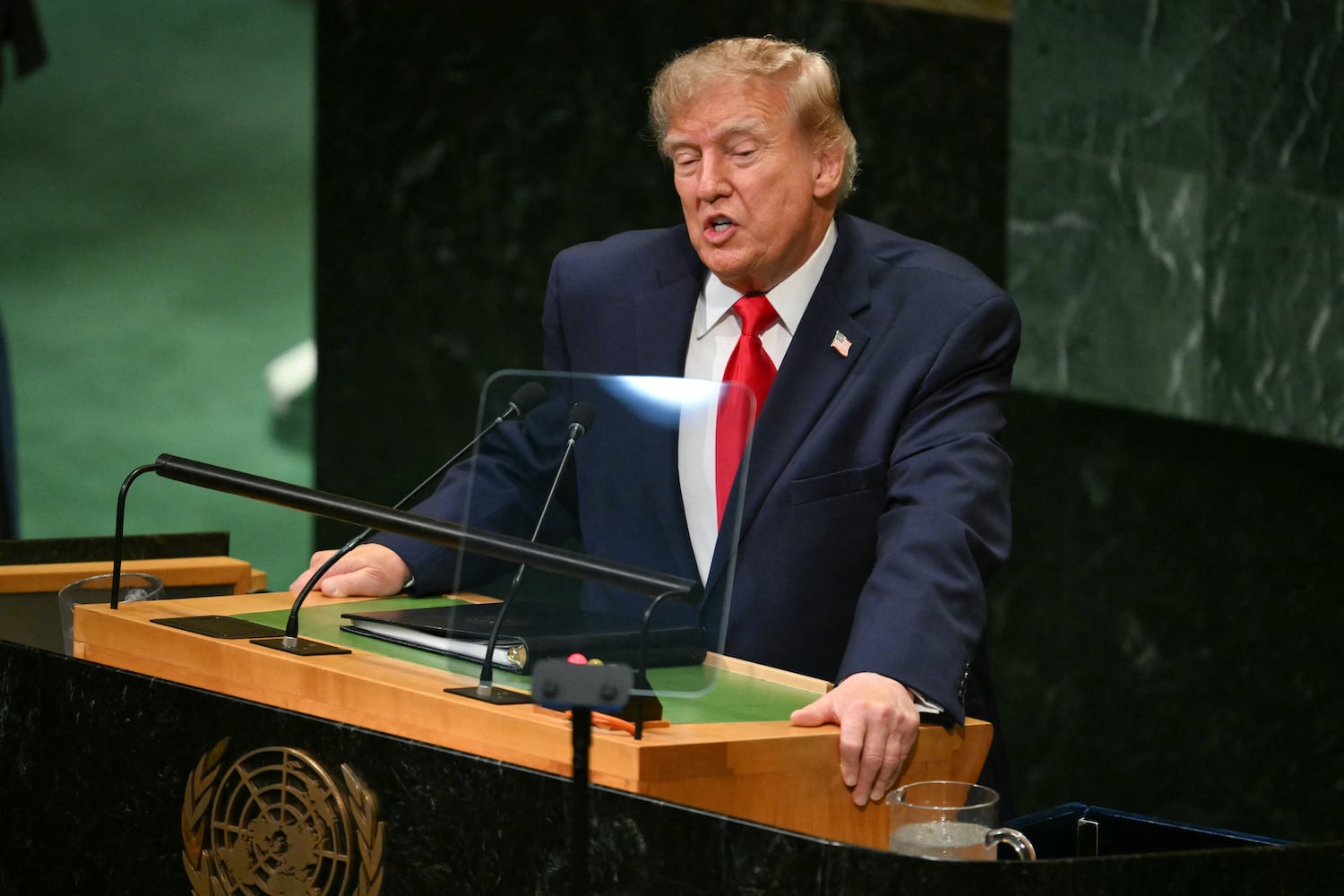
The president’s call to rebrand AI as “super intelligence” has led to a surge of interest in Slovenia’s “.si” web domain. Trump, wearing a red tie, addresses the United Nations General Assembly from behind a lectern. U.S. President Donald Trump addresses the 81st United Nations General Assembly at United Nations headquarters in New York on Sept. 22. Angela Weiss/AFP via Getty Images September 28, 2026, 3:41 PM For most of the past year, Slovenia’s official web domain registrar has recorded just around a thousand new registrations a month. That’s to be expected—after all, the small Eastern European country is home to only 2.1 million people. But last week, after U.S. President Donald Trump addressed the United Nations General Assembly in New York, the portal received more than 6,000 registrations in just two days. For most of the past year, Slovenia’s official web domain registrar has recorded just around a thousand new registrations a month. That’s to be expected—after all, the small Eastern European country is home to only 2.1 million people. But last week, after U.S. President Donald Trump addressed the United Nations General Assembly in New York, the portal received more than 6,000 registrations in just two days. During a riff about global efforts to govern artificial intelligence, Trump said he was changing the technology’s name to “super intelligence” in all official U.S. documents. “The use of the word ‘artificial’ makes intelligence … sound fake, and it is not fake. It’s actually amazing,” he said. “In other words, welcome to the new world of super intelligence—SI,” he added. “It sounds much better, it is much better, and it’s more accurate. Let’s see if I have any power.” It just so happens that Slovenia, where U.S. first lady Melania Trump is from, owns and operates the “.si” domain name. The impact was immediate. More than 2,000 new websites were registered using the “.si” domain name on the day of Trump’s speech and more than 4,000 the day after, according to data shared by the Academic and Research Network of Slovenia (ARNES), which oversees the country’s domain registration portal. That brought the number of domain registrations in September to over 10,000 and pushed the overall number of web domains registered with the country past 200,000 for the first time ever. Register.si, the portal run by ARNES, does not give out the domains itself; it only records registrations made by roughly 90 domestic and foreign registrars, for which it charges 10 euros per registration. “The final price for domain holders depends on the policy of the individual registrar, and Register.si has no influence on it,” the portal said in a statement posted online. “In any case, we advise holders of trademarks, slogans, companies … who do not yet have a domain under .si to register it as soon as possible.” At least one registrar is already cashing in. Hostinger, a web domain provider headquartered in Lithuania, is advertising “.si” domains on its websites at a discounted rate of $11.99 for the first year and $16.99 thereafter. “AI is now called superintelligence. Register your .si domain,” one advertisement reads. Hostinger also has a first-year discount for “.ai” domains (which belong to the British overseas territory of Anguilla), charging $89.99 initially and $109.99 thereafter. ARNES, Register.si, and Hostinger did not immediately respond to requests for additional comment on Monday, outside of regular business hours. As Bloomberg reported in 2023, Anguilla—which was assigned the domain “.ai” by the Internet Assigned Numbers Authority, a global nonprofit that manages web domain registrations—has made a killing off the surge in demand for “.ai” websites after the 2022 launch of OpenAI’s large language model ChatGPT thrust AI into the global lexicon overnight. The island made around $32 million off domain registrations in 2023, according to the International Monetary Fund, accounting for more than 20 percent of the government’s annual revenue. Purchases of “.ai” domains on GoDaddy, one of the most popular private registrars, have increased by 2,000 percent in the past eight years, the company says on its website. While it remains to be seen if Trump’s “super intelligence” push will have a similar impact on Slovenia, it’s clear that the term is here to stay—at least within his government while he’s president. The day after Trump’s speech, Michael Kratsios, the director of the White House Office of Science and Technology Policy, touted the impact of “super intelligence, formerly known as AI,” in a speech to the U.N. Security Council. But the Slovenian registrar wrote in a blog post that its standard price for registrations means that “speculations in the media about ‘millions of earnings for Slovenia due to increased interest in .si’ … have no real basis.” Science and Technology United States Europe Rishi Iyengar Read More U.S.President Donald Trump is seen walking of off the stage at the United Nations in New York City. A Tale of Two UNGA Speeches U.S. President Donald Trump made threats, while outgoing U.N. Secretary-General António Guterres called for peace and multilateralism. Amandeep Singh Gill, United Nations envoy on technology, speaks at the 2022 Concordia Annual Summit in New York City on Sept. 19, 2022. ‘Scorpions in a Bottle’: What the U.N. Can Do About AI Safety A conversation with the multilateral institution’s top tech envoy. OTHER SUBSCRIPTION OPTIONS Stories Readers Liked Go to slide 1 Go to slide 2 Go to slide 3 Go to slide 4 Go to slide 5 Go to slide 6 Go to slide 7 Go to slide 8 Go to slide 9 Go to slide 10 A statue of a seated, bearded man with a bare torso and draped cloth around his waist, holding a scroll in one hand, positioned in front of a row of large classical columns. An illustration of Donald Trump in a blue suit and long red tie gesturing with open hands in front of a grid patterned background with jagged red, blue, and black line graphs diving downward. Five people sit in folding chairs pushed up against a wall, all of them on their phones and several looking board. Text on the wall behind them says "AI for Real" with images of robotic arms and household appliances printed around it. An illustration depicting a man submerged up to his nose in water. The wavy water is divided horizontally into three color bands that mimic a flag: white foam at the very top peaks, a deep blue middle section filled with bubbles, and a red lower section covering his neck and suit jacket. His blue eyes look upward with a wide, strained expression. As the Tide Turns Against Putin, Beware the Drowning Man By Peter Frankopan Negotiators from the United States, Canada, and five European countries converse after finishing the draft of the North Atlantic Treaty in Washington on March 18, 1949. Trans-Atlanticism Isn’t Dead—It’s Being Renegotiated By Alexandra de Hoop Scheffer A woman crosses a road in front of a mural depicting Russian President Vladimir Putin in Kashira, Russia, southeast of Moscow, on Oct. 16, 2017. The Western Myth of Russian Greatness By Christian Caryl An illustration of a vintage-style map featuring North America and parts of Europe and Africa. Overlaid on the map are 3D red brick walls shaped exactly like the borders of the contiguous United States and Alaska, casting long shadows to the right. America, the Once Global Nation By Odd Arne Westad A creative illustration against a pale yellow background showing a garden planter containing a dense green hedge. Five human arms emerge from the hedge, with four of the hands holding small flags of China, Russia, the United States, and the European Union, while the fifth hand holds the flag of India. An illustration showing a pair of hands tightly wringing out an American flag. Water droplets shaped like missiles squeeze out of the twisted fabric and fall toward a puddle shaped like the map of Iran on a red background. An aerial photo shows Doha in the booming petrostate of Qatar.
How Trump Is Sparking a Slovenian Website Boom
Full Article
Original Source
Read the full article at Foreignpolicy →KhanList aggregates and links to publicly available news content. We do not host full articles from third-party sources. Always verify important information with original sources.