
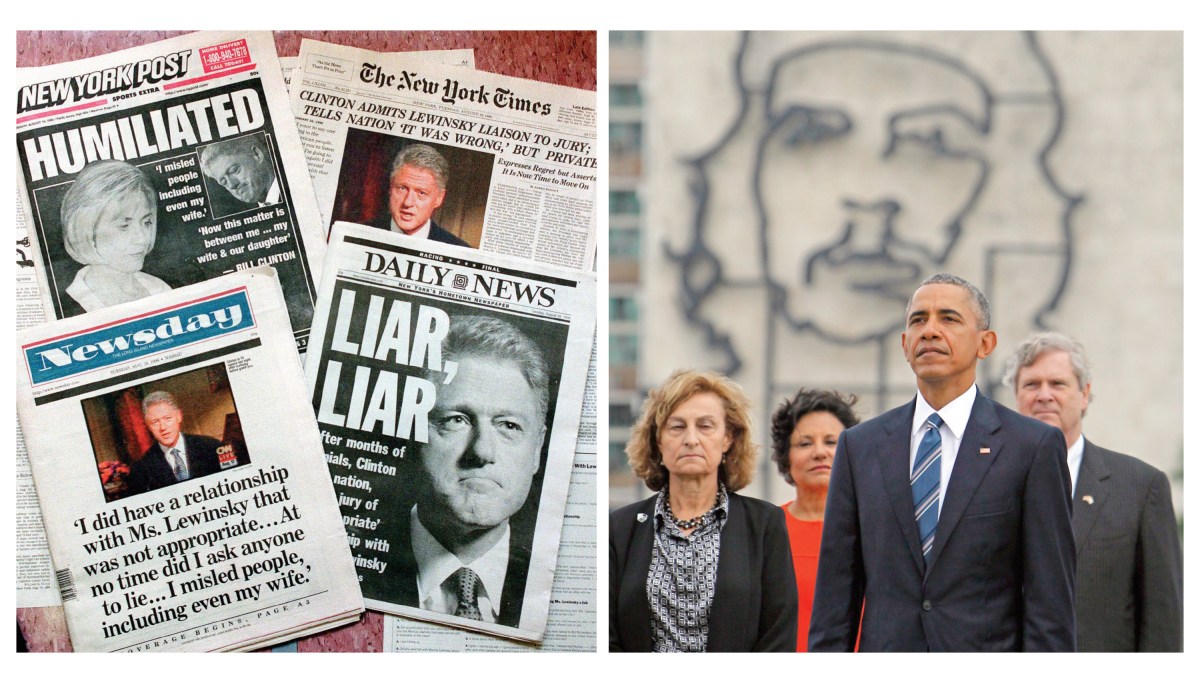
The final countdown has officially begun. As President Donald Trump goes into his last two years as president, he is only one of six presidents to have entered his last two years following the ratification of the 22nd Amendment, and therefore constitutionally precluded from running again.Like Trump, every one of those predecessors experienced midterm election losses and had to grapple with opposition control of Congress going into their finales. Some handled it better than others, and their experiences could be helpful to Trump as he tries to figure out how to succeed in this challenging period.Dwight D. Eisenhower may have had the easiest time, but even he, with his extraordinary planning skills, faced significant opposition. In 1958, Democrats took advantage of an economic downturn and scored big in the midterm elections. Despite those losses, Eisenhower presided over Alaska and Hawaii becoming states, and the United States passed the Landrum-Griffin Act in 1959 to address labor union corruption. Eisenhower also had to deal with continuing fallout from the 1958 departure of his powerful chief of staff Sherman Adams and the shootdown and capture of U-2 pilot Francis Gary Powers over Soviet territory. Ike’s final years as president are remembered primarily for his farewell address in which he warned of the dangers of the military-industrial complex and its impact on Washington politics and spending. It remains one of the best-known presidential addresses in history. Following the admission of Alaska and Hawaii as states, President Dwight Eisenhower displays the new 50-star flag for the first time at the White House, Aug. 21, 1959. (Byron Rollins/AP) After Eisenhower, it would be almost three decades before another president faced the same mandated last-two-years situation. Ronald Reagan lost the Senate in the 1986 midterm elections, meaning Democrats held both houses of Congress for his final two years. Reagan did not get much of his own agenda advanced legislatively in that time, although the Democrat-controlled Congress passed the Civil Rights Restoration Act, the Clean Water Act, and a highway bill over his veto. Unfortunately for Reagan, his last two years were largely marked by setbacks, including hearings on the Iran-Contra scandal, the Senate’s rejection of Judge Robert Bork’s nomination to the Supreme Court, and the Black Monday stock market drop of Oct. 19, 1987. Still, Reagan left office with high approval ratings and is the only one of the five to see his vice president, George H.W. Bush, succeed him. In fact, Reagan is the only one of the five to have his immediate successor come from his own party.The first Democrat to face this constitutionally mandated final two years was Bill Clinton. Republicans had both houses of Congress, but the 1998 midterm elections were seen as a win for Clinton, as Democrats did better than expected. House Republicans impeached Clinton over the Monica Lewinsky scandal during the post-election lame duck period. The Senate acquitted Clinton in 1999, but the entire episode was both damaging and embarrassing to Clinton.The passage of permanent normal trade relations with China was seen as a win at the time but is viewed far more skeptically today. Clinton also desperately tried to get a peace agreement between Israel and the Palestinians, but Palestinian leader Yasser Arafat rejected every offer without even counter-offering, choosing instead to start an intifada that killed more than 1,000 Israelis.Clinton wins in his final period included successfully staving off the potential Y2K crisis and generating excitement about the new millennium via his “bridge to the 21st century” rhetoric. While Clinton had high approval ratings toward the end, he damaged himself on his way out the door by pardoning financier and tax dodger Mark Rich, whose ex-wife had given large sums to Democratic causes.At right, a selection of New York newspapers the day after President Bill Clinton testified before a grand jury on his relations with former White House intern Monica Lewinsky, Aug. 18, 1998; at right, President Barack Obama takes part in a wreath-laying ceremony under the image of Communist icon Che Guevara in Havana’s Revolution Square, March 21, 2016. (Marty Lederhandler/AP; Joe Raedle/Getty Images) Clinton’s successor George W. Bush had perhaps the roughest last two years. He lost both houses of Congress in the 2006 elections, a Democratic blowout Bush himself called a “thumping.” Bush shook up his staff in the aftermath, replacing Don Rumsfeld at the Pentagon in a move widely considered to be overdue. While Bush had some success with the Iraq surge in 2007, voters for the most part had grown tired of the discouraging headlines out of Iraq and Afghanistan. Also, despite some bipartisan support and a major administration push, Bush failed to pass his comprehensive immigration reform.Unfortunately for Bush, his last two years are best remembered for the financial collapse in the fall of 2008. He did get an emergency infusion of capital package through Congress, but Democratic sentiment was so bitter toward Bush that he had to step back and let his Treasury Secretary Hank Paulson work directly with Democrats to make it happen. Bush’s approval ratings upon leaving office were the lowest of the group, and Barack Obama trounced Republican John McCain in the 2008 election.Obama then became the third president in a row to face the lame duck challenge. He focused on foreign policy initiatives in that period, pushing through the Iran nuclear deal, joining the Paris climate accords, and visiting Cuba in March 2016. Obama also faced setbacks, including Merrick Garland’s failed Supreme Court nomination, congressional investigations of the Benghazi Embassy attack, and questions regarding the handling of terrorist attacks in both San Bernardino, California, and Orlando, Florida. In contrast to Eisenhower, Reagan, and Clinton, Obama’s vice president, Joe Biden, chose not to run to replace Obama. Obama played a role here, as he had encouraged Biden to step aside in favor of Hillary Clinton, who lost to Trump.(Examiner graphic; Clinton, Kenneth C. Zirkel; Bush, Ffitzsimons) This unhappy history does provide some lessons and warnings for Trump, the latest president to face this last-two-year crucible. The first lesson is that major legislative accomplishments are very hard to come by, which means that the president should focus on things within his control, specifically executive actions and agenda-setting. The second lesson is to avoid scandals and significant staff turnover to the extent possible. Trump would be wise to secure pledges from staff hired or promoted from now on to stay until the end of the administration.WHY TUESDAY’S ELECTION RESULTS WILL DEFINE THE LAST TWO YEARS OF TRUMP’S PRESIDENCYThe playbook of executive action and avoiding tumult creates both an opportunity and a challenge for Trump. He has shown in his second term an ability and an interest in unilateralism, getting things done without Congress, and he should use that ability to his advantage in his final years. Trump has already signaled that he is thinking this way, talking about using pardons and vetoes to blunt the efforts of a Democratic Congress. He’s also proved skillful at setting the national agenda, marketing ideas effectively, and framing conversations that get the whole nation talking. He should consider choosing a major area of concern and highlighting it, as Ike did with the military-industrial complex.At the same time, Trump is prone to controversies, scandals, and dramatic staff turnover, things that have bedeviled other presidents in their last two years. These two factors that define Trump are two sides of the same coin. It will be his ability to master one while minimizing the other that determines whether he can use these lessons from his predecessors and have an effective last two years.Washington Examiner contributor Tevi Troy is a senior fellow at the Ronald Reagan Institute and a senior scholar at Yeshiva University’s Straus Center. He is the author of five books on the presidency.
How Trump can navigate the rest of his term with a Democratic Congress
Full Article
Original Source
Read the full article at Washingtonexaminer →KhanList aggregates and links to publicly available news content. We do not host full articles from third-party sources. Always verify important information with original sources.