
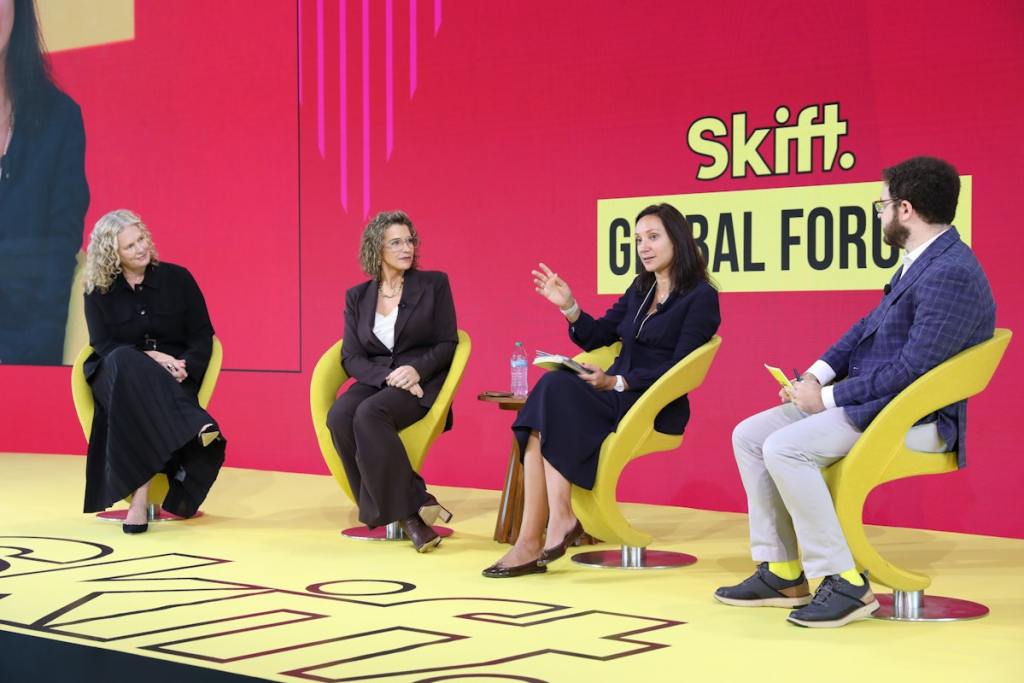
The Decision Brief Traci Mercer, Chief Commercial Officer, PricelineHeather Balsley, Chief Commercial & Marketing Officer, IHG Margaux Constantin, Partner, McKinsey & Company Moderated by Seth Borko, Skift THE VERDICT The distribution and marketing funnel is changing shape. Skift and McKinsey’s seventh annual research collaboration, based on a study of 1,000 consumers and traveler diaries, found that the booking journey has transformed from a linear path to more of an orbit — expanding, contracting, and continuing well past the transaction. Constantin said the number of touch points from intention to booking has grown from roughly 45 in 2018 to an estimated 65 now, though she called that number “slightly arbitrary” because it is “very difficult to pinpoint when that journey really starts and when it ends.” One in every three steps in the journey takes travelers further away from making a decision. More than 50% of travelers change their minds and rebook after the initial booking. Companies still organizing their spending around a linear path to purchase are investing based on a model that no longer describes how travelers actually behave. PATHS FORWARD Show up where AI is doing the research. Mercer said travel companies are facing a shift from search engine optimization to generative engine optimization. They need to “make sure that you’re actually there in all of those funnels to be explored.” Balsley said IHG is rolling out a modern hotel content platform this year to ensure properties have “machine-readable, high-quality” content that surfaces across its own channels and through third parties. Any travel brand whose content is not structured for AI-powered discovery risks being invisible in a channel that more than 70% of travelers already use for research. Treat the post-booking window as live marketing. Constantin said more than 50% of travelers rebook after their initial booking, with about 40% looking for better prices and 30% driven by fear of having made the wrong choice. She said the period between booking and check-in is “a unique opportunity to engage with that traveler that is currently maybe a little bit underappreciated.” Balsley said IHG is introducing lifecycle marketing between booking and stay, including upsell and flexibility products. Companies that go dark after confirmation are handing that window to competitors. Build memory into the experience. Constantin said travelers often go back four or five times to the same website to continue searching, but there’s “no memory of that.” Mercer said Priceline’s Penny agent keeps “the context of the entirety of the trip and the optionality across the trip” in one place. Any platform that remembers what a traveler looked at, compared, and booked has a structural advantage over one that starts fresh with every visit. WHAT TO WATCH More than 70% of travelers use AI for research and comparison, but fewer than 16% are comfortable actually booking through an AI tool. Balsley said the question is “which platform AI is running on and which platforms they will trust.” She said that when IHG partners with AI platforms, the booking itself still goes through IHG. How fast that trust gap closes — and who captures the booking when it does — will determine whether agentic booking becomes a distribution channel or remains primarily a research tool. Constantin said 60% of travelers feel AI has made finding options faster, but that the process paradoxically takes longer because more information raises the pressure to choose well. She said 80% of travelers enjoy spending time researching, which suggests AI may be adding to traveler anxiety rather than reducing it. In that scenario, the value of an AI agent that can close a booking increases. Access all the Skift Takeaways from this event, as well as full session videos, presentation documents, and more editorial coverage at our Skift Global Forum attendees hub.
How Travel Search, Discovery, and Booking Are Being Rewritten
Full Article
Original Source
Read the full article at Skift →KhanList aggregates and links to publicly available news content. We do not host full articles from third-party sources. Always verify important information with original sources.