
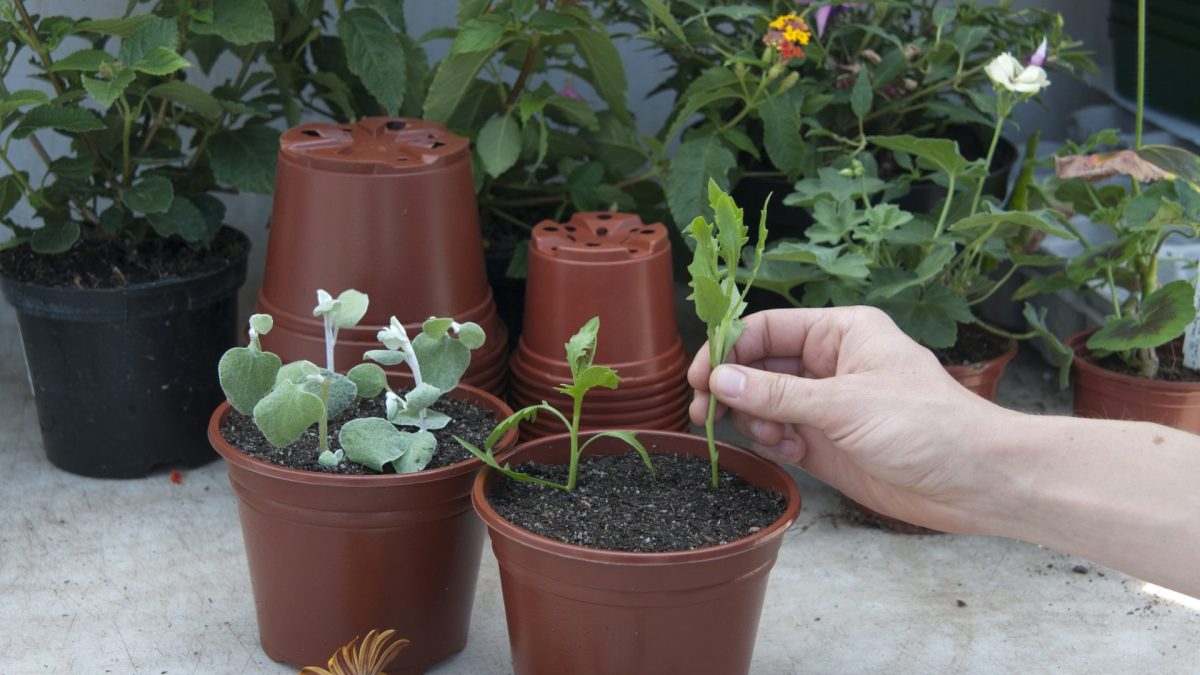
Tender plants – lantana and petunia, for example – come from brighter, hotter countries than Britain and have thrived in the warmth and light of this summer. Now is the time to start thinking about keeping them for next year to save buying more in spring. The plants are large now and take up much space over winter even if you have a heated greenhouse or conservatory (and can afford the heating). Saving space by taking cuttings in late summer and early autumn is an easy way to keep a stock. Little, space-saving rooted cuttings can be kept going over winter on a window sill or other bright, frost-free place. They can be repotted in spring and more cuttings taken if needed. Shorts Choose firm, pest-free, non-flowering shoots, about 5-10cm long, severed at a leaf joint (inset), and all leaves on the lower half removed. Use a sharp knife or Stanley blade. Root these in sandy potting media in small pots or trays in an unheated propagator, in a cold frame or just cover the trays with a plastic bag and leave in a greenhouse or on a window sill. Insert the cuttings up to the lower leaves with a dibber and water well to settle. Rooting powders are unnecessary and no fungicides are recommended for cuttings nowadays. Expect rooting in about three weeks, when the plants can be uncovered in stages to acclimate them to less humidity. Start with zonal and ivy-leaved pelargoniums, as these root relatively slowly. Take 100- to 120mm-long cuttings, sliced at a leaf node, and place each cutting in a small pot – there is no need to cover pelargoniums. Keep the pots moist but not wet. Expect rooting in three weeks, then keep outdoors until frosts threaten. Some people uproot their pelargoniums in October, wrap them in newspaper and place them in a cardboard box to keep them frost-free until spring. This requires very careful judgement, but if no other option is available it is worth an attempt. Other tender plants to consider include abutilons, argyranthemum, aubrieta, bidens, calceolarias, salvia and verbena, including lemon verbena. In spring, the plants can be started back into life with watering, feeding and more warmth, to be potted up for planting out or for more cuttings. They should be moved to an unheated greenhouse or other sheltered spot as soon as possible. Keep Pelargoniums moist but not wet (Photo: Trials Dept, Wisley/RHS) Hardier cuttings including diascia, penstemon and osteospermum can over-winter in unheated protection such as a coldframe, cloche or unheated greenhouse in a fleece tent. The main danger is rotting from excess moisture, so ventilation needs to very generous, but in freezing weather cover with double fleece or hessian. If you need some more shrubs, including privet, cherry or Portugal laurel, it is not too late. Take quite large cuttings, 19-23cm, pull off with a heel or cut at a joint with sharp secateurs, and place in your cold frame or similar. They might not root until May, however. Some plants obligingly have tubers (dahlias, left, salvia patens and begonias), bulbs (gladioli) or rootstocks (canna) – these can be left until October before they have to be retrieved. In light, sandy soils in southern regions dahlia tubers can be left in place over winter with a protective mulch of wood or bark chips. Other tubers and rootstocks should be lifted, trimmed, partially dried, packed with dryish potting compost and stored in trays in frost-free places including sheds. Centrally heated homes are too warm for them to survive well. Being leafless, they don’t need greenhouse conditions.
How to take plant cuttings and save money next spring
Full Article
Original Source
Read the full article at Inews →KhanList aggregates and links to publicly available news content. We do not host full articles from third-party sources. Always verify important information with original sources.