
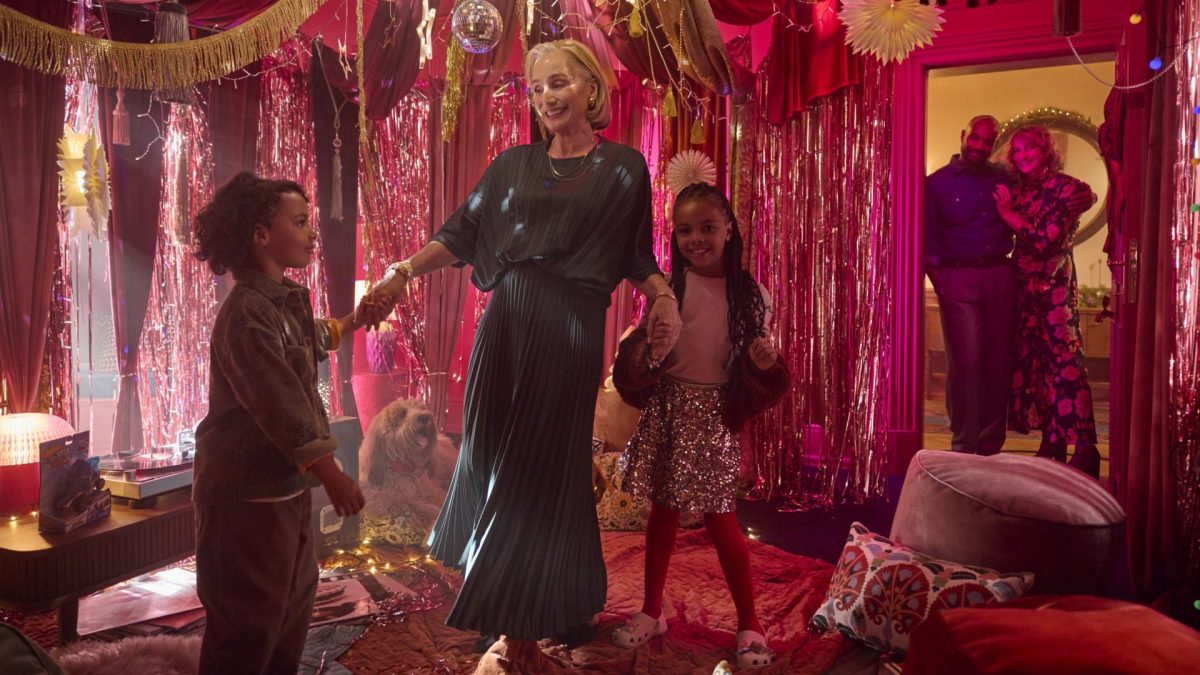
The brilliant thing about young grandchildren is that they love you unconditionally and they show it. But then for many grandparents, the heartbreaking day comes when it’s clear that those same children would rather be with their friends or on their screens than hanging out with tired, old granny. The John Lewis Christmas advert depicts just this: a glamorous grandma, played by Dame Kristen Scott Thomas, is struggling to connect with her grandchildren as the Christmas fun they’re expecting is not to be found in her – or her elegant, pristine home. Cue a trip to the shops, and lo and behold, a home disco makeover is the answer to their intergenerational concerns. But unfortunately, it’s not always as easy as putting up some tinsel and shimmying around to some pop classics. For some grandparents, it’s quite distressing to feel that once-strong connection begin to fade. Lynette, 70, a retired teacher from Leeds, has a 10-year-old grandson. “I used to love picking my grandson up from nursery,” she remembers. “He was always so excited to see me and he would rush up and give me a big hug. These days, his mum has to tell him to ‘say hello to Nana’ and when he comes over for the day, he often says he’s bored. It feels like I’ve lost something very precious and that’s quite painful. It also makes me feel a bit past it. Little kids don’t notice your age, but older ones do!”Grandparents often complain that their teenage grandchildren are more interested in their phones than in talking to them. But some grandparents feel a distance opening up when the kids are still at primary school. Natalie, who is 66 and from Banbury, has three grandsons, aged 11, eight and five. “You start losing them at such an early age. Suddenly, you’re not the centre of their world any more. Even the five-year-old doesn’t want to get down on the floor and play trains with me. All three boys are on computers, and suddenly they’ve got their own schoolfriends and football clubs. So I’ve had to give up all the things that I used to love, like snuggling in bed reading stories and playing imaginative games and taking them to the animal farm. I find it deeply sad that there will come a time when they’ll see visiting me as a chore or an obligation. But it’s inevitable. It’s like the empty nest all over again.” It can hurt even more if grandparents are used to the special closeness that comes from doing days of regular childcare when the kids are little. It’s inevitable that grandparents have less time with their grandchildren once they go to school, and they no longer have a direct line into their current obsessions and interests. Suddenly, you haven’t got a clue what they’d like for their birthday. While grandchildren’s horizons are rapidly expanding it can leave grandparents feeling left behind or a little redundant. Martin, who used to look after his nine-year-old grandson one day a week, says: “It’s no longer that all-encompassing, intense one-on-one closeness we used to have. Without that regular day on our own, I see much less of my grandson. Of course, it’s more fun for them playing with their mates, especially if grandad is getting too slow to keep up when we play football. But it’s still a bit sad.” A grandmother of three herself, Karen Woodall, a psychotherapist and writer, believes that the process of letting go starts as early as five. Her grandchildren are 15, six and three. “When your grandchildren are little it’s the most joyful experience because here is this small person who utterly adores you. For me, it’s the most uncomplicated relationship of my whole life. But grandparents often forget that as grandchildren grow older, they grow away from us. Developmentally, it’s very natural. Their future is somewhere we can never know, and that makes the loss we feel all the more poignant.” But there’s no need for grandparents to get too downhearted. In one study of 11 to 16-year-olds, led by the Oxford academic Ann Buchanan in 2009, over a third said their closest grandparent was the most important person in their life outside their immediate family. A grandparent’s home can be a haven away from friction with their parents. “Teenagers don’t want to be hanging around with their grandparents, they want to be off with their mates, and so they should be,” says Woodall. “Yet, there are points of connection with grandparents that teenagers really appreciate, that parents can’t give because they’re involved in boundary-setting and the like. Grandparents can be more nurturing and more indulgent. It’s a joke in our family that I always put my metaphorical pinny on when my grandson comes. It’s about allowing the young child inside the older child to come back.” The key, she adds, is being curious about grandchildren’s lives and finding ways to keep the connection going. Natalie works hard at this with her three grandsons. She’s aware that because there are younger children in the family it’s harder to focus on individuals, so she always makes a point of making time with each child on his own. That way she can tune into what’s going on for them all. “I’ve realised that if I want to be relevant and not turn into boring, old Grandma, I’ve got to find a way into their lives and pay attention to what they are interested in,” she says. “It’s so difficult to find something in common, because they don’t like the books and things that I loved with my children. It doesn’t help that I can’t play football anymore because I’ve got a problem with my feet. Fortunately, I live near enough to go to sports days and football matches, and that’s opened up more of their world to me because I get to meet their friends.” Unlike grandparents who despair that their grandchildren ignore them because they spend so much time on screens, Natalie sees it as a vital part of relaxing and fun for them. She says: “My 11-year-old grandson went through a phase where he was on his computer all the time. Rather than feeling hurt or pressurising him into coming downstairs, I decided to play the games with him. He doesn’t seem to care that I’m useless; in fact, he seems to enjoy that I’ve paid attention to him.” Woodall suggests grandparents create activities and joint interests that are uniquely theirs, and that they can continue to share through the teenage years. It could be a pocket money scheme, a TV series, a football team or an annual holiday. When her own 15-year-old grandson was about nine, she looked for things they had enjoyed together since he was little, chiefly superhero comics and Spiderman movies. “Watching Spiderman is something he does with his Nan. It keeps a thread which is age appropriate, that he can pick up and easily enjoy, but then go away again. That gives me a point of connection from his little years that we can still share. The little boy I spent hours and days and months with is still there as a teenager. And even when I’m dead and gone, our connection will still be there for him. “The power of the early years is that they are not only joyful for grandparents, but also incredibly formative for our grandchildren. We become an internal part of their experience of the world that will last for the rest of their lives. If grandparents can understand this then the task of letting grandchildren go becomes no less painful, but we can accept that it’s what’s required of us.” Celia Dodd is the author of Grand Expectations: The Joys and Dilemmas of Being a Grandparent Karen Woodall’s nine tips for creating a connection with older grandchildren Don’t bombard grandchildren with questions and never try to have eye-to-eye discussions. When they arrive, give them time to flop down and find their space, and allow the connection to build gradually. Check out what your grandchild is watching on TV and the different apps they interact with. Find ways of communicating that aren’t about getting down with the kids, because there is nothing less cool. Find a connection that is unique to you both, that can continue through the teenage years, such as a hobby, an annual holiday, or a pocket-money scheme. The most powerful way of connecting is to be curious. Let them tell you about their world and really listen to what they say. Grandchildren are sensitive. If they feel their grandparents are disappointed or annoyed, it’s likely to push them away further. It’s important to hold boundaries, whether it’s about screen time or disappearing upstairs. Find ways of moving children from watching TV or playing computer games to a planned activity together, whether that’s cooking or playing cards.
How to stay connected with grandchildren as they grow up
Full Article
Original Source
Read the full article at Inews →KhanList aggregates and links to publicly available news content. We do not host full articles from third-party sources. Always verify important information with original sources.