
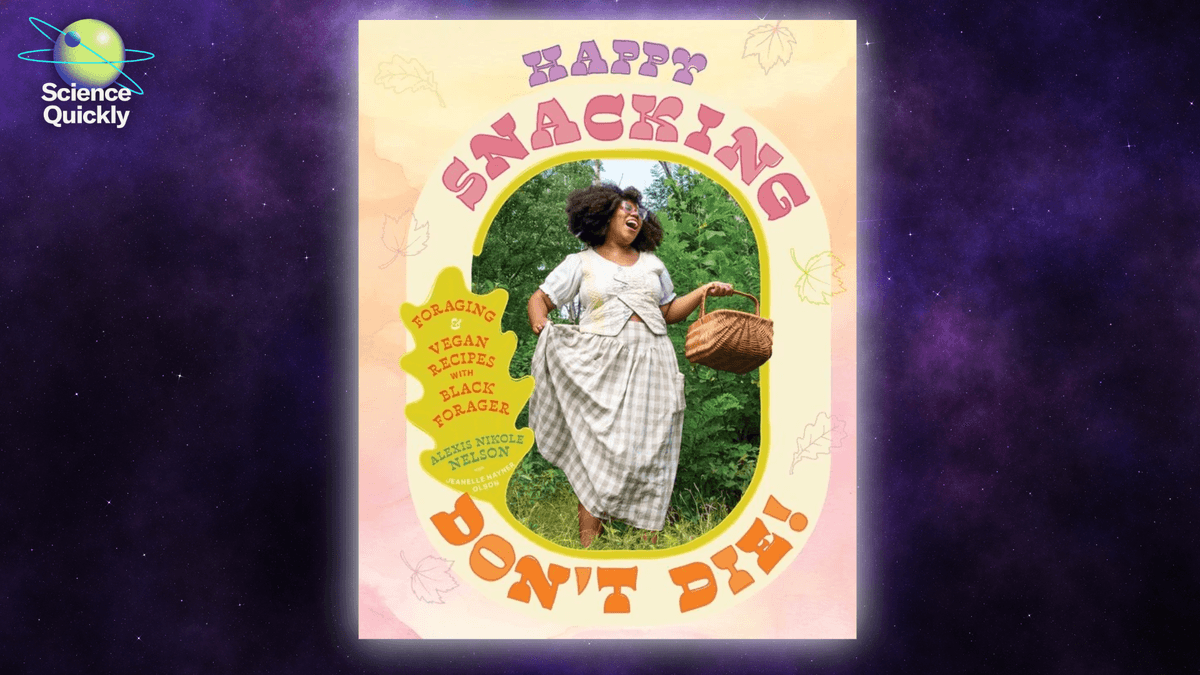
Rachel Feltman: For Scientific American’s Science Quickly, I’m Rachel Feltman. And normally I’d tell you who today’s guest is but she described herself so delightfully that I want you to hear it in her own words:Alexis Nikole Nelson: Alexis Nikole Nelson, field botanist, eater of things off ground?Feltman: Even if you don’t know Alexis by name, you’ve almost certainly seen some of her work on social media as Black Forager. Millions of followers devour her videos about finding and eating wild foods, from fruits to flowers to seaweeds. She’s here today to talk about her debut book, Happy Snacking, Don’t Die!On supporting science journalismIf you're enjoying this article, consider supporting our award-winning journalism by subscribing. By purchasing a subscription you are helping to ensure the future of impactful stories about the discoveries and ideas shaping our world today.Thank you so much for coming on to chat with us today.Nelson: Oh, my gosh, I’m so happy to be joining you.Feltman: So let’s talk about your new book a little bit and how you got to be writing it. I would love to just go back in time a little bit and hear how you first got into foraging.Nelson: So I began foraging at, like, the ripe old age of five with my mom. I used to love tagging along when she was working in the garden on the weekends. And I don’t know if you know this, famously, five-year-olds, not the most helpful genre of human. Motor skills not fully downloaded yet. And so whether it was an act of love and sharing knowledge or an act of trying to keep a small child busy, my mom pointed out some onion grass that was growing in our back lawn, and I had never noticed it before.I asked her when she put it there. She said she didn’t, it was just there on accident, and that there were lots of plants that were just there minding their own business that were also edible and medicinal. And to me, a small child, that blew my mind. I was like, “What do you mean you didn’t put it here? And why isn’t everyone talking about this? Alert the presses. Alert the masses.” And that just sparked my love of knowing all things edible that happened to be growing in my general vicinity, which, you know, has now spread to just a love of the natural world in general.Feltman: You know, speaking of the love of the natural world and, you know, how foraging feeds that for you, tell me about, you know, what you love about foraging and why it feels so important to share with other people.Nelson: I think it’s two main things that I really love about it. One is: It’s really meditative. It’s a beautiful way to force your brain to slow down and to notice tiny details about the world around you, to participate in your local ecosystem. And I think that does my brain a whole world of good. I know I’ve been traveling a lot lately, so I haven’t been able to, and I can definitely tell the difference in brain when I am outside in the woods every day and brain when I’m not.And additionally, I think especially this past summer, we have recognized how fragile some of our food systems are and how maybe we have created such a big food system in which we’re so separated from the food that ends up on our plates that maybe we’ve taken a bridge too far. So it’s really nice to have some things in your pantry, on your dinner plate, that you know the entire trajectory of its travel from being in the ground to being on your plate.I think it’s a good skill to have. I don’t think it’s ever gonna replace the grocery store for anybody, but there’s something really fulfilling about being responsible for some of the things you’re eating. You know, people who have hobby vegetable gardens will say the exact same thing.Feltman: So in doing this work publicly including on the Internet, what kinds of questions do you get from the people who are watching what you’re creating?Have you been surprised at all by what kinds of feelings come up in people when they, they see you sharing stuff about foraging?Nelson: Yeah, absolutely. I think the two most surprising questions that I still get with some amount of frequency is always a question of where I’m foraging and the legality of me as an individual foraging there.Feltman: Interesting.Nelson: And there’s a lot to unpack in that particular question, ’cause sometimes it is really coming from a place of, like, earnest curiosity. A lot of times, some people are also kind of telling on themselves with some of their own inherent biases, and I try to talk through that with people to the best of my ability, ’cause a lot of our feelings about trespass and who has access to wild spaces ends up becoming, like, a classism conversation, I think, a lot faster than people necessarily expect it to.And I also don’t think a lot of people realize that the origin of a lot of trespass law lies in purposefully cutting off poor people and people of color from being able to access wild foods, be they plants, fungi, fish, squirrels, on land that doesn’t belong to them.The other question very much in that same vein is “Well, what happens if everyone starts foraging? What’s gonna be left?” People think everyone’s gonna see one of my videos, and then it’s just going to be, like, a cartoon desert with a tumbleweed going by—except maybe no tumbleweed, ’cause, you know, that’s a brassica. Somebody might try to eat that, too. And the first thing that I love to assure people is everyone’s not gonna become a forager.I know, ’cause I try. I can’t even get my whole family to go foraging with me. And that’s okay. Choose your own adventure, like the books at the library in the ’90s. Choose your own adventure. I am not here to yuck anybody’s yum, and sometimes people are city mice and inside mice, not country mice, and that’s fine.Second of all, I think, to assume some sort of, like, capitalist intent behind every single person who is foraging is also kind of telling on yourself if that’s the frame of mind you’re going into asking the question with—because I do honestly and earnestly believe that if people were just foraging for the sake of being able to take care of themselves, their family and the community in which they live, and that includes your human neighbors and your not human neighbors, too, then they will make an informed choice while they are gathering.You know, there are a lot of different global cultures that have rules and rituals to follow, whether that is, you know, some of the Indigenous bands here in the United States taking a moment to pause, lay down tobacco, because that moment of mindfulness helps you from going overboard. You know, globally there’s a lot of also, you know, never take the first thing that you see of a specific species. You know, never take a noticeable amount of a specific species—because not only would that be bad for the thing you’re gathering, but in the long run, it’s also bad for you.Feltman: Right.Nelson: You know, foragers are constantly having to be future-focused. We are constantly in a conservationist mindset, not just because we also want to keep having that experience, but we would love people a generation down the road, seven generations down the road, to also get to foster these relationships with our nonhuman neighbors, with the trees and the plants and the fungi and the animals that we happen to be lucky enough to live near.I think foraging becomes poaching when you start putting money into the equation. I live in a part of the country that is, you know, in the ramp belt. And if you’re not a foodie, a ramp is a very pungent wild onion that is in season for about a month in the Midwest.Feltman: And people lose their minds.Nelson: They lose their minds. People lose their ever plant-loving minds over them.Martha Stewart wrote one article about them two decades ago, and the ramps have not recovered since. And you will see people, in order to be able to stock, like, farmers markets in Manhattan and in order to be able to stock, you know, the kitchens of Michelin-starred restaurants around the country, coming into places like southeast Ohio, coming into West Virginia, and filling up trash bags with this plant that frequently can take nearly a decade to reach maturity. You know, [it] can sometimes take 10 years before it is at a point where it can be procreating, creating seeds. Those seeds take an additional two years then to break down their seed coat and germinate. So you, you do have to be using your noggin when you’re going out and gathering.And if you’re just gathering enough for you and your family to have a mess of greens for a couple nights in the spring and to pickle a couple jars of bulbs, that’s totally fine. I’m not the person who’s gonna be, like, pick-shaming people for going and gathering ramps. They’re a wonderful springtime treat. But yeah, the second that you put money into the equation and start putting more steps in between the gathering and the consuming of the plant, the muddier the waters become, the less careful the people doing the gathering suddenly start to be because you have this magical dollar sign hovering over your head that you’re chasing.Feltman: Yeah. So let’s talk about your book. Who is it for, and what are they going to come away with after reading it?Nelson: My book is for current and future foragers. I think people assume you have to be at my level to be considered a forager, and I think if you just go and dig up the dandelions in your backyard, congratulations, you are a forager. Your laminated name tag will be in the mail shortly, I promise. And I want this book to help people recognize that and also help them recognize that you don’t have to live in the middle of the woods on an expansive piece of land in order to become a forager.There are so many opportunities. I live in the middle of a city. I love getting—you know, another question I get a lot is “Oh, where do you live where you find all of the”—Columbus, Ohio. We often don’t take stock of the plants that do exist around us. Even if you feel like you’re living in a concrete jungle, odds purslane is still coming up out of the sidewalk cracks. There you go. That’s a snack that you could be foraging. Make sure it’s not in a place where a dog could have peed on it, but you know, that’s still something forageable in the heat of summer, surrounded by nothing but industry and concrete.Feltman: Yeah, very cool. What are some other of your favorite sort of like gateway-drug foraging things that, like, are more abundant than people realize, that they’re gonna love once they try them, and then they won’t be able to stop picking stuff?Nelson: Ooh, my favorite is actually a throwback for both of us, Rachel, and that is serviceberries, which secretly have a million names. If I don’t call them by the name that you at home specifically call them, I’m so sorry, but we don’t have time....Feltman: And you can go listen to my other show,The Weirdest Thing I Learned This Week, if you want to hear, still probably not literally every name for the serviceberry, but many more of them.Nelson: They’re such a popular planting for parks and lining city streets because they’re resilient, their foliage is beautiful in the autumn, and their fruits are so good. Amelanchier arborea is the species that I see used in parks globally the most. I saw an Amelanchier arborea in the middle of Tokyo earlier this year.So when I say that there is one hiding near you, that is not a joke. Unless you live right around the equator, where it’s a little too toasty for them, you will probably find a park close to you that has these guys, and they are such a springtime treat. You might have to fight some birds for them. I have an uneasy truce with the robins in my neighborhood. They’re like, “You don’t bring out the berry rake, we don’t poop on you. That’s the deal.”Feltman: Well, and so as an experienced forager, I would also love to hear, to inspire our guests for their future foraging endeavors: What are some of the more surprising or challenging things that you have foraged yourself?Nelson: Ooh. Well, I was in Glacier National Park last summer and just hanging out on a mountainside, eating alpine strawberries. That was fun and worth it. I mean, that hike did kick my whole butt. But also, if you’ve never had a wild strawberry, I need you to pencil it in for next summer because the amount of flavor that gets packed into one of those little guys is insane. They’re so good.Feltman: Well, another one that I would love to hear more about, I think you recently did some ocean pickling, uh, which of course, so much interesting science there. So for our listeners who don’t follow you yet online, it would be great if you could tell us a little bit about that one.Nelson: So I love food history, especially when it comes to things like foraging and fermentation and older food preservation methods. And there is a pretty strong bit of evidence for humans discovering lacto-fermented pickles through preserving things in saltwater, because frequently, so long as it hasn’t rained super recently, ocean water is right around the salinity that you want to make a good sour lacto-fermented pickle—like, high 2 percent to high 3 percent range, enough that you get some good salty flavor but also not so salty that the lactobacteria can’t get really active and create that delicious lactic acid that we love, that wonderful crisp acidity that we love from a good pickle.So to showcase this, while I was visiting some of my family on Martha’s Vineyard—far away from industry, I promise, that’s always everyone’s biggest fear—I checked the water quality levels before I did this. I gathered up a bunch of seawater, put it through multiple layers of filtration. We filtered out the bits, big and small, brought it up to a rolling boil for just a moment, just to kill off anything too small to be able to be filtered out.And then I have pickled beets, jalapeños, garlic. They all pickle beautifully. And due to the fact that our ocean water, it’s not just sodium making a salt in the ocean, we also have some magnesium salts in there, too, which I think add to the flavor profile of the pickles. They are pretty slammin’, if I may say so myself. And I love an excuse to sneakily shove some science education into my videos.Feltman: Amazing. Well, thank you so much for coming on to chat with us. This has been wonderful.Nelson: Thank you so much for having me.Feltman: That’s all for today’s episode. We’ll be back on Monday with our usual science news roundup.Science Quickly is produced by me, Rachel Feltman, along with Fonda Mwangi, Allison Rodgers and Jeff DelViscio. This episode was edited by Alex Sugiura. Marielle Issa and Aaron Shattuck fact-check our show. Our theme music was composed by Dominic Smith. Subscribe to Scientific American for more up-to-date and in-depth science news.For Scientific American, this is Rachel Feltman. Have a great weekend!
How to start foraging for edible plants, according to Black Forager
Full Article
Original Source
Read the full article at Scientificamerican →KhanList aggregates and links to publicly available news content. We do not host full articles from third-party sources. Always verify important information with original sources.