
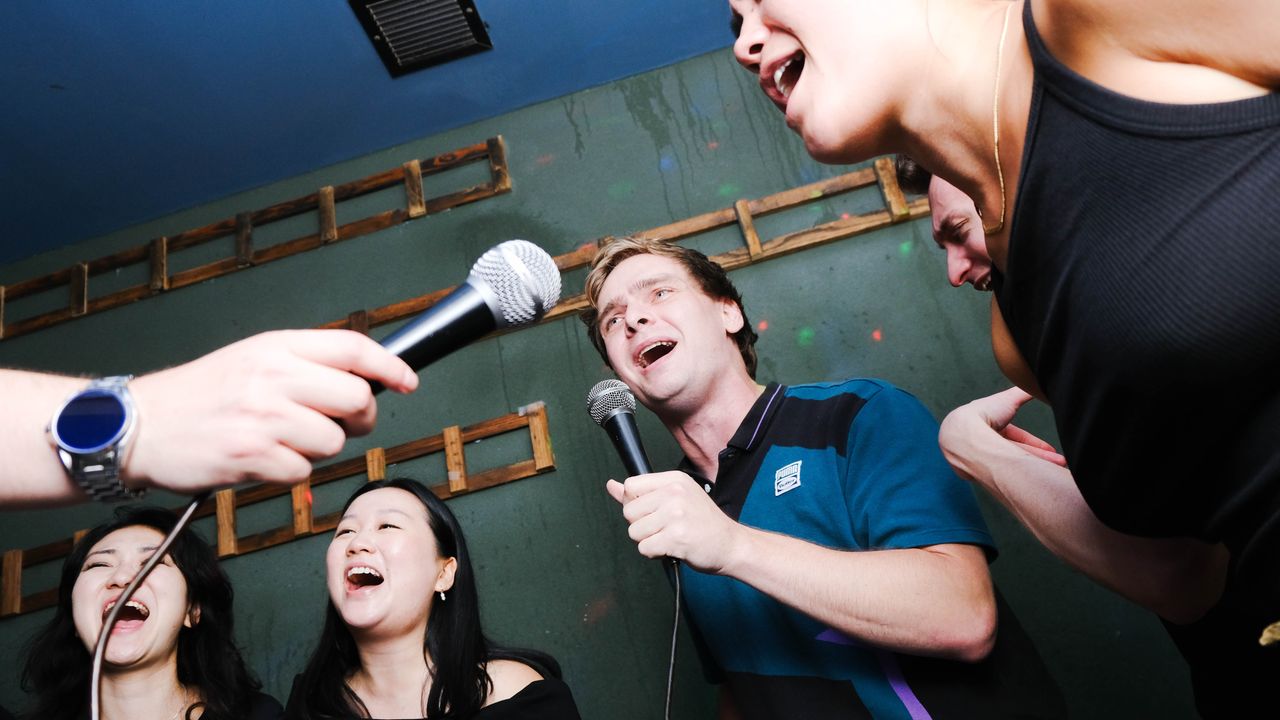
Two writers spend a week singing their way through karaoke bars across New York, exploring nightlife’s most vulnerable third space.Skyli AlvarezIn 1968, Daisuke Inoue decided he was going to be in two places at once. A musician who played in a backup band working Kobe’s nightlife circuit, Inoue soundtracked the evenings of soulful salarymen whom he befriended. With drums as his instrument of choice because “all you have to do is hit them,” he turned those relationships into business, arranging entertainment for their other engagements. As the legend goes, he couldn’t make it out to a gig he had booked at an insurance company’s trade show, so he invented the next best thing. Combining a standard eight-track tape player used in car stereos, a microphone, an amplifier, and a 100-yen coin slot, he placed his ghost in the machine, which he fashioned into the Juke 8. Inoue’s device—the progenitor to the modern-day karaoke machine—was a success.A more rigorous history might question whether Inoue really invented the first such machine or whether that credit belongs to electronics manufacturer Shigeichi Negishi’s Sparko Box a decade earlier. But the meteoric takeoff of karaoke has soared far past its humble—and slightly murky—origins. A portmanteau of the Japanese words kara, meaning empty, and oke, meaning orchestra, karaoke evokes both loneliness and collective belonging. Nearly 60 years on, we still root for the little machine that could—and all the brave singers who bare their heart through age-revealing ballads and club classics.An impassioned rendition of Celine Dion’s “It's All Coming Back to Me Now” transpires at Beats Karaoke Cafe in Williamsburg Skyli AlvarezPerhaps nowhere is karaoke’s full breadth more on display than in New York City, where, on one side, you’ve got lounges complete with floor-to-ceiling video walls and speakers with built-in auto-tune capabilities and, on the other, decades-old dives whose performers are as much an institution as the establishment.A karaoke spot is the one place where post-prom dates, wedding parties, and career performers alike gather to spend their time and money on gloriously subpar entertainment, entirely without irony. When you’re the one behind the mic, it becomes something mythic—a reprieve from the passive consumption dominating much of the city’s nightlife. Tally up the past year’s most recent headlines, and you’d get the impression that we’re becoming less fun—we’re having less sex, drinking less alcohol, going to fewer parties, and hosting fewer of our own. The karaoke bar might be one of the last, thriving places in New York where we wait half an hour to openly embarrass ourselves, and for that it’s well worth our nights out.With the hundreds of sing-along nights and 30-plus specialized bars in New York City listed on trackers like Karaoke Crowd, there was no way we’d be able to cover them all. So we visited one place a day for a week, crisscrossing the boroughs for a taste of the city’s diversity. We commenced our week in Koreatown, where some-dozen private rooms are conveniently concentrated on a single street, and continued our spree at an Irish pub on the Upper East Side, where shouting for sport and song are one in the same. We hit up a Staten Island dive of devoted locals and a year-old Astoria restaurant where, once the Tagalog ballads have begun, you must push the plate away and join in. These watering holes, old and new, are living proof of the many shapes karaoke takes and the unifying joy of belting it out together, even when so much else threatens to divide us.A singer takes the stage at Iggy’s on the Upper East Side to perform Billy Joel and Elton John’s “Piano Man” Skyli AlvarezMonday Surveying KoreatownLocation: West 32nd Street, ManhattanBest song to sing: “Poker Face,” by Lady GagaWe began the week where many end it, on the dense corridor of West 32nd Street between Sixth and Seventh Avenues. Along this stretch of Koreatown, karaoke bars, podiatrists, escape rooms, and coworking spaces stack atop one another. Our crawl started at Gagopa, whose BYOB policy is a favorite among the large-group partiers and Midtown corporate crowd for fast-tracking camaraderie. The bar eluded us at first, not for a lack of signage but for its location on the fourth story of its building, and the search more or less provided a template for our crawl: a ride up an elevator the size of an airplane lavatory and head-scratching decor. At Gagopa’s sister bar, 32 Karaoke, this last item consists of Polaroids of visiting groups on the walls—the very karaoke canon that, once you’ve stepped through its doors, you become part of.Anticipatory staircases aside, no amount of symbolic literacy can prepare you for a K-town elevator panel. Despite its abundance of labeled buttons, deciphering them only makes things more confusing. To reach Space Karaoke Bar and Lounge, for instance, you have to avoid accidentally ending up at Space Ping Pong, one of two Space sports bars, or the Space golf simulator. Take it as a sign to stop trying to make sense of things and just embrace the ride.Across the street, Chorus Karaoke Lounge has a clubbier feel, with a purple-and-blue-lit bar. To the left is a hallway of private rooms, lined with porthole window portraits of Madonna, Morrissey, Elvis, and all the other greats. On the evening we visited, only one karaoke room at the end of the white hallway was occupied—by a lone singer crooning to himself. It may well have been a strict weekly ritual, the first step in a vocal warm-up regimen. “I sing, therefore I am,” read a sign near its entrance as we left, a reminder that although thinking may be proof of existence, song is proof of life. —Skyli Alvarez & Kat ChenPianist Mark Benjamin, left, accompanies performers at Sid Gold's Request Room on 26th Street, which has additional locations in Detroit, Nashville, and Washington, DC Skyli AlvarezTuesday at Sid Gold’s Request RoomLocation: 165 West 26th Street, ManhattanBest song to sing: “Someone Like You,” by AdeleIn the liminal space between Chelsea and Flatiron, Sid Gold’s Request Room is a bit of an outlier. Sandwiched between an empty office space and halal buffet, its old-timey façade simply reads “piano” and “karaoke.” Both await you in the spacious piano lounge, tucked behind a pair of velvet curtains at the back of the cocktail bar.We arrived around 9 p.m. and slid into one of the alcoved booths closest to the stage, a small black platform beside the bar centerpiece: a Baldwin baby grand. As we settled in, a singer, backdropped by pianist Mark Benjamin’s harmonies, wrapped up his performance to a crowd of now four; he then came to take our order. Fortunately, others trickled in: tourists and their New Yorker friends; Tuesday-night regulars; a dog named Henry. Many, as we learn, were here for Benjamin's performance—and succor.As we came to find out later on in the week, karaoke works better in numbers, but Sid Gold’s makes the case for a small yet mighty group. A particularly moody evocation of Chris Isaak’s “Wicked Game,” prefaced by the singer’s memories of angst-ridden high school years, drew out lower-than-low notes. In what could only be described as a shouty but otherwise cheery cover of “Back to Black,” each verse’s forceful delivery was more unpredictable than the last. At some point Benjamin called upon someone named Eric, who kicked off his flip-flops to sing “Part of Your World,” a method for getting into character (one can only assume) that would be frowned upon everywhere else but here.If you think you can evade the stage, Benjamin will make sure you get on up there. He’ll harmonize and improvise riffs even if he’s never heard the song (or wants you to think this); pause to match your pace; and convince you that it was made for you to sing. —S.A.Wednesday at Barkada Social ClubLocation: 33-05 Broadway, Astoria, QueensBest song to sing: “Bakit Pa,” by Jesse ZaragozaI was immediately given the cousin treatment when I passed the threshold of Barkada Social Club. In case there was any ambiguity about the cultural identity of this Astoria restaurant and bar, let it be known I walked into Bruno Mars’s “Risk It All,” with plates of lumpia and kwek kwek covering the tables. It was a good night to come—Barkada NYC, a separate but similarly named LGBTQ+ Filipinx community group, hosts its monthly Kikay Konek karaoke event here. Joey, a queer-affirming physical therapist by day and programming coordinator with Barkada NYC, was my gregarious host for the night. When I asked them about encountering struggles with finding kindred souls, they gave me a considerate look before breaking out into a smile and saying, “I honestly can’t relate.” This came as no surprise as I watched them record the “Toxic” floor routine for BNYC’s Instagram before rushing off to plan next month’s programming, discuss bringing BYNC to the Bronx, finalize plans for a hike three weekends away, and introduce me to their boyfriend. It takes a social whirlwind like that to bring together a collective of members from across all five boroughs, plus exotic reaches like Tenafly, New Jersey. The crowd is in constant flux, peeling off and joining in depending on what the song queue has in store. The one exception to the rule is when someone requests Jesse Zaragoza’s “Bakit Pa,” a sweeping Tagalog ballad from the ’90s about unrequited love that brings everybody rushing to the fore. “It’s like our national anthem,” Joey says. —K.C.Tim sings at Steiny's Pub in Staten Island Skyli AlvarezAt Sid Gold's, patrons are more than ready to be called up for a harmonized performance Skyli AlvarezThursday at Steiny’s PubLocation: 3 Hyatt Street, Staten IslandBest song to sing: “Mr. Brightside,” by The KillersAt the site of the former Mayfair Bar and Grill, a favorite among St. George’s queer patrons in the 1950s and ’60s, Steiny’s Pub was once a low-key gay bar turned sports joint that now exists somewhere between the two. It’s fitting for a borough that’s often the butt of the joke, cloaked in its perceived suburban isolation, though an eight-minute walk from the Staten Island Ferry makes it surprisingly less difficult to reach from Manhattan than one might assume. We passed a small group of local 30-somethings smoking near the entrance and, once inside the dive, encountered a lively emcee who goes by the DJ name Nazz Raidience. We’re quickly singled out for not being regulars and handed a Sharpie and clipboard to add to a queue that Nazz only loosely followed.As co-owner John Michael works behind the bar, a few seated patrons watch tennis and baseball while others belt it out to their backs. The L-shaped booth seating next to the DJ setup operates as the stage. Most who perform adhere to genre: bar patron Dia’s heavy metal numbers by Kittie are complete with death growls, Connor does Eminem with breakdancing and triple-threat delivery, and others insist on 1980s ballads. Nazz shepherds the queue at an auctioneer’s pace, sometimes joining in and always poking fun, calling upon you to spin the prize wheel that could lead to a free drink or 10 push-ups. Although they host karaoke nights across the city, Steiny’s is their favorite for the many different worlds it attracts, and they'll convince you to stay for the ferry sailors who, post-shift, are said to come singing around 2 a.m. When it became clear to us this would not be the night, we left without sea chanteys in our hearts but with a better understanding of the appeal of the city’s least-populated borough. —S.A.Friday at Bronx Beer HallLocation: 2344 Arthur Avenue, the BronxBest song to sing: “NUEVAYoL,” by Bad BunnyPerforming karaoke cosplaying as Shadow the Hedgehog, hands full with impulse purchases from Comic Con’s artist alley, is my penance. I had postponed this visit for too long, leaving me with no option but to come as I was. Bronx Beer Hall is nestled within a larger food hall in the historic Italian neighborhood of Arthur Avenue (please, try the veal). By the time Friday karaoke night is in full swing, all of the surrounding businesses are fully closed. From the outside the telltale sign that anything is happening is the ambient trail of music. Channel an ’80s B-movie slasher victim, and follow the noise into the darkness. Upon emerging into the light, you’ll see a hallway lined with T-shirts printed with lines like “Call it gravy, not sauce!” or “I’m not a gynecologist, but I’ll take a look.” As for the music selection, it’s what you’d expect from a generationally eclectic crowd. There’s tender performances of Bon Jovi and Air Supply following the crowd-rousing momentum of “NUEVAYoL” by a man wearing a snapback with what was certainly a record-breaking number Yankees logos embroidered on the design. Every three songs the DJ would queue up 50 Cent’s “In Da Club” to announce yet another birthday, and BBH turned out to be just the kind of place where an unrelated 24-year-old and 40-year-old blow out their candles together. Being Shadow the Hedgehog did not go unnoticed either. Our millennial bartender who grew up playing the original Sonic games requested “Live and Learn,” the main theme song of Sonic Adventure 2. As I took in the lyrics for the first time on the TV screen, I lived and I learned. —K.C.The karaoke room at Iggy’s becomes rowdier as the night progresses Skyli AlvarezSaturday at Iggy’sLocation: 1452 2nd Avenue, ManhattanBest song to sing: “Lips of an Angel,” by HinderThis Irish karaoke bar was our first reporting excursion, and it established a curious precedent. Between its Upper East Side location, Gaelic rafters, and portraits of 27 Club musicians, the place seemed tailor-made for Xennial dads. We assumed butt rock was inevitable and hedged our bets on at least one rendition of Hinder’s “Lips of an Angel.”My hunch came from Eve Kosofsky Sedgwick, specifically her theories of homosociality: the nonsexual bonds between people of the same sex. Spend enough time at karaoke, and you’ll notice that “Lips of an Angel” is almost always performed as a duet between two men. For the uninitiated, the song imagines a phone call between a singer and an ex he still quietly yearns for, wishing she were there instead of the “girl” in the next room. Sure enough, two friends took up the mantle. Maybe it was simply a fun song to sing; maybe karaoke offered a safe conduit for expressing something else. We encountered the song at every subsequent karaoke night, always sung by two people of the same sex.While some bars use online queues for song requests, attendees go analog at Iggy’s Skyli AlvarezAs a week of karaoke draws to a close, you will come to find specific crowds come in waves. First come those who learned to love performance in youth-theater productions, usually in duos or trios, and take their sing-alongs seriously. Then there are the harder-to-place groups: coworkers, reunited friends, or couples using karaoke as a social buffer. Next come the balladeers and lone yearners, eager to broadcast exactly how they’re feeling, followed by the humble soloists who know they’re good and have nothing to prove. Finally, the rowdy late-night crowd of after-partiers spills in, at worst hogging the mic and at best uniting an entire room.In our five hours at Iggy’s, the former theater kids delivered truly spectacular covers of “Defying Gravity,” the Irishmen shouted Irish pub songs, and the soloists flirted by way of song choice. Three dollars grant you one song that you select from an impressively up-to-date binder and scrawl onto a piece of paper, then the waiting game begins. “We just met in the photo booth” is how one performer introduced a B-side from The Cure, an effort to woo over a stranger who he knew shared at least one common interest. Karaoke gives singers permission to say what they otherwise cannot or will not admit, though the message is rarely subtle. —S.A. & K.C.Though Seventh Heaven's evenings often begin with film screenings, watch parties, and other community events, they always end in karaoke Skyli AlvarezSunday in BrooklynBeats Karaoke Cafe location: 219 Grand Street, BrooklynBest song to sing: “Zombie,” by The CranberriesSeventh Heaven location: 4 Irving Avenue, BrooklynBest song to sing: “Unravel,” by TK from Ling Tosite SigureDuring a week when we spent every other waking hour thinking about karaoke-ing, we sometimes looked past dives and private rooms for other ambitious reinventions, like on a boat; in a taxicab en route to the airport; or in an East Williamsburg apartment turned karaoke rental. Still, it’s ultimately the most obvious spots that draw the crowds. Take Williamsburg’s Beats Karaoke Cafe, an eight-minute walk from the Bedford Avenue station, with a rustic bar on the first floor, leading to a hall of private rooms that continue downstairs. We eventually wound our way into film production coordinator Natalie’s group of eight, who told us this was their go-to whenever they “want to add a little divorced dad rock to the night,” and we had caught them testing out new material. Still, they made their way through classics like The Cranberries’ “Zombie” and “Time of My Life,” while also executing many Dirty Dancing lifts.Farther along the L train, it was only appropriate that we ended up at a bar named Seventh Heaven. We were among the youngest crowd by far, at least in taste. Karaoke-goers swarmed the stage and fluently rattled off the romaji lyrics of “A Cruel Angel’s Thesis,” the theme song to ’90s anime Neon Genesis Evangelion. This bar gets its crowd, with a cocktail menu filled with allusions to the fandom, like the Apothecary’s Negroni fashioned after popular light novel series The Apothecary Diaries, or my own drink, the Boy’s Love G&T, which is named after the popular fiction genre that focuses on the romance between male characters. Turns out, there are plenty of effusive ex–theater kids who understand the assignment.The DJ cued up our request, “Viva la Vida.” From the vantage point of the stage, the outstretched hands of the crowd looked not unlike the Eugène Delacroix painting of the Revolution of 1848, which Coldplay used as cover art their 2008 album Viva la Vida or Death and All His Friends. A notably resigned wedding party lingered at the back of the audience, while city newcomers hailing from nearby venue House of Yes gleefully accepted our mic to unleash a few verses. The karaoke-goers had in the very least not given up on tonight. —S.A. & K.C.Skyli Alvarez is the editorial assistant at Condé Nast Traveler. She holds a BA in journalism and minor in art history from the University of Georgia and has words and photos in Teen Vogue, Vogue, Polyester Zine, and more. Her work, written and visual, explores style, scenes, and subcultures past ... Read More
How to Sing Karaoke Every Night, in Every Borough of New York City
Full Article
Original Source
Read the full article at Cntraveler →KhanList aggregates and links to publicly available news content. We do not host full articles from third-party sources. Always verify important information with original sources.