
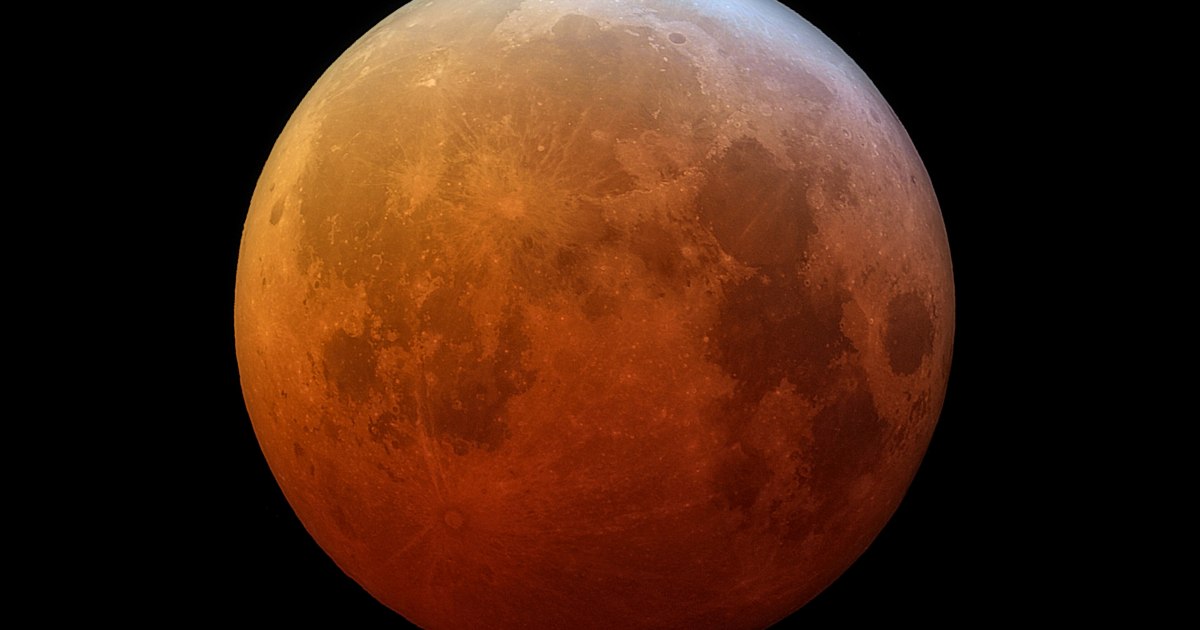
Eclipses frequently come in pairs, and this month is no exception. Following the stunning total solar eclipse on August 12, it’s the Moon’s turn to line up for some time in — or, rather, out of — the spotlight durning a deep partial lunar eclipse the night of August 27. The lunar eclipse is visible across North and South America, Africa, Greenland, Iceland, and western Europe. In the U.S., the Moon rises around 7:30 P.M. local daylight time on the 27th, located in Aquarius the Water-bearer. Maximum eclipse, when the Moon sits deepest within Earth’s shadow, occurs at 12:13 A.M. EDT on the 28th (Friday in the Eastern time zone only for the U.S.), with 96% of our satellite’s total area covered by Earth’s inner shadow. Only a thin sliver along the Moon’s northeastern limb will remain bright white, while the rest of our satellite will appear a dim, dusky orange or red. When to see the lunar eclipse Lunar eclipses are not like solar eclipses — they proceed slowly and can be viewed without any equipment or eye protection at all, making them readily accessible and enjoyable. There’s no rush to catch only a few minutes of action, either, as the Moon slides slowly into and out of Earth’s shadow, its appearance changing the whole time. Thursday’s eclipse begins at 9:23 P.M. EDT, as the Moon first enters the outer part of Earth’s shadow, the penumbra. But the real visual effects will start at 10:33 P.M. EDT, when the Moon first passes into the umbra — the darker, inner portion of our planet’s shadow — and the partial eclipse begins. This means the start of the partial eclipse is visible in the eastern half of the U.S., while the Moon is eclipsed shortly after rising in the Mountain time zone and right around the time of moonrise along the West Coast. As the partial eclipse progresses, the Moon will grow darker and darker, though it may take some time for its color to shift. The eclipse continues overnight for the eastern half of the U.S. Maximum eclipse occurs at 12:13 A.M. EDT on the 28th (again, early on Friday in the Eastern time zone only, and late on Thursday for the rest of the U.S.). This is just minutes before the Moon officially reaches Full phase, which occurs at at 12:19 A.M. EDT, bringing us the August Sturgeon Full Moon. Lunar eclipses are sometimes called Blood Moons because our satellite can take on a blood-red color. During a total lunar eclipse, the entire Moon turns to Blood. But even at the moment of maximum eclipse during this event, not quite all of the Moon will sit in Earth’s shadow — about 2′ of the nearside will remain outside Earth’s inner shadow, glowing brightly even as the rest of the nearside has taken on a dusky, orange-red hue. The two differing effects will offer a stark contrast that should be fascinating to see. Then, the Moon will start to move out of Earth’s shadow again and the effects will play out in reverse, as more of the lunar surface is lit directly by the Sun. The partial eclipse ends at 1:51 A.M. EDT — now the 28th in the Eastern and Central time zones — and the eclipse fully ends just before 3:02 AM EDT, as the Moon finally moves free of even the outer portion of Earth’s shadow. Related: Why does the Moon turn red during a lunar eclipse? How to watch the lunar eclipse Lunar eclipses are much more accessible than solar eclipses. You do not need special eye protection, and in fact do not need any optical aid at all. Your eyes are all you need! Because lunar eclipses progress slowly, there’s no rush to get a look like there can be during the brief totality during a solar eclipse. You can simply watch the nearly Moon change over the course of several hours, and can even do so from inside your home if you wish (provided the Moon is visible out a window, of course). In face, because changes take place slowly, checking back in on the Moon every so often holds particular benefits, as the differences will seem bigger and more noticeable after some time away. If you’re only able to catch part of the eclipse, the best time will be at maximum eclipse, when the Moon’s appearance is most dramatic. What to look for during the lunar eclipse No two eclipses are ever the same. In particular, the color of the eclipsed Moon differs each time, as sunlight passing through Earth’s atmosphere illuminates the portion of the Moon that falls within Earth’s shadow, changing its color. This effect always scatters shorter wavelengths (blue and green) while letting light with longer wavelengths (orange and red) through, but ever-changing factors such as the chemical composition of Earth’s atmosphere dictate the exact shade that results. An increase in, say, volcanic particles or wildfire smoke at the time of the eclipse can have a profound effect on the Moon’s color and brightness. Observers use the Danjon scale to rate the appearance of the Moon during lunar eclipses. Developed by André-Louis Danjon in 1921, it provides a visual guide and a five-point scale, from 0 to 4, on which to rate each eclipse. Use the reference below to rate for yourself how the Moon looks, also taking note of its brightness as well as its color. The Danjon scale rates the color of the Moon during a lunar eclipse, from nearly black to rust red to copper-orange. Credit: Astronomy: Roen Kelly At maximum eclipse, you might also see more stars than were visible before. This is because the Full Moon’s bright light typically washes out the sky around it, hiding many fainter stars from view. With the Moon mostly in Earth’s shadow during the eclipse, however, those stars now have more of a chance to shine. What’s next? After this month, the next lunar eclipse will take place in February 2027. However, that eclipse will be a partial penumbral eclipse, where most of the Moon only passes through the dimmer outer shadow of our planet, never reaching the darker inner regions. Then, too, there will be a sliver of the lunar surface outside the shadow entirely, shining brightly while the rest of the Moon is slightly — but not dramatically — dimmed. And the second lunar eclipse of 2027, in August next year, will be an even less impressive penumbral eclipse, with only about half the Moon passing through the penumbra at all. 2028, at least, brings three lunar eclipses, including one total lunar eclipse. But only two of those three are visible from any part of the U.S., and most of the country will not see the total phases of the latter. So, this week’s eclipse is one of the best lunar eclipses the U.S. will see for quite some time. If you’re able to get outside at all on Thursday night to see any part of it, you’ll be in for a real — and rare, for at least a time — treat.
How to see Thursday’s lunar eclipse
Full Article
Original Source
Read the full article at Astronomy →KhanList aggregates and links to publicly available news content. We do not host full articles from third-party sources. Always verify important information with original sources.