
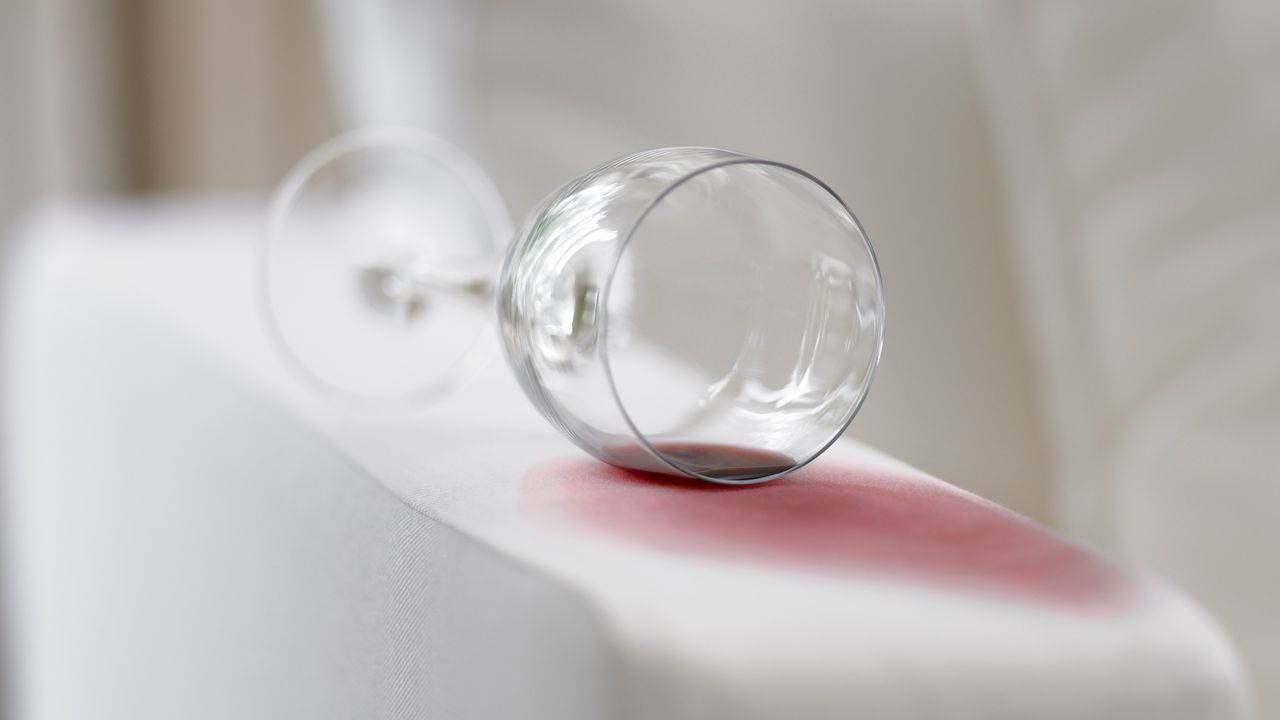
Tap into your upholstery savior complexA red wine stain on the arm of a white sofa.Photo: Adam Gault via Getty ImagesMost of us probably didn’t understand our parents’ obsessions with keeping food and drinks off the couch until we had to learn how to remove stains from our own prized possessions. Furniture stains and splotches are the last thing anyone wants to think about when curating the perfect domestic space, but there’s nothing remotely enjoyable about discolored blobs on furniture.Nonetheless, even the most carefully positioned glasses of red wine can be tipped over, and anyone with a pet or young child knows that messes are unpredictable. So when bad luck strikes, how should you go about cleaning stained upholstery and wooden furniture?How to remove stains from upholstered furnitureStep 1: Identify what you’re dealing with“In some cases, you may have experienced the stain in real time, in which case you know where it came from,” says Dan Selechnik, the environmental health and safety director of the American Cleaning Institute, a trade group for the cleaning product industry. But some detective work might be in order if you find a stain the morning after a party. Consider the color, pattern, splatter, and location of the stain to figure out what it is.This is a good time to check the fabric tag, as this will tell you what cleaners are safe to use on your fabric. Common codes include the following:W: Water-based cleansers, as well as fabric steamers, are safe for your sofa upholstery.S: Spot-clean with fabric-safe solvents or dry-clean the fabric.S/W: Solvent- and water-based cleansers are safe to treat spots on the fabric.WASH: If the fabric is removable from the stained sofa or cushion, you can safely pop it into the washing machine. Use cold-water delicate settings, then air-dry or tumble dry with low heat.X: Only use a vacuum cleaner on this material.Step 2: Gently remove as much as you canAvoid pushing the substance further into the fabric, but remove any excess from the surface with something like a butter knife or a spoon. For thin, pooling substances, use a rag or paper towel to blot up the substance. That prevents deeper seepage that will be harder to lift.Decide whether your spot needs the wet or dry method. Photo: Kalmora Velin/Getty ImagesStep 3: Treat the spotThere are two main strategies for handling upholstery stains: a wet method and a dry method. Both are similar, but there are important distinctions to bear in mind, according to Mallory Micetich, a home expert and communications specialist with Angi, a home services company.Wet method: With the wet method, you’ll begin applying a cleaning solution, which will vary depending on the fabric and type of stain, gently to the spot in a dabbing-and-blotting motion.Dry method: For this option, wait for the area to dry before using a bristly brush to carefully sweep the area.The latter method works better on fabrics with a grain, like velvet, and with spills that aren’t entirely liquid, according to Micetich. But, even if you’re attempting this method, it’s important to gently sop up as much as possible, so that it dries quickly.Step 4: Dry and fluffAfter you’re satisfied that the stain has been lifted as much as possible, let it air-dry. Don’t grab a hair dryer to speed up the process—once it has been heat-set, further removal is tough if not impossible. Then, after drying, use something like a stiff brush to reshape the fabric’s texture.Extra tips to keep your furniture cleanKeep the tagsYou won’t go to jail for taking the tag off your furniture, but you should definitely keep it either on the item itself or somewhere you can easily reference it. According to Peter He, the cofounder and chief scientist of Dirty Labs, a biodegradable cleaning solution company, there are three general types of fabrics. Although technological innovation means there are now often multiple types of fibers in a single product, fabrics can be plant-based (cotton), synthetic (plastic fibers), or protein-based (leather).But specialty fabrics, regardless of the general fabric type, may require specific care, says Micetich. Saving those tags means that you can consult any common care designations listed on the tag.Keep calm and dab onRegardless of the type of mess, you’ll want to immediately sop up any excess liquid with clean rags or towels with gentle dabbing and blotting motions. Using aggressive or rough motions could push the unwanted liquid or solid into the material, which will make removal much harder. Vacuum the spot to remove any excess gunk to make any further treatment more effective and prevent as much muck from actually leaving a stain in the first place.And whether you opt for the wet or dry method, completely drying out the area is necessary. Get creative: place the cushion next to a sunny window and break out some fans. A mix of warmth and air flow will help dry the area. Be careful not to leave the upholstery to dry in a humid or damp area, as that might just introduce mold or a stale water smell, Micetich says.“I have accidentally spilled a little bit of queso dip on my velvet couch, and the dry method worked perfectly for that,” Micetich explains. “I dabbed up the excess and because it was [a semi-solid] cheese, it rose and I was able to use a toothbrush [reserved for cleaning] and very lightly get it up without impacting the grain of the velvet that much.”.Proceed with caution with specialty chemicalsTackling some kinds of stains, like pet urine or feces, may require a specific pretreatment to help break down the stain and also sanitize the area. Let any stain-specific pretreatments sit on the spot for a while to do its job. Certain products that focus on breaking down the enzymes in protein-based stains may be necessary to get rid of not only the visual problem but any associated odors.Many harsh stain removers aren’t necessary. Photo: Getty Images“Sometimes you don’t see the spot, but it smells,” Dirty Lab’s He explains. “Pet urine will not necessarily give you a color, but will leave a smell because of the release of bad bacteria that festers.” Dirty Labs sells cleaning products with “enzyme-driven cleaning technology” that the company promotes as “nontoxic, readily biodegradable, [and] free of known pollutants.”“The really good news is that there’s a lot of [stain removal] you can do with things like white vinegar and rubbing alcohol that are super easy, and that are not necessarily toxic, that can clean so many different areas,” says Tonya Harris, an environmental toxin and cleaning expert.Harris believes that harsh or specialty chemicals are rarely if ever necessary to get the job done. “I like to use the least toxic thing possible,” she says. She adds that products like white vinegar, rubbing alcohol, and baking soda are less likely to be too harsh and ruin certain materials unless used exactly as directed.Get professional helpIf you’ve tried to do it yourself once or twice, but you still haven’t quite rid your sofa of the splotch, it might be time to call in an upholstery cleaning service.“There are professional cleaners out there that just do upholstery cleaning,” said Micetich, whose employer, Angi, helps arrange such cleaning services. “Find a good pro and have them do it.” She adds that, at a typical cost of between $150–$200, hiring a professional is the way to go for investment or sentimental upholstery. Any fabric that you would likely dry-clean if it were a shirt instead of a piece of furniture, like wool or silk, is a prime candidate for professional cleaning.Think long-term when buying upholstered furnitureIf the mere possibility of stains on your upholstered furniture gives you hives, opt for removable cushion covers that you can throw in the washing machine the moment a splotch strikes. That way, any spills can be immediately handled with a cycle of suds, while you get back to what’s important, like demolishing a pizza with friends while screaming at the latest Love Island episode.It’s also critical to think about whether that touchy fabric you love is appropriate for the space you’re looking to fill. White velvet chairs around where your family eats? That’s a bold design choice, and not in a forward-thinking way. But investing in pieces that age gracefully will save you stress as the years go by. Micetich has a camel-colored leather chair that has endured multiple tenants and pets alike.“If you want something to really live with in the long-run, think about something where that occasional spill or accident is going to add character” to the fabric, she explains.Frequently asked questionsCan old stains be removed?Some older stains are treatable, but there are no guarantees.“Once a stain has been through the dryer, it’s heat-set,” explains Selechnik. That means it’s going to be tough, if not impossible, to lift at that point.But all hope is not lost. You can try a few rounds of pretreatment and laundering, letting the pretreatment soak in a while before rewashing, but “this is dependent on the material and if it’s safe for the fabric,” says Selechnik.Bleach “can sometimes lift those really tough set-in stains,” he adds, even on non-white fabrics. However, Selechnik cautions that you must read the fabric tag or manufacturer’s guide to see whether bleach is appropriate for the product. After using bleach, let the fabric air dry.How do you get stains out of wood furniture?Unlike fabric, the source of the stain really doesn’t matter when it comes to wood furniture, according to Drew Taylor, the owner of Carpenters Woodworks and Restoration in Mount Pleasant, South Carolina.The source of a stain matter less with wood furniture. Photo: Getty ImagesFirst, establish how large and how deep the stain is. That will determine whether you will need to refinish the entire piece or can simply blend back the existing finish. After that, his team typically starts with a chemical strip of either the stained area or, if it’s extensive damage, over the entire piece.If the stain hasn’t seeped past the wood stain, like a light water ring from a drinking glass, then you can simply refinish the piece from there. But if the stain has penetrated the wood, “you’re going to open the pores with sanding, then try to drive it out a bit more with a chemical flush that’ll help pull anything out that’s in the deeper pores” before refinishing.Does vinegar remove stainsYes and no, says Selechnik. In his experience, white vinegar is helpful with hard water residue and older sweat stains on fabrics like clothing. And alternating between white vinegar and liquid detergent on barbecue sauce stains is “really effective,” he adds, because it helps destabilize the various ingredients in a sauce.However, white vinegar isn’t a disinfectant and “it can damage certain surfaces depending on the material…like natural stone, hardwood floors, hardwood furniture, and set-in stains like food and blood generally require a more formulated stain remover rather than just raw vinegar alone.”He of Dirty Labs adds that vinegar and other low-PH surface cleaners don’t help much with greasy, oily, or protein-based stains—and cautions against mixing vinegar with any cleaners that contain oxygen or chlorine bleach.Not a subscriber? Join AD for print and digital access now.Sign up for our daily newsletter to get the best of design in your inbox.Bridget Reed Morawski is a freelance energy and environment reporter who enjoys writing features and explainer pieces on sustainable design, food systems, conservation, gardening, clean energy, and worker/consumer protection. Based in Washington, D.C., she has written for Architectural Digest, The Washington Post, Washington City Paper, Dwell, USA Today/HomeFront, EcoWatch, and ... Read MoreRead MoreThe Best Bathroom Wall Shelves Won’t Dampen the VibesGive your 12-step Korean skin-care routine or fancy hand soaps a boostThese Coffee Tables With Storage Wear Multiple Hats With EaseAs conversation starters, clutter keepers, and decor displaysThis 465-Square-Foot Trailer in Malibu Is a Warm and Woody CocoonPart boat, part camper, it’s one hundred percent perfectBy Vaishnavi Nayel TalawadekarThese 18 Remodel Trends Are Actually Ruining Your KitchenThey make look nice, but they’re not doing your home any favorsThis 462-Square-Foot Paris Studio Used to Be a Ceramics WorkshopIn the heart of Paris, this former creative studio slips into a new and expressive interior designThe Best Laundry Hampers That Double as DecorHouse your dirty clothes without dragging down your design schemeYes, These Heritage Brands Are Actually Available on AmazonFrom Danish silver to French cookware, the icon lineup is stackedThe Small-Space Rules Designers Want You To BreakSmall rooms suffer from antiquated “design rules,” but our smallest home tours all seem to refute them. We asked designers their prescriptive details for this decadeI Found the Secret Amazon Storefront Where Everything Is Editor-ApprovedDesigner throw blankets, striped dessert plates, and heirloom-worthy glasswareThe Best Fourth of July Mattress Sales Are Already HereIndependence Day means saving big on a brand-new, AD-approved sleep pick
How to Remove Stains From Furniture: 4 Simple Steps to Removing Even the Most Difficult Spots
Full Article
Original Source
Read the full article at Architecturaldigest →KhanList aggregates and links to publicly available news content. We do not host full articles from third-party sources. Always verify important information with original sources.