
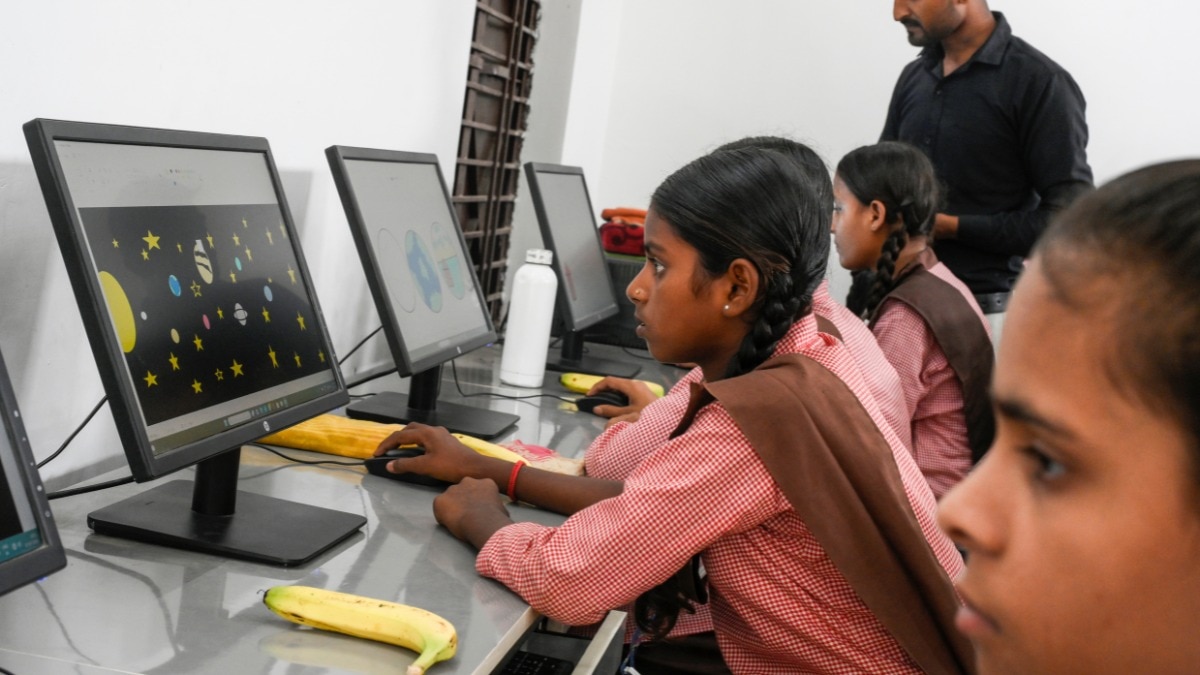
Policy has put schools within a kilometre of most villages, yet 100 million women and girls never finished class 10, says Educate Girls founder Safeena HusainRoughly 100 million women and girls in India have not completed class 10, says Safeena Husain, social entrepreneur and founder of Educate Girls, a non-profit organisation. She worries the figure is being lost in a quieter story: that the problem has been dealt with. “Somehow there is this feeling that the problem of girls’ education is over, but actually it isn’t,” says Husain. Educate Girls has set a target it calls “10 by 10”: 100 million learners in 10 years.Policy has moved, mindsets haven’t When Educate Girls began in 2007, the policy ground was bare. The Right to Education (RTE) Act did not exist nor did Beti Bachao Beti Padhao. Many villages had no school nearby. That has changed. “Now we have a school within a kilometre of every village, because of RTE,” she says, adding that the two policies “solved a large chunk of our biggest challenges”.What they could not legislate is belief. Husain describes hearing that educating a daughter is “like watering your neighbour’s garden”, and that “a goat is an asset and a girl a liability”. In the villages where she works, girls have been named Faltu (useless) and Chyna, a Bengali word meaning unwanted. “It isn’t biology,” she says. “It’s just up here (in the mind), for all of us.” Finding the girls who fall through Educate Girls targets what Husain calls “the last girl”, the one who is out of school. Early on, the team worked district by district, beginning with the 26 districts the Ministry of Education identified as having the widest gender gaps in enrolment. It now uses its own predictive model. “Our prediction has shown that 5 per cent of villages in India have 40 per cent of out-of-school girls,” she says. The model directs effort towards rural, remote and tribal pockets, the “villages farthest from the main road”.Once a district is chosen, the organisation recruits an educated young person from each village. These volunteers, known as Team Balika, go door to door and count every out-of-school girl. About 55,000 young people have joined and roughly 70 per cent are men.Beyond enrolment Getting a girl back to school is the first step. For children in classes three to five, the organisation runs lessons in English, Hindi and mathematics, because, in Husain’s words, “if they can’t read and write, they won’t be able to sustain in school.” Girls who have aged out of the RTE Act’s cover, which runs to age 14, can join a second-chance programme. It is a village-based learning boot camp that prepares them for the class 10 exam through state open schooling. The organisation works with girls and women aged six to 29.“My education stopped 10 years ago, when I was married,” an 18-year-old from the Bhil tribe who recently graduated told Husain. “Imagine her courage, grit and resilience,” says Husain. The case for rights, not returns Advocates often argue that educating girls pays off elsewhere: fewer child marriages, higher immunisation and better outcomes on climate. Husain accepts the evidence. “Nine of the 17 sustainable development goals can be improved if you educate girls,” she says. But she resists leading with it. “We have to be careful of falling into the trap of patriarchy by making an argument saying we should do it because it’s helpful for something else,” she says. “We have to do this because this is her right.”The same logic shapes how she reads individual stories. A mother who sat for the class 10 exam alongside her son scored higher than he did. “Now he will listen to me,” she said. For Husain, that is the point: “Otherwise, what value does her voice have in the house?”Why awards aren’t enough Educate Girls has won a string of awards, which Husain calls “a gift” mostly because they put the unfinished work in front of the public. “All these accolades are really helpful in putting that mission out there, saying, hey, we haven’t achieved our goals,” she says. She argues that the gap does not stay in school. “It then shows up in the workplace, participation rates and so many things,” she says.The scale of the task worries her more than the praise reassures her. “The problem is still so much larger than what we have been able to accomplish in the past 20 years,” she says. “We need a lot more acceleration.”Subscribe to India Today Magazine- Ends
How to reach the last girl
Full Article
Original Source
Read the full article at Indiatoday →KhanList aggregates and links to publicly available news content. We do not host full articles from third-party sources. Always verify important information with original sources.