
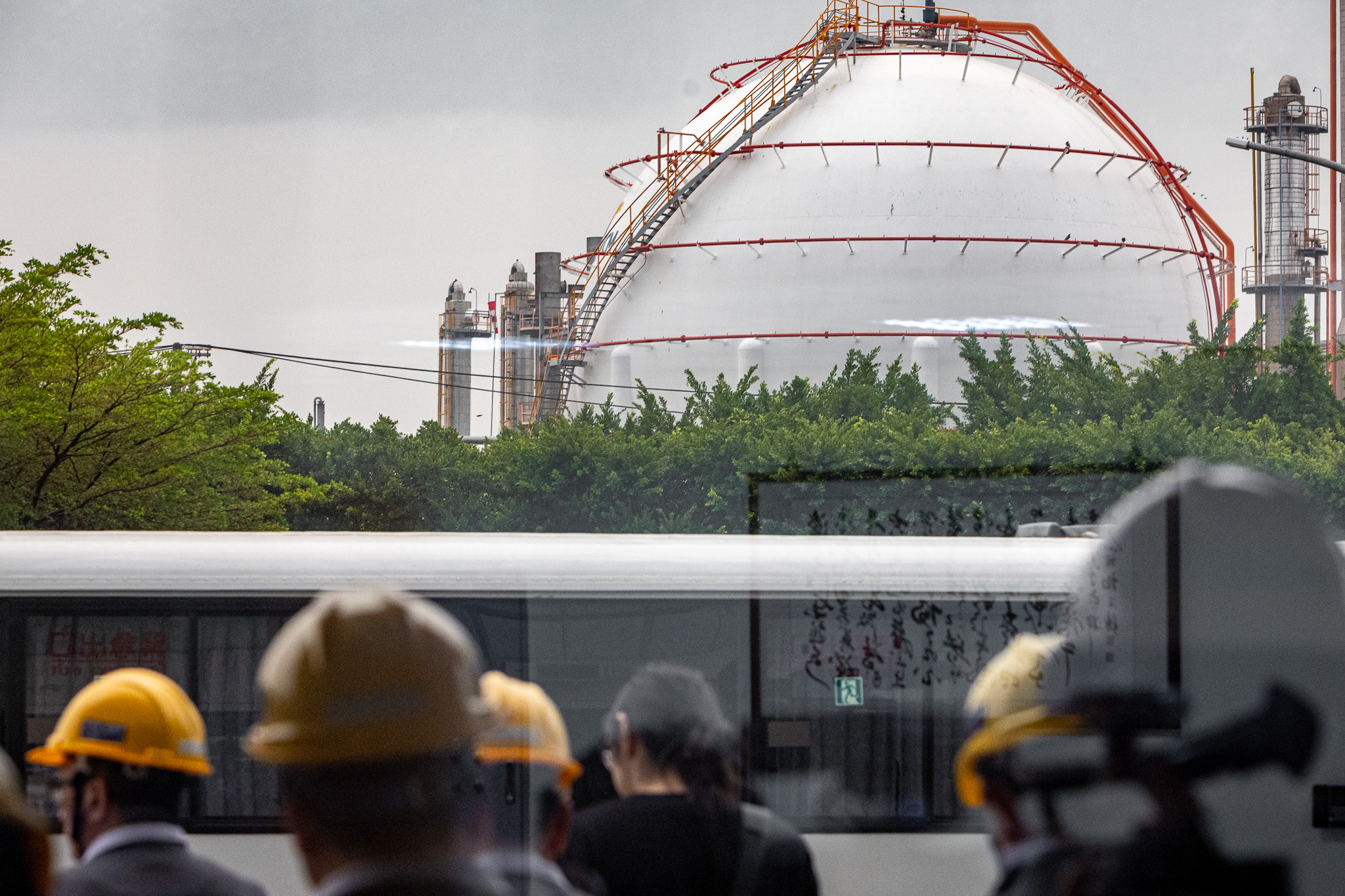
November 2, 2026 • 9:00 am ET Joseph Webster Bottom Lines Up Front Beijing is laying the groundwork for an energy quarantine of Taiwan.Economic, political, technical, and military factors could lead energy quarantine risks to peak in 2028 and 2029.To deter this coercive action, the United States and allies should work with Taiwan to bolster its security through support for an all-of-the-above energy strategy, concentrating on supplying northern Taiwan with diesel for power generation. Introduction Chinese Communist Party (CCP) General Secretary Xi Jinping has consistently made clear his view that Taiwan should be “reunified” with mainland China, stating in 2013 that “long-standing cross-Strait political differences … cannot be passed down from generation to generation (总不能一代一代传下去).” Xi also warned of “clashes or even conflicts” over Taiwan in his May 2026 meeting with US President Donald Trump. The matter appears to be a question not of determination but of timing. For political, economic, and technical reasons, the risk that Xi might move against Taiwan could peak in 2028 and 2029. To achieve its longstanding unification goal, Beijing might attempt to coerce Taiwan via non-kinetic measures. The ambiguity and flexibility of a quarantine could render it an especially attractive option for Xi. Beijing could claim that a quarantine—allowing some ships to pass while turning back others, especially oil tankers and liquefied natural gas (LNG) carriers—is a domestic law-enforcement measure rather than an act of war. There is some evidence that Xi’s forces are already rehearsing for a quarantine rather than an invasion, as the Chinese coast guard is maintaining a continuous presence in waters east of Taiwan and trying to normalize interdictions of live commercial traffic, thereby challenging Taipei’s maritime control. A quarantine to cut off Taiwan’s energy supply would be particularly effective as a coercive tool. Taiwan has virtually no indigenous production of oil, natural gas, or coal, rendering it almost totally reliant on seaborne imports for hydrocarbons. Beijing has long understood the importance of energy security in a Taiwan contingency. It is currently much less vulnerable to an energy outage and is prepared to weather a cutoff of some of its own energy imports as needed. An energy quarantine of Taiwan would be a grave matter for the United States. Taiwan is strategically important to Washington due to its geography, deep technological expertise, and position as a critical node in artificial intelligence (AI) supply chains. China’s absorption of Taiwan would tilt the global economic and strategic balance of power in Beijing’s favor, making it imperative for US policymakers to avert coercive action against the island, which could escalate into a military conflict. It is difficult to overstate the dangers of a collision: the United States and China are nuclear-armed nations with powerful conventional militaries; technological superpowers, especially in AI; and huge economies with an array of coercive tools. Countering these risks will require substantial military investments, but coalition policymakers should not overlook the serious risks of a near-term energy quarantine. To deter an energy quarantine of Taiwan, the United States and other democracies should work with Taiwan to reinforce its energy security with an all-of-the-above approach and the strategic prioritization of rapidly deployable fuel sources, especially diesel. The United States, Taiwan, and other actors should immediately begin preparing for a contingency by deploying a diesel-generation supply chain across Taiwan, especially in the energy-scarce northern regions surrounding the capital, Taipei. That will include diesel production at refineries, distributed storage, and ultimately generators for power supply. The humble diesel generator could be a key determinant in the future of global power. The groundwork: Beijing is mitigating its own energy vulnerabilities In 2003, then General Secretary Hu Jintao warned that China faced the “Malacca Dilemma,” or “马六甲困局.” Hu noted that Beijing’s reliance on seaborne oil imports from the Middle East navigating the Malacca Strait near Singapore raised acute vulnerabilities, as shipments could be interdicted by the US Navy. More than two decades later, Beijing is becoming increasingly self-sufficient in energy overall and in transportation fuels such as gasoline, diesel, and jet fuel. While Beijing will not achieve true independence in transportation fuels for several years, it is on its way to effectively mitigating the Malacca Dilemma. Beijing has been seeking to mitigate this dilemma via a combination of reduced transport fuel demand (largely from vehicle electrification), elevated domestic crude oil production, overland crude oil pipeline imports (largely from Russia), maximizing refinery production of transportation fuels, and tapping unprecedentedly large petroleum stockpiles. Beijing’s growing oil security will enable it to increasingly decouple from international markets and allow it to act more aggressively vis-à-vis Taiwan. Electrification has been fundamental to China’s energy self-sufficiency drive. Electricity’s share of final energy in China has grown from about 5 percent in 1990 to nearly 30 percent today, an increase of about 1 percentage point every year, and will soon surpass the percentage share of every Group of Seven (G7) economy. Mainland China’s power generation capacity has risen from 138 gigawatts in 1990 to over 4,000 gigawatts by May 2026; China has also added 24.2 million charging points (not stations) and, by 2023, had already provided $230 billion in government support to its EV industry. Finally, many Chinese cities have mandated that ride share vehicles and urban logistics vehicles must be “new energy vehicles”—in practice, usually battery EVs. These measures have enabled China to become the undeniable world leader in vehicle electrification. Vehicle electrification rapidly mitigates Beijing’s exposure to the Malacca Dilemma by directly reducing gasoline and diesel demand, especially in politically-sensitive first tier cities. According to the International Energy Agency, electric vehicles are set to reduce Chinese oil demand by about a total of 2.7 million barrels per day (MMbpd) by 2030. In a July 2025 analysis, Rhodium Group found that China’s total electric vehicle fleet already displaced more than 1 MMbpd, with battery electric vehicles beginning to make significant headway in trucking fleets that rely primarily on diesel. For these reasons, the International Energy Agency and others hold that Chinese gasoline and diesel demand has likely already peaked. Deployment of advanced, energy-dense batteries to medium and heavy-duty vehicles would further reduce diesel consumption, alleviating Beijing’s chief transport fuel constraint in a crisis. Adoption of advanced batteries in heavy-duty vehicles might rise sharply over the next year or two. As it reduces its transport fuel demand via vehicle electrification, China has also stockpiled about 1.2 billion barrels of crude oil in December 2025 in total petroleum reserves, by far the world’s largest. While Beijing is drawing down oil inventories amid the oil market disruptions from the US–Iran war, storage levels remain elevated and can be expanded if the conflict winds down. In the case of a quarantine, Beijing would rely heavily on supply flows of oil, not only on stock withdrawals. Here it’s useful to divide Beijing’s oil supplies into different resilience tiers. Tier 1, the most secure tier, is China’s own domestic crude oil production, which ticked up from 3.8 million barrels per day (MMbpd) in 2017 to about 4.4 MMbpd in the first seven months of 2026, covering about 30 percent of domestic demand before the US–Iran war. In addition to its own domestic production, China can also obtain additional volumes from relatively secure overland pipelines in Tier 2A. China’s secure overland crude oil shipments total about 0.8 MMbpd. This is split between the Russia-to-China leg of the East Siberia–Pacific Ocean pipeline, with deliveries of about 600,000 barrels per day (b/d), and the Atasu–Alashankou pipeline, which brings both Russian and Kazakhstani oil via Kazakhstan and delivers roughly 200,000 b/d to Xinjiang. Existing Russian and Kazakhstani overland pipelines have delivery capacity of about 1.2 MMbpd; in a crisis, China would likely be able to access these full volumes, albeit at a possible premium. Tier 2B consists of Russian maritime crude imports. Russia typically ships about 0.75 MMbpd to China from its Kozmino port, near Vladivostok, with other export terminals typically providing about 0.25 MMbpd. The US Navy and coalitional navies would weigh carefully whether to interdict Russian ships and disable Russian exports. Targeting Russian vessels and infrastructure risks horizontal and perhaps even vertical escalation, but in a Taiwan contingency the benefits of disabling Russian energy shipments to the Chinese mainland could, under some conditions, outweigh that risk. To mitigate the risks of maritime transit, Beijing and Moscow might expand the capacity of the mainland China leg of the East Siberia–Pacific Ocean pipeline, “promoting” perhaps 0.8 MMbpd from Tier 2B into Tier 2A. Tier 3 is the 200,000 b/d pipeline from Myanmar, which delivers oil to Yunnan. This source can be thought of as only quasi-overland, however, as it relies on maritime imports to the Made Island oil import terminal that could be interdicted relatively easily. Tier 4 imports, meanwhile, consist of all other maritime sources. China can reliably access about 5.6 MMbpd of crude oil supply from domestic and overland sources if all existing pipeline capacity is utilized. Adding about another 1 MMbpd from Russian maritime imports would bring the total to nearly 6.6 MMbpd. If its most secure supplies are operable in a crisis, then about 30 percent of China’s supplies would hinge on Russia, demonstrating Beijing’s interest in maintaining close ties with Moscow. Turning to demand, China’s refinery runs for crude oil stood at about 15.2 MMbpd in January–February 2026 (assuming 7.33 barrels/ton). Amid the US–Iran war, these runs fell to about 12.5 MMbpd in June, per China’s National Bureau of Statistics. In a contingency, Beijing could again sharply reduce its demand, including in petrochemicals, which accounts for about 25 percent of Chinese oil demand and largely serves the export market. In addition, Beijing could order refineries to maximize output of transportation fuels, including diesel and jet fuel for its military. Given that total domestic supply from production and secure import capacity equals 6.6 MMbpd, and assuming total refinery runs of 12.5 MMbpd seen in June 2026, China would face a daily deficit of about 5.9 MMbpd in a contingency today. Assuming that China has reserves of about 1.1 billion barrels of crude oil after Iran war-related drawdowns, and that it would be able to draw inventories to only 20 percent before facing constraints from geographic dispersion and tank draw, China would be able to sustain at least one hundred and fifty days of civilian and military activities before reaching physical shortage. By 2030, however, Beijing will very likely enjoy far greater oil security. Tier 1 and 2A overland crude supplies could very easily rise to 6.8 MMbpd on higher domestic production and greater overland tie-ins with Russian and Central Asian crude oil pipelines. Crude oil demand, meanwhile, could fall to 11.5 MMbpd amid vehicle electrification, leaving a deficit of 4.7 MMbpd. Assuming 1.2 billion barrels of crude oil reserves and a maximum drawdown of inventories to 20 percent, Beijing could likely cover at least two hundred days of refinery runs in a contingency by 2030. Beijing may soon be able to withstand an oil blockade for well over half a year, and perhaps much longer if it continues to increase the size of its oil reserves, can still access Russian maritime imports, or accelerates vehicle electrification. The United States’ implicit answer to a potential Taiwan quarantine has been to impose a counter-blockade of China’s oil imports. That strategy is increasingly outdated. Policymakers in Washington, Taipei, Tokyo, and beyond need to understand this dangerous new reality, insulate against an energy quarantine, and find other sources of coercive leverage against Beijing. Taiwan’s exposure: Two likely scenarios for an energy quarantine Taiwan’s indigenous energy production (including nuclear energy generation) as a percentage of all energy demand declined from 8.3 percent to 5.3 percent from 2016 to 2025. Taiwan’s reserves of oil, coal, and LNG are required to cover ninety days, thirty days, and eleven days of consumption for each commodity, respectively, although inventories typically cover more. In March 2026, the Ministry of Economic Affairs reported oil, coal, and LNG on-hand inventories of one hundred and fifty days, forty days, and eleven days, respectively. Still, Taiwan’s actual days of consumption covered vary based on several factors, including seasonal weather patterns, its ability to export goods such as semiconductors from its energy-intensive industrial sector, and the continued operation of refineries. Other regional democracies’ roles in a Taiwan contingency could be constrained by their energy-related vulnerabilities. Japan and South Korea also have limited storage inventories, while other US allies such as the Philippines and Australia are themselves highly reliant on energy imports. Australia’s fuel dependency is staggering: it relies on imports for 83 percent of all refined petroleum products. The coalition has serious work to do to improve its collective energy resilience, and to do so quickly. If Beijing attempted to subjugate Taiwan via an energy quarantine, two scenarios are most likely. Beijing might straightforwardly implement a quarantine or even blockade of Taiwan, attempting to interdict any inbound energy shipments via its coast guard by claiming a legal pretext. Alternatively, Beijing might try an indirect approach by exploiting or even stimulating a future Middle Eastern oil crisis. Surging oil prices would disproportionately damage Beijing’s regional rivals, which are relatively reliant on oil imports even as China increasingly turns into a self-sufficient electrotech state. Timing the risk: Quarantine dangers might peak in 2028 and 2029 The dangers of an energy-weighted geopolitical crisis over Taiwan are already serious but might peak in 2028 and 2029 due to economics, politics, Taiwan’s electricity reserve margins, military readiness, and AI. Mainland China’s economy is showing significant strain even as Taiwan’s powers ahead; both Taiwan and the United States will hold key elections in 2028; Taiwan’s electricity reserve margin is on track to reach dangerously low levels in this period; US military readiness levels might be damaged by protracted deployments in other theaters; and while AI timelines are highly unpredictable, the United States might begin to experience takeoff growth, which could enable it to establish permanent technological dominance. Given these factors, and his own age, Xi might believe by 2028 that he has a limited window of opportunity to act. Beijing has economic reasons for attempting to control Taiwan sooner rather than later. If economic trends continue, Beijing’s comparative performance legitimacy will weaken vis-à-vis Taiwan through January 2028. Taiwan’s gross domestic product (GDP) growth is projected to reach an astonishing 11 percent in 2026. While most economic growth is concentrated in the tech sector, real median incomes are rising, Taiwan’s government is flush enough to disburse cash payments, the fiscal budget is balanced, and Taiwan’s debt-to-GDP ratio is the lowest in East Asia. Taiwan’s economy is doing well, even if growth will likely decelerate. Conversely, while Beijing retains formidable economic power, mainland China’seconomy shows significant weakness. Growth rates are undeniably slowing. Chinese debt levels are in a “league of their own,” according to Mark Williams, chief Asia economist at Capital Economics. Logan Wright, partner at Rhodium Group, warns that Beijing’s growth model is “fundamentally broken” and faces “steady decay.” The risks to mainland China’s economy may provide added urgency for Xi to pursue an energy quarantine of Taiwan and coerce it into accepting Beijing’s rule. Assuming current economic trends continue, Taiwan’s living standards will further outpace mainland China’s, significantly damaging the appeal of unification for Taiwan’s voters. Taiwan will hold its next presidential election in January 2028. While nothing is certain, the outcome of the election is likely to lead to intense discomfort in Beijing (as the author has been warning since June 2026). In most democracies, rising living standards benefit the incumbent party. That means that the Democratic Progressive Party (DPP) is likely to prevail in 2028 presidential elections, assuming Taiwan maintains robust economic growth, which is likely; the DPP is also favored to obtain a majority in the Legislative Yuan, Taiwan’s parliament. Living standards are not the only variable affecting elections, and the composition of candidates from the three main parties in Taiwan will matter greatly for the 2028 election, governing, and cross-Strait relations. Nonetheless, initial indications suggest that political economy trends in Taiwan do not appear to be moving in Beijing’s favor. As political economy theory might predict, Taiwan’s voters may be rewarding the incumbent party for producing rising living standards. In a stunning reversal from even a few months ago, the DPP is now favored to win the Taipei mayoral race. The approval rating of President Lai Ching-te of the DPP has steadily climbed for months and is at its highest level since April 2025. Other parties could still win in 2028, especially if economic growth falters, perhaps due to an AI market correction in the United States. Nonetheless, assuming robust (and reasonably well-distributed) economic growth continues, then the DPP will likely win both the presidential and the Legislative Yuan elections in January 2028, to Beijing’s immense dissatisfaction. The United States will also hold its own presidential election in November 2028. Political trends indicate the election will be divisive, potentially distracting Americans from cross-Strait affairs. In addition, while Beijing eyes Trump warily, CCP leaders believe Trump’s transactional approach to governing might offer opportunities vis-à-vis Taiwan in the remainder of his term. Technical factors will amplify political and economic risks. Taipower, Taiwan’s state-run power company, projects that its nighttime reserve margin will fall to about 8 percent in 2028 and 2029, far below its targeted reserve margin of 15 percent. If current trends continue, Taiwan’s power sector could face interrupted power supplies at night even in peacetime, which would make it even more vulnerable to a potential energy quarantine. Beijing will also be weighing US military readiness and weapons inventory levels. Where these will stand in 2028 is uncertain, especially if the US conflict in Iran escalates. AI timelines are their own huge source of uncertainty for 2028–2029. Beijing’s perception that the United States might be on the verge of establishing permanent technological dominance via powerful AI might upend Xi’s assumptions about the desirability of strategic patience and further incentivize Xi to intervene against Taiwan, the world’s most advanced chipmaker. Finally, there is the human element: Xi’s own sense of destiny. If Taiwan shows no medium-term interest in peacefully or semi-peacefully uniting with the mainland, then Xi might feel pressure to act. He will turn seventy-five in 2028, will have limited patience for sentiment to change through future Taiwanese elections in 2032 or even 2036, and has made clear he does not want the Taiwan issue ‘passed down from generation to generation.’ All these considerations do not guarantee that 2028–2029 will be the peak period of risks in US-China relations. Risks might persist for decades. Still, these factors suggest a convergence of serious, compounding risks that warrant preparation and mitigation. A strategy for deterrence: Taiwan and its friends should prepare for an energy contingency There is a need to hedge against the foreseeable and highly consequential risk of an energy quarantine of Taiwan by Beijing, perhaps as early as 2028. While Taiwan is already taking important steps to enhance its energy resilience, its government and the United States must do more to prepare for this risk—and quickly. To address its urgent energy security challenges, Taiwan needs to take an all-of-the-above approach to electricity generation while bolstering transmission. Nuclear energy, in particular, is one of the most important pillars of Taiwan’s energy resiliency and should be expanded. Nuclear energy can operate continuously for at least eighteen months once fueled. Additionally, reactors are unlikely to be deliberately destroyed by CCP forces in a contingency. Beijing does not want to risk radiation exposure on the island it seeks to seize. Working with the United States, Japan, and other actors, Taiwan should seek to expand nuclear energy capacity as quickly as possible and start bringing its third nuclear power plant in Maanshan back online in 2028. In addition to nuclear energy, Taiwan should expand use of LNG, renewables, oil for generation and transportation, and even coal where appropriate. Taiwan should continue to deepen ties with the US LNG complex; expanding natural gas storage capacity will also prove useful. Finally, and most importantly, the island should adopt a “north diesel, south renewables” approach to electricity generation in preparation for a contingency, and resource this plan effectively. Northern Taiwan, home to the capital Taipei, is critical. While northern Taiwan has some limited generation capacity, it is a net “importer” from the southern and central parts of the island, in what officials call ”南電北送,”or “send southern power north.” In a contingency, northern Taiwan might not be able to access power generation from the southern and central regions due to sabotage of power stations, substations, transmission lines, or other infrastructure. Moreover, northern Taiwan cannot rely on local renewables generation: Taipei’s solar capacity factor is, inadequately, about the same as Seattle’s, onshore land availability to build more solar is minimal, and regional offshore wind projects, while useful, generate less power in peak summer electricity demand months and also face sabotage risks. Finally, gas-fired power plants at Datan and Tunghsiao constitute the bulk of northern Taiwan’s indigenous power generation, and northern Taiwan’s LNG inventories are finite. If south-to-north transmission lines are cut in a contingency, Taipei could run out of electricity in under one month. Fuels, especially diesel, are therefore critical for countering an energy quarantine or blockade of Taiwan, particularly one that could occur on a short timeline before the island has time to strengthen resilience through nuclear energy expansion and other tactics. Diesel can be stored for long periods of time and can provide distributed power without transmission wires, as Ukraine is proving. Additionally, diesel units can be deployed in a matter of weeks, although deploying this systematically will require more time and resources. For approximately $10 billion in up-front capital expenditure plus an estimated $500 million a year to maintain, test, and rotate fuel, northern Taiwan could field about 2 gigawatts of diesel generation (based on author calculations). About half of the capital expenditures would be for a dedicated diesel fuel stockpile and dispersed, hardened storage; generators would account for the rest of the initial outlay. That level of diesel generation would provide enough power to keep hospitals, cooling stations, sanitation, telecom, and emergency services running in northern Taiwan for roughly five months without any power from the south. Taiwan could very likely stand up a first tranche of this system by summer 2027, when it could conduct power generation exercises as part of the Urban Resilience drills. The full buildout could be completed across 2028 and 2029 (and accelerated as needed). In addition, Taiwan’s southern and central regions have large existing thermal generation power plants along with good-to-excellent renewable resources that cannot be interdicted easily, as they are less reliant on vulnerable, long-distance transmission lines and infrastructure that carry power north. In addition to strengthening the resilience of thermal power plants, including by stockpiling coal and natural gas reserves, Taiwan should increase construction of onshore solar and wind resources in the southern and central regions. Distributed renewables generation is much more difficult to take offline by Chinese forces in a quarantine, blockade, siege, or invasion. With diesel generation in the north, generation from coal, gas, and nuclear power plants in the south, distributed renewables throughout the island, and aggressive rationing, Taiwan could extend its ability to endure an energy blockade from mere weeks to months. Taiwan need not act alone, however. The United States has a critical role to play in averting a Taiwan energy contingency. US firms should engage with counterparts in Taiwan across all parts of the energy supply chain, including diesel generators and storage, LNG infrastructure, nuclear energy know-how, and solar and energy storage systems. The chief US contribution to Taiwan’s energy infrastructure might be preventing sabotage. In a contingency, CCP intelligence services would likely seek to degrade or disable Taiwan’s south-to-north power transmission lines and other energy infrastructure with either cyber or kinetic means. To accomplish kinetic sabotage, CCP intelligence services would use the full spectrum of their assets, including their connections with criminal networks. Accordingly, the United States should rotate a far greater number of energy, counternarcotics, and countersabotage personnel through Taiwan, drawing on the Department of Energy, the Drug Enforcement Administration, the Federal Bureau of Investigation, and other civilian security agencies, through the American Institute in Taiwan. China’s vulnerabilities: Leverage that could enforce stability In addition to precautionary defensive measures, Washington, Taipei, and other actors should find other forms of leverage over Beijing. China’s food vulnerabilities are significant, while its steel industry relies extensively on Australian iron ore imports. Analysts should carefully scrutinize these commodities, especially if China begins to build inventories. The most effective form of leverage vis-à-vis Beijing, however, could be economic and financial. China’s economic growth model might be broken. China remains highly reliant on other countries absorbing its overcapacity, as net exports’ contribution to GDP growth stood at 32.7 percent, the highest level since 1997. Far from successfully rebalancing, China’s economic and financial model has become more reliant on exports, investments, and debt, raising the likelihood of a painful correction. If Beijing attempted to coerce Taiwan, including through an energy quarantine, China’s ability to reach export markets might be imperiled due to a combination of economic, financial, cyber, and other measures. If China loses substantial access to export markets due to an unwise attempt to coerce Taipei, the risks for its economic, financial, social, and ultimately political stability could be profound. While the risks of an energy quarantine are significant and rising, Taipei and Washington are well positioned to mitigate these dangers. Taiwan is already making great strides in enhancing its energy resilience. It should build on these efforts by building new generation for the long term and, especially, leveraging diesel as a near-term bridge solution. Similarly, Washington should take a more active role in opposing unilateral changes to the status quo by either side. Washington should underscore its continued commitment to the “One China” policy, anchored to the Taiwan Relations Act, the three communiqués, and the Six Assurances, while warning Beijing not to undertake aggression. If Taipei and Washington can see through this moment of danger, they could settle into a period of relative stability. Joseph Webster is a nonresident senior fellow at the Atlantic Council’s Global Energy Center and the Indo-Pacific Security Initiative; he also edits the independent China-Russia Report. This analysis reflects his personal opinion. about the author stay connected Sign up for PowerPlay, the Atlantic Council’s bimonthly newsletter keeping you up to date on all facets of the energy transition related reading explore the program The Global Energy Center develops and promotes pragmatic and nonpartisan policy solutions designed to advance global energy security, drive economic opportunity, and foster a sustainable energy future. Image: April 1, 2026, Kaohsiung City, Sanmin District, Taiwan: Oil storage tank facilities at a CPC Corporation plant. (Credit Image: © Cheng-Chia Huang/ZUMA Press Wire)
How to prevent an energy quarantine of Taiwan
Full Article
Original Source
Read the full article at Atlanticcouncil →KhanList aggregates and links to publicly available news content. We do not host full articles from third-party sources. Always verify important information with original sources.