
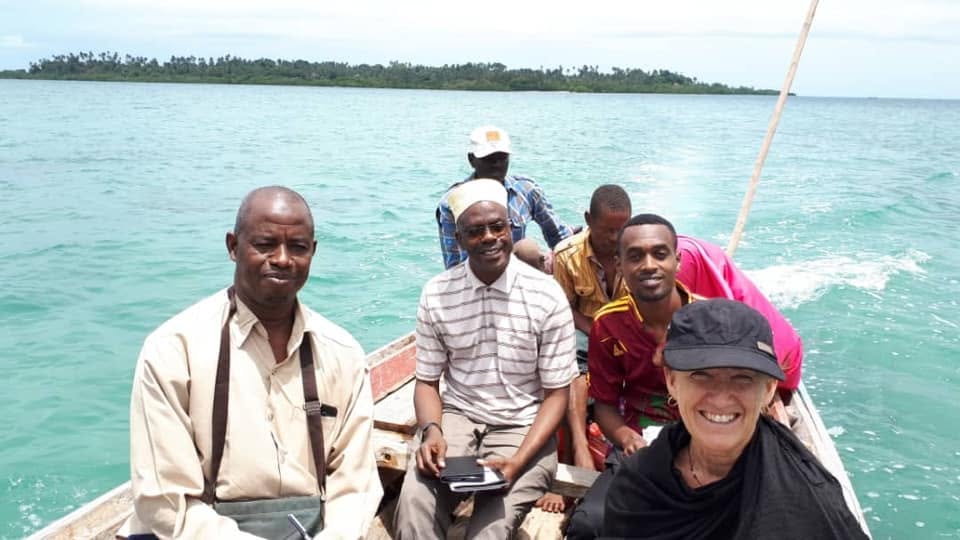
Ali Thani and Lorna Slade shared frustration with top-down conservation and a belief that coastal communities could manage their own resources led them to come together to create the Mwambao Coastal Community Network.Their partnership grew from different experiences. Thani, a Tanzanian from the coast who had worked in government and with international conservation groups, brought intimate knowledge of coastal communities; Slade brought decades of experience and understanding of the international institutions financing conservation.Mwambao has since grown into a multimillion-dollar organization and helped communities experiment with fisheries closures, co-management and livelihood programs. But its experience has not been uniformly successful, with different degrees of acceptance from communities.Its growth also raises a harder question for its founders: can a community-led model remain truly community-led as the organization itself becomes larger? UNGUJA, Tanzania — Decades before they would partner to build a marine conservation organization together, Ali Thani and Lorna Slade crossed paths in Tanzania. Years later, Slade returned to the East African country researching tourism for her master’s degree when she became involved in an initiative aimed at strengthening the knowledge and rights of local resource stewards. Then came the 2008 global financial crisis. The organization backing the initiative withdrew from Tanzania, providing only a fraction of the funds it had earlier promised — $25,000 — and an idea worth pursuing. “So they said, ‘OK, well, it’s a good idea. We have $25,000, so here you are,’” Slade recalls. That modest beginning would eventually become the Mwambao Coastal Community Network, a locally rooted organization now working with coastal communities across Zanzibar and mainland Tanzania, with an annual budget of around $3.5 million. For Thani, a coastal Tanzanian who had worked in government and with larger conservation organizations, Mwambao grew from a conviction that conservation could not simply be designed elsewhere and brought to communities. People who depend on natural resources, he says, should have the knowledge, capacity, and authority to help manage them. That idea has wider resonance as countries pursue the global goal of conserving 30% of the world’s land and oceans by 2030. Local organizations and communities are expected to shoulder much of that work, even as many struggle to secure the long-term funding available to larger international organizations and intermediaries. Mwambao’s work includes supporting community fisheries management, temporary fishing closures, and livelihood initiatives. But independent evaluations that Mongabay obtained have also documented mixed community reactions, disputes and mistrust around some fishing closures, uneven enforcement, and questions about whether community institutions can sustain gains without continued outside support. Those tensions now confront Mwambao’s founders. “That’s a strategic debate for us right now,” Slade says. Thani and Slade, who is British, brought very different experiences to that experiment. Thani brought deep knowledge of coastal communities and local culture; Slade brought decades of experience in Tanzania and an understanding of the international institutions that finance conservation. What sustained their partnership, they say, was simpler. “Respect each other,” Thani says. During a reporting trip to Zanzibar, Mongabay’s David Akana sat down with Thani and Slade to discuss Mwambao. The following conversation has been edited for length and clarity. Lorna Slade, one of the co-founders of the Mwambao Coastal Community Network. Image courtesy of Mwambao. Mongabay: Let’s start with the beginning. Lorna, how did the story of Mwambao begin? Lorna Slade: I will go back about 31 years. Ali was working with my husband in the Department of Forestry in Zanzibar, and I was working in the Department of Environment. So, we knew each other. We worked here [in Tanzania] for about five and a half years and then went our separate ways. Later, I came back to do some master’s research in tourism. As a result of that, we came into contact with an organization called Sand County Foundation [based in the U.S.]. They were interested in championing the rights and knowledge of landowners and resource stewards. They asked me to look regionally and see whether we could establish some kind of network. I did a study and came back and said, “I think we should concentrate on Tanzania. There’s a lot of work to be done.” They agreed. But just as we were about to start, it was 2008 and there was the stock market crash. They decided to withdraw completely from Tanzania. They basically said, “It’s a good idea. We have $25,000, so here you are.” That’s how we started. At the time, Ali was working with CARE [Tanzania] and WWF, and I was working part-time in the U.K. and coming back here part-time. With that $25,000, we decided we wanted to establish a knowledge and advocacy network to share good practices between communities. We trained ourselves in something called participatory media. You go into a community, design a story together, teach people how to use cameras, develop and edit a story, make a film, and then share that with others. I think we made about 10 or 12 films altogether. Then we realized that funding for knowledge and advocacy is really difficult to get. You need to be doing stuff. We started getting small opportunities, doing consultancy work and gradually moving into implementation. For quite a while, the money was just trickle, trickle, trickle. At the beginning, we were subsidizing the costs of the organization through our own salaries. About two years later, we eventually managed to get enough money to employ both of us. And we’ve really grown from there. Ali Thani co-founded the Mwambao Coastal Community Network with Lorna Slade. Image courtesy of Mwambao. Mongabay: Ali, you had already worked in government and with organizations such as CARE and WWF. Why leave that environment and start something yourselves? Ali Thani: From what I experienced during that time, I felt this could be the time to start by ourselves and practice co-management, governance, and other things. I had done a lot in government and with WWF. We believed in strengthening capacity in resource management. Co-management was an approach we believed could help address many of the problems we were seeing in communities. At the beginning, we were doing things voluntarily. We put all our efforts into making sure we were working with communities and trying to solve their problems. We had seen many of these problems through our work and assessments in Kenya, Pemba, and Tanga. We could see that some could be addressed through co-management and by strengthening governance capacity in communities. Mongabay: But you had both seen how large international organizations operated. They had access to significantly more resources. What made you believe a small, locally rooted organization could succeed? Lorna Slade: I think there was a sense that being from here or, in my case, having been here for a long time and working with people who are from here, gives you an understanding of coastal communities. You have people who are respected by coastal communities, who know how to work with people in the area, rather than an outside organization coming in with ideas about how they’re going to fix the problem. That can become very top-down. Initially, we thought international organizations could bring the scientific approach and evidence, and we could be the facilitators because we had the community trust and the community approach. We thought we could work alongside each other. Over time, we realized that we also needed to strengthen the scientific side of our own work. We began using data more and taking a more rigorous approach to monitoring. Mongabay: Ali, how important has being from Zanzibar and understanding coastal culture been to Mwambao’s success? Ali Thani: Very important. To understand conservation, you need to know people’s culture. You need to know how people perceive conservation and how you want to align with them. If I came from somewhere else, I don’t think I would have been as successful. But as a coastal Tanzanian, I can work here. Even in Kenya, I can work because the culture of coastal communities is similar. If you come from outside, you need to study the community first. Lorna came from somewhere else, but she studied the community. She knows coastal communities. She has spent time with communities along the Tanzanian coast. Lorna Slade, co-founder of the Mwambao Coastal Community Network, shares a moment with a member of a community where the organization works in Tanzania. Image courtesy of Mwambao. Mongabay: Lorna, presumably there is also value in knowledge and experience coming from outside. How have those two kinds of knowledge worked together? Lorna Slade: We work together as a team because we bring different skills to the table. We have some of the same skills, but different skills as well. Sometimes, to relate to the people who are going to fund us, you have to speak their language. I don’t mean German or English. I mean understanding their expectations, ticking the boxes, those sorts of things. Of course, you can learn from other places. You can read about what is happening elsewhere, bring people in, do exchange visits. But when we talk about donor culture and expectations, I always say to our team, “Look at what you’re bringing to the table. You have so much value.” We have so much value as a team, as an organization and as people. People coming from outside cannot necessarily do what we do. We have those networks. We have those partnerships. We know those people. We know the government. You can’t just jump in and expect to be able to do this stuff. Mongabay: You started with about $25,000. Mwambao now has an annual budget of around $3.5 million. How does that change an organization? Ali Thani: Right now, we’ve got a very good finance team that can make sure we’re managing the funds. But staff outside the finance team also need to understand how to comply with financial policies. We have finance policies, HR policies, and other policies. I don’t think that is a very big challenge at the moment. It is more about enforcing those policies and making sure everybody follows them. Lorna Slade: For me, one of the bigger challenges is that at some point Ali and I are going to move on. We feel an ownership because we’ve grown the whole thing ourselves. We’ve been involved in every part of it, right from the beginning. Bringing other people in who feel that same sense of ownership and keeping the same ethic going forward is a challenge for any growing organization. Getting very skilled people is also difficult. We sometimes joke that we’re a bit of a training academy. You get young, enthusiastic people, you train them, and then they find a better job with a bit more pay. That’s good for them, but it’s difficult for us. And as you grow, you have to ask: Is it a good idea to keep growing, covering more ground and hiring more people? How do you maintain the quality of what you’re doing? That’s a strategic debate for us right now. Before co-founding Mwambao, Ali Thani worked in government and with larger conservation organizations. These experiences helped shape his thinking about how conservation should be organized and led. Image courtesy of Mwambao. Mongabay: Before we get to Mwambao’s future, what achievements make you particularly proud? Lorna Slade: One is the eco-credit program, because I think that’s quite novel. But more broadly, it’s the community role in management, building people’s confidence so they know they can actually do it. And also building respect from government so government knows communities can do it. We’ve really seen people empowered and enthused. I feel like they have a sense of ownership over their future. We’ve also achieved quite a lot with the way local fisheries management committees operate. For example, there wasn’t much written around gender representation or election procedures. We’ve worked with government on standard operating procedures that include those things. We’re sitting in the same room with government and coming up with procedures that they accept. That’s an achievement. Another area is local marine spatial planning. We brought community resource plans together and got different government departments around the same table. Government departments can work in silos. There is also significant pressure from tourism investment and other development. Sometimes communities don’t know that a hotel is planned here, something else is planned there, or that an area is going to become a particular kind of zone. It’s only when you get those people together at the same table that things start coming out. We’re still at the beginning, but I feel we’ve helped pioneer that process. Mongabay: Let’s talk about eco-credit. Why connect conservation with people’s livelihoods? Lorna Slade: When you’re working in a marine environment where people depend on the environment for their everyday livelihoods and food, you can’t do conservation without [considering] people’s concerns. It’s just never going to work. And caring about people is the right thing to do anyway. One barrier for people who want to engage in business is that they haven’t had training and don’t have access to cash. The program makes small amounts of money available to invest in businesses and provides training on selecting a business, running it, budgeting, and deciding what to keep for the household and what to put back into the business. People really appreciate that. It shows that we care about them. We care about the environment, but we also care about their livelihoods. The conservation-compliance part isn’t always easy. If you say, “Plant five trees,” you can count five trees. If you say, “Respect this closed area of the water,” you can’t always tell whether somebody is respecting it unless you’re doing patrols all the time. But I’m amazed at how people have embraced it. One challenge is scale. We might start with five groups — about 150 people or 150 families — but we’re working in communities of 2,000 or 3,000 people. There are other groups waiting. So, we’re looking at how we expand. Ali Thani: And the credit is aligned with the culture of the community. People are attracted to it and want more, but Mwambao doesn’t have the capacity to take everybody. One sign of success is that some communities decided to start themselves. They only wanted the knowledge from us. That’s good news. Mwambao’s founders say understanding local culture is essential to conservation. Image courtesy of Mwambao. Mongabay: What does community-led conservation mean to you in practical terms? Lorna Slade: There need to be rules. There need to be national laws and national guidelines, and we can advocate for more community-friendly guidelines. But people know what works on the ground. They know their people. They know who is related to whom. They know how they use their area. They know which things are harmful and which are not. They know that resources have declined, and quite often they understand why. There’s so much knowledge within the community. People need to be empowered to use it. That means knowledge of the laws and opportunities within the laws. It means training and information so people can make the best decisions. I always think governance is about good, informed decision-making. And governments simply don’t have the resources to look after these huge coastlines and do everything that needs to be done. So, community management can be a win-win situation. Mongabay: Ali, let’s talk a bit about different approaches to conservation enforcement. You’ve said you don’t agree with approaches that rely more heavily on militarized enforcement. Why? Ali Thani: I’m not interested in militarized conservation. If there is a problem, whether it’s dynamite fishing, deforestation, or something else, you need first to understand why they did it and who did it. You need to study. You need to collect information. That information can help you address the problem. When you identify the people doing something harmful, you can call them and try to make them understand the importance of the issue. You shouldn’t assume that everybody in the community is doing it. And then you can receive ideas from the people themselves about what can be done to solve the problem. It’s not always you who has the solution. You can solve the problem together. There should be rules. But you also need to inform people about those rules and understand why something is happening. Mongabay: Lorna, surely there are situations where strong enforcement is necessary? Lorna Slade: Absolutely. If you find somebody dynamite fishing, you need a strong approach. They need to be stopped because it is very harmful, selfish, and unsustainable. There are times when you need to draw a line and say, “This is not allowed.” But you can also think about alternatives: education, learning, livelihoods, and adding value to the products people are bringing in. If people are paid a fair price, they don’t necessarily need to extract as much. And if resources are sustainably managed, there will be a sustainable supply. An aerial view of Pemba Island, one of the two main islands that make up Zanzibar. Mwambao works with coastal communities in southern Pemba and across parts of mainland Tanzania. Image by David Akana/Mongabay. Mongabay: Could success eventually mean Mwambao becoming less important because communities are managing these resources themselves? Lorna Slade: To some degree. These communities may know what they want to do. They may have good plans and good governance structures. But finances are still needed. Realistically, I can’t see how either communities themselves or government are going to produce all the funds needed to manage these areas effectively in the next 20 years.We heard about revenue going back to communities from marine park fees, but the amounts can be tiny. You can’t run many patrols or support meetings with that. So yes, communities can increasingly take ownership, but they still need resources. Mongabay: Does that raise a bigger question about Mwambao’s own model? Do you keep expanding, or increasingly transfer resources and responsibility to community organizations? Lorna Slade: Exactly. That’s the strategic debate. We work with organizations and communities where we’ve been for quite a long time and where people are increasingly doing their own planning. Maybe we should start re-granting more to them, with the idea that they do more of the work themselves. Then our role changes. We would be monitoring, supporting, and looking at financial accountability and budgeting. So do we have a smaller, highly skilled team managing and re-granting to other groups? Or do we continue with the same model: growing the team and moving into more places? That’s something we’re thinking about. Ali Thani: We have requests from other areas, including political leaders and government, asking us to come and work there. So we also have to decide whether to replicate what we’re doing in other places and what the structure of the organization should look like in the future. Seaweed farming offers coastal communities an alternative source of income that can reduce reliance on fishing. Mwambao trains local farmers, particularly women, in more productive and environmentally responsible farming methods, including techniques designed to increase yields and improve returns. Image by David Akana/Mongabay. Mongabay: You now work closely with government. What have you learned about that relationship? Ali Thani: Right now, I would say we’re working very well with government. What we need to improve is collaboration: having MOUs, working together, and having regular reporting meetings. We’re working with national government, but there are also local government offices and district councils. We need all of them to understand what we’re doing. We need regular meetings where we present what we’re doing and they give us suggestions and comments. And with other NGOs, the space is not for one NGO. It’s for all. Everyone needs to understand what the others are doing. We need to share lessons and sometimes divide responsibilities. Mongabay: Lorna, there are many more conservation organizations working in this space today. Is that entirely positive? Lorna Slade: When we started, there weren’t many organizations doing what we were doing. In recent years, there have been many more organizations coming up and doing similar work in other places. I think that’s great because it shows it’s a good model. But ultimately, it can become a scramble for resources and a scramble for space. That’s difficult. So, we need to continually ask ourselves: Are we still adding value? What can we do that adds more value? And if that means changing our strategy, we need to be open to that. Mongabay: After everything you’ve seen, what gives you hope about the future of the ocean? Lorna Slade: Sometimes it is a bit hard to have hope, bearing in mind the whole global situation. But you have to have hope, or else you just give up, wouldn’t you? We do see signs of improvement. We see signs of better stewardship. Whether it’s enough, and whether it’s happening soon enough, I can’t tell you. But that doesn’t mean you shouldn’t do anything. You have to have hope in people. You have to have hope in the environment and in the resilient nature of the environment. But you can’t just leave it. You have to be as active as you can to try and build the resilience of both people and the environment. Ali Thani: I don’t have 100% certainty about the future of the oceans. But I hope there will be increasing social and ecosystem resilience through the community. That is where the future has to be. Banner Image: Mwambao’s founders say understanding local culture is essential to conservation. Image courtesy of Mwambao. Credits Topics
How to grow $25K into community-led conservation: Interview with Tanzania’s Mwambao
Full Article
Original Source
Read the full article at News →KhanList aggregates and links to publicly available news content. We do not host full articles from third-party sources. Always verify important information with original sources.