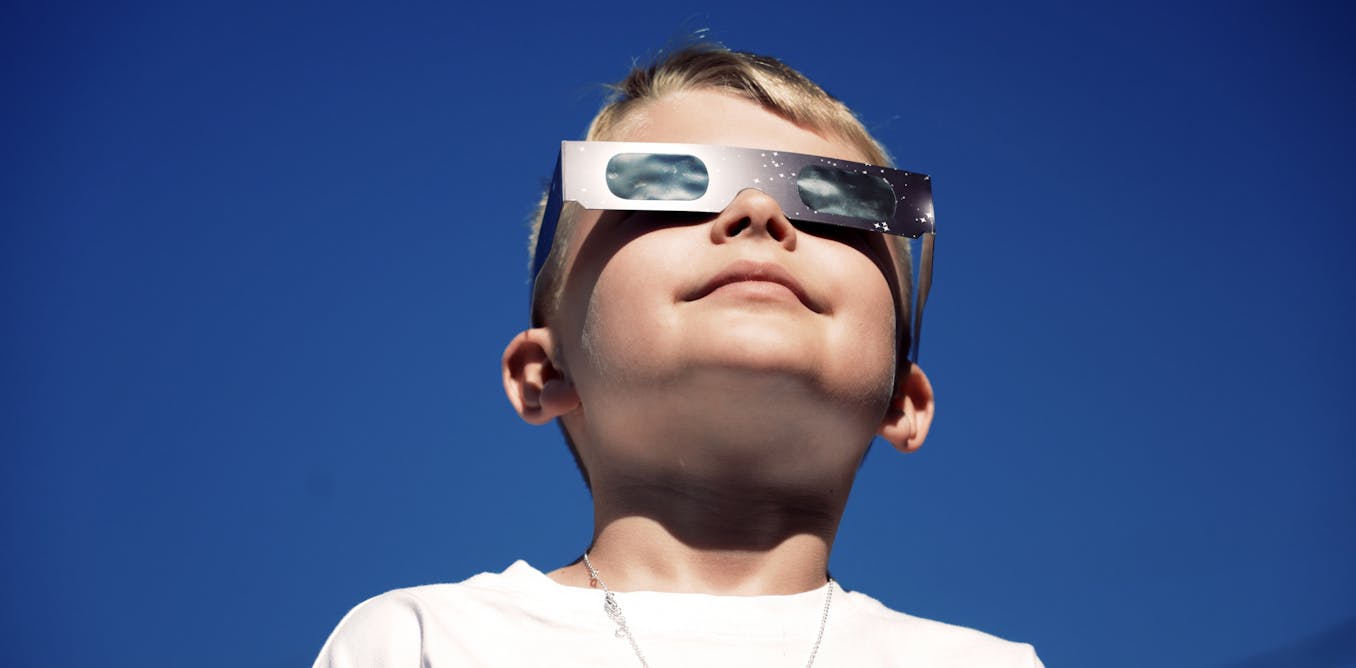
Most people underestimate how much light a pair of sunglasses blocks out. A typical dark pair removes around 80 to 90% of the visible light reaching the eye. Safely looking directly at the Sun requires reducing the light reaching the eye by a factor of around 100,000, meaning roughly 99.999% must be removed. Ordinary sunglasses can let around 10,000 times too much visible light through. That is especially important on Wednesday 12 August, when the Moon will pass in front of the Sun, creating a deep partial solar eclipse across the UK. Timings and the amount of the Sun covered will vary by location. In Bristol, the eclipse begins at about 6.17pm and reaches its maximum at around 7.12pm. Viewers in Cornwall will see roughly 95% of the Sun covered. Sunlight can injure the eye without causing pain or any obvious warning at the time. Solar retinopathy occurs when intense light damages the retina, the light-sensitive tissue at the back of the eye. Symptoms can appear several hours after exposure and include blurred or distorted vision or a dark patch in the centre of your sight. Many people recover over the following weeks or months, but some can be left with lasting changes to their vision. The safest way to look directly at the eclipse is with proper solar-viewing glasses or a handheld solar viewer that meets ISO 12312-2, the international safety standard for filters designed for looking directly at the Sun. Ordinary sunglasses are covered by different safety standards and are not designed for direct viewing of the Sun. Solar viewers are thousands of times darker and use filters designed to reduce visible, ultraviolet and infrared radiation to safe levels. An ISO number printed on the glasses is not, by itself, proof that a pair is safe, because counterfeit products are sold online. Buy from a reputable supplier whose products have been properly tested, and inspect the filter before use. Do not use glasses with scratches, tears or other damage. If you can see ordinary objects through them indoors, do not use them. Put eclipse glasses on before looking towards the Sun and remove them only after turning away. Children should be supervised throughout, particularly if adult-sized frames do not fit securely. Never look at the Sun through binoculars, telescopes or camera lenses while wearing eclipse glasses. These instruments concentrate sunlight and can damage both the filter and the eye. Any optical equipment used to view the Sun needs a proper solar filter securely fitted over the front of the instrument. Colander cameras If you are reading this on the day of the eclipse and local shops have sold out of eclipse glasses, what do you do? Reach for the colander. A colander does not filter sunlight. Its holes act as tiny pinhole cameras, projecting small images of the Sun onto another surface. Stand with your back to the Sun, hold the colander so its shadow falls onto a sheet of white paper or pale ground, and look at the projected spots of light. During the eclipse, those usually round spots will become tiny crescents. Never look through the holes towards the Sun. The method is remarkably old. More than 2,000 years ago, an ancient Greek text traditionally associated with Aristotle described how an eclipse viewed through leaves, a sieve or gaps between the fingers produced crescent-shaped patches of light. Centuries later, the 11th-century mathematician and pioneer of optics Ibn al-Haytham investigated how the image of an eclipse formed when sunlight passed through a small opening into a darkened space. And in 1545, astronomer Gemma Frisius published an illustration showing a solar eclipse being observed using the same camera obscura principle. Illustration of camera obscura in Gemma Frisius’ 1545 book De Radio Astronomica et Geometrica. Leonardo da Vinci, Public domain, via Wikimedia Commons If you don’t have a colander, though, a simple eclipse viewer can be made from two pieces of card. Make a small hole in one piece, stand with your back to the Sun and let the sunlight pass through the hole onto the second piece. You will see a tiny image of the Sun, which will become a crescent as the Moon moves across it. The principle is always the same: keep your back to the Sun and look at the projected image rather than directly at the Sun. So enjoy the eclipse, but watch it safely. The British Isles will not see an eclipse this close to totality again until September 2081, and the next total solar eclipse visible from the UK will not arrive until 2090. It is a rare sight, and one worth seeing without putting your vision at risk.
How to enjoy the solar eclipse safely
Full Article
Original Source
Read the full article at Theconversation →KhanList aggregates and links to publicly available news content. We do not host full articles from third-party sources. Always verify important information with original sources.